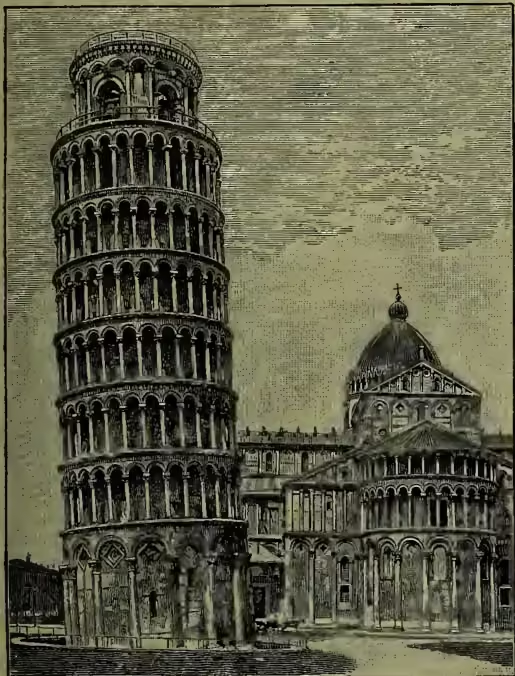
Pisa, one of the oldest cities of Italy, the rival of Venice and Genoa, which still has its walls standing and a citadel, is situated on the Arno, by rail 49 miles W. of Florence and 13 NE. of Leghorn. It was formerly a great port, though six miles from the sea, but owing to the silting-up of the river is now quite inaccessible to ships. Its commerce has been transferred to Leghorn. It is still a city of fine buildings, foremost amongst which is the cathedral (1063-1118), with a noble dome, fine paintings by Cimabue, Andrea del Sarto, and others, and beautiful marble altars. Its shape is that of a Latin cross, 311 feet long by 252 wide; the nave is 109 feet high. Externally it has a magnificent façade of four superimposed rows of pilasters and arches, and fine bronze doors by Giovanni da Bologna and others. Near the cathedral stands the round marble campanile, the 'Leaning Tower of Pisa,' which is a magnificent specimen of the southern Romanesque architecture, but is peculiar in that it (including the cornice) deviates about 14 feet from the perpendicular. This peculiarity is not due to original design. The tower seems to have begun to heel over to one side when the third story was completed; the architects deliberately accepted the conditions, and adhered to the inclining position, but diminished the slope of the upper stories so as to keep the centre of gravity well within the walls. (There are two leaning towers also at Bologna, q.v.) The tower is 180 feet in height, consists of eight stories divided by rows of columns, the last, which contains the bells, being smaller in diameter than the others. The tower was erected in 1174 and succeeding years by the architects Bonanno of Pisa and William of Innsbruck; but the eighth story was not completed till the middle of the 14th century. The marble Baptistery, or Church of St John (1152-1278), opposite the cathedral, is circular, and supports a dome, crowned with a cupola. The interior, noted for its wonderful echo, contains the grand and elaborate pulpit of Niccola Pisano (1260) and a large marble font. The beginning of the Campo Santo, or ancient national cemetery, was several loads of earth brought from Jerusalem towards 1200. In 1278-83 the ground was surrounded by cloisters by Giovanni Pisano, the walls of which were adorned with fresco-paintings by Orcagna, Benozzo Gozzoli, and others. The city contains numerous other churches, some of great age, dating from the 13th century and even earlier; also many fine palaces, private and official residences, including that of the archbishop. The university (1338) has a natural history museum, a botanical garden, a library (1742) of 120,000 volumes, and sixty lecturers and 600 students. The town possesses an academy of fine arts and archives. Amongst distinguished natives may be named the popes Eugenius III. and Nicholas V., the Visconti, Peter the Deacon, Leonardo the mathematician, Giovauni (but not Niccola) Pisano, and Galilei. The industrial activity is now confined to cottons, silks, ribbons, and the working of coral and alabaster. Dromedaries are bred at a royal farm in the neighbourhood. Pop. of commune (1881) 53,957; (1896) 64,700. The province has an area of 1180 sq. m. and (1896) a pop. of 311,742.
History.—Ancient Pisa, originally an Etruscan city, became subject to Rome in the 2d century B.C.; but, on the decline of the western empire, it was compelled to submit in turn to the nations who successively overrun Northern Italy. Early in the 11th century Pisa had developed into a powerful republic, possessing a formidable fleet and extensive territories along the Tyrrhenian Sea; it yielded little more than nominal homage to its suzerain lords, the emperors of Germany. Throughout the 11th century Pisa was at the height of its prosperity; to this period belong most of its splendid monuments of art that still adorn the city. It had extensive commercial relations with the East; its 'customs of the sea' (1075) were the pattern upon which the sea-laws of nearly all peoples navigating the Mediterranean were modelled. During the same century the Pisans repulsed the Saracens (1011), took Sardinia from them in 1022, attacked them in Africa in 1030, and routed them utterly off Palermo in 1062. Early in the next century, in 1114-16, they wrested the Balearic Isles from the same enemies. In the second crusade too they played a prominent part, and helped the pope against the Normans, taking Amalfi in 1135 and again in 1137. But already in the 11th century the rivalry between Pisa and Genoa had broken out. Florence too, a Guelph city, grew into an enemy of the Ghibelline Pisa. Wars many and often were waged between Pisa on the one side and a coalition of cities, headed by Florence and Genoa, on the other, with varying fortune, until in 1284 the Pisan fleet was crushed at Meloria. After this Pisa was compelled to give up Corsica, part of Sardinia, and 160,000 gold pieces to Genoa. At the same time Ugolino (q.v.) della Gherardesca made himself master of the town. Various individual rulers or tyrants followed, until the Pisans finally threw themselves (1399) under the protection of Galeazzo Visconti of Milan. The son of the latter sold the Pisan territory to their greatest enemies, the Florentines, from whose tyrannical rule they were for a time relieved by Charles VIII. of France, who, in 1494, accepted the protectorate of the city. When the French left Italy the old struggle was renewed; and, after a desperate resistance, the Pisans, in 1509, were compelled by hunger to surrender to the Florentine army. The most influential families, as formerly in 1406, emigrated. From this time Pisa steadily declined, until in the middle of the 16th century it had less than 8600 inhabitants. Its history henceforth coincides with that of Tuscany (q.v.). With the rest of Tuscany it became part of the kingdom of Italy in 1860.
THE COUNCIL OF PISA met in Pisa on March 25, 1409, and of which the twenty-third and last session was held on 7th August following. Its aim was to end the schism which had divided the Western Church for thirty years, and with this view the leading cardinals, finding that neither of the rival popes, Gregory XII. and Benedict XIII., would keep their promises to abdicate, set aside the claims of both, and themselves convoked a general council. It was attended from first to last by 24 cardinals, 4 patriarchs, 80 bishops, 102 proctors of bishops, 87 abbots, 200 delegates of abbots, besides many generals of orders, doctors, deputies of universities, and ambassadors. After the rival popes failed to appear in obedience to its summons, the council formally tried the claims of both in turn, and deposed them as schismatics and heretics. The cardinals then formed themselves into conclave and elected Cardinal Philargi, who assumed the name of Alexander V. But the council, instead of getting rid of the contending popes, had only added a third, and the faithful continued to be distracted in their allegiance for eight years longer, down to the time of the Council of Constance. Bellarmine considers the Council of Pisa as 'neither clearly approved nor clearly rejected;' Hefele says 'neither ecclesiastical authority nor the most trustworthy theologians have ever numbered it among the ecumenical councils.' See Hefele's Concilien-geschichte, vol. vi.