Pisciculture. Fish-culture is the art of increasing the supply of food-fishes—first, by breeding and rearing them artificially; secondly, by protecting the gravid fish and the natural spawning and nursery grounds through legislation; thirdly, by creating new breeding-grounds through the removal of obstructions or the placing of fascines, stakes, tiles, &c. for the collection of ova or of spat; lastly, by increasing the amount of natural food in any practicable manner. In recent years the artificial culture of sea-fish has been attempted on a large scale in several countries. In the United States and in Norway fully-equipped hatcheries for sea-fish and shellfish have been in operation for a number of years. In 1889 the Newfoundland government erected a marine hatchery at Dildo, Trinity Bay; and a similar establishment was completed in 1891 by the Canadian government near Picton, on the Northumberland Strait, Nova Scotia. In 1890 the Newfoundland hatchery turned out over fifteen millions of cod fry and four hundred millions of young lobsters. In Britain the hatching of sea-fish has not yet been undertaken on a large scale; but very excellent experimental work has been done at Plymouth by Mr J. T. Cunningham, who succeeded in artificially fertilising and hatching the eggs of the common sole in the early part of 1890; at St Andrews by Professor McIntosh; and by the Fishery Board for Scotland at Dunbar. Under the second head the Fishery Board for Scotland entered in 1883 on a series of experiments to ascertain what legislation, if any, was required to protect the inshore waters either as spawning, nursery, or food-producing grounds, and several bylaws have been passed protecting the greater portion of the Scottish inshore waters. These provisions were extended by the Herring-fishery (Scotland) Amendment Act, 1889.
Ponds for fresh-water fishes have been common from a very remote antiquity. It appears from Isaiah, xix. 10, that they were used in ancient Egypt. In the times of Roman luxury almost every wealthy citizen had fish-ponds. The Chinese have long bestowed more attention on pisciculture than any other nation, and with them it is truly a branch of economy, keeping up the supply of food, fish being used as much as meat by rich and poor at every meal. In China a large proportion of fish for the markets of the interior are reared in ponds. Some of these are generally placed in front of the villages, and in some places large numbers of them spread over plains. A common way of rearing in that country is to keep a number of male and female fish in small ponds so as to furnish eggs. After these are hatched, and the young fish become two or three inches in length, they are transferred to larger ponds. At the end of six or eight months they are caught and sent to market. Carp, perch, tench, and bream are some of the kinds kept in ponds. In some countries of modern Europe this branch of pisciculture is also prosecuted to a very considerable extent, particularly in Germany and Sweden, and of late years in France, in order to increase the supply of fish for the market. In Britain it has only recently been systematically prosecuted. The country-seats of the nobility and gentry have, indeed, been generally provided with fish-ponds, but in most cases rather as ornamental waters than for use. In the northern parts of Britain trout, perch, and pike are almost the only fish kept in ponds; in England they are often stocked with carp and tench, and are turned to much better account than in Scotland. In Germany ponds carefully attended to are found very productive and remunerative. There can be no doubt that in Britain also many a piece of land at present very worthless might easily be converted into a pond, and made to yield large quantities of excellent fish.
The greatest improvement in pisciculture, and a most important branch of it, to which the term is often restricted, is the breeding of fish in artificial breeding-places, from which not only ponds but rivers may be stocked; or the art of fecundating and hatching fish-eggs, and feeding and protecting the young animals till they are of an age to secure their own food and protect themselves from their numerous enemies.
In the middle ages, and especially in the 14th century, fish-ponds were common in the domains of princes and nobles and religious communities; but these were used only for rearing purposes. The first attempt at artificial fertilisation of fish eggs appears to have been made at the beginning of the 15th century, by Dom Pinchon, a French monk; but his experiments attracted no attention. Between 1725 and 1765 Stephan Ludwig Jacobi of Holenhausen, Lippe-Detmold, bred trout artificially; but commercial pisciculture owes its origin to the French, the art having been first practised by Rémy, a poor fisherman who worked the streams of La Bresse in the Vosges. It was the great waste of eggs incidental to the natural system of fish-breeding that led Rémy about 1842 in conjunction with a partner, Géhin, to try to repeople the fish-streams of his native district. His plan, being successful, attracted the notice of many of the French savants, and led to preferment for Rémy; the new art was besides taken up by the government. At Hünigen in Alsace, on the Rhine, a gigantic fish-nursery and egg-depôt was erected in 1852, chiefly through the energy of M. Coste. Since the cession of Alsace to Germany the operations of the establishment at Hünigen have been conducted on a still larger scale by a German association.
Rémy and Géhin's plan of rearing trout artificially is this: At the time the female is about to spawn she is caught and gently pressed on the abdomen by the hand, when the ova or eggs spurt forth into a vessel containing water. In the same way the milt is taken from the male. The eggs are well mixed with the milt, and the water changed once or twice. The fecundation being completed, the next thing is to place the eggs for security into a covered vessel. Its early form was that of a flat, round box about eight inches in diameter, with a hinged lid. This was made of zinc, perforated with small holes, and had a layer of fine gravel on the bottom. A considerable number of fecundated eggs were enclosed in the box, which was then placed in the bed of a current of pure water and covered with pebbles, care being taken that the water passed freely through, as it is necessary for the eggs to be slightly agitated. The hatching takes place in from two to four months, the time depending on the nature of the water and other circumstances. For a description of the early changes which the fish undergoes, see SALMON. After the little fish are fully formed they are kept in the box from eight to fifteen days, and then set at liberty. The later plans for artificially propagating trout or salmon differ principally in mixing the ova and milt in an absolutely dry nitensil and in the details of the hatching-boxes, in the use of houses, and in many of the young fry being kept in ponds till they are a year or more old.
The most sustained effort in British pisciculture has been in connection with the salmon-fisheries of the river Tay. At Stormontfield, near Perth, since 1853, a series of open-air breeding-boxes, covered with gravel and capable of receiving 500,000 eggs, have been in use; but for years nothing like this number have been hatched, and probably not 20,000 young fish annually have for some time past been turned out of the ponds there. The Tay District Fishery Board in 1883 erected a new hatchery a few miles away at Dupplin on the Earn. It was put up to try the system of glass grill hatching-boxes, designed prior to 1860 by M. Coste of Paris, and presently to be described as in use at Howietown. On this plan it was estimated to hatch 300,000 ova. But in the autumn of 1883 the Board decided to adopt only partially the grill hatching, and to try along with it the simpler Canadian system of shallow trays of perforated tin-plate, and coated with Japan varnish; in which the eggs, instead of being in separate rows, are packed very closely together, river-water being used. In 1889 it was stated to be capable of hatching four or five hundred thousand fish.
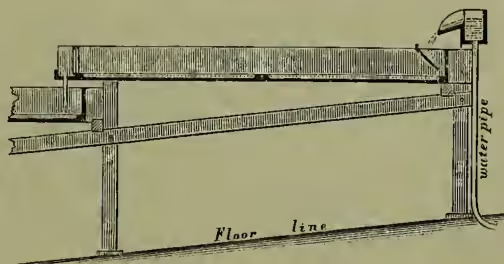
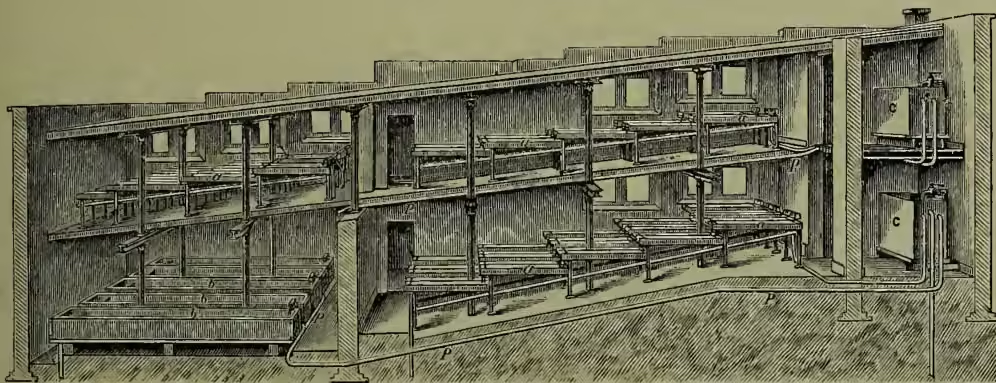
The most extensive fish-rearing establishment in Great Britain is the one belonging to Sir James Maitland, situated at Howietown, near Stirling. It consists of hatching-houses and, at a distance from them of half a mile, an extensive series of ponds. The principal hatchery is 86 feet long by 40 feet wide, each of its two stories being 10 feet high. Its walls, built of brick and concrete, are nearly 2 feet thick; and the roof is covered with a layer of concrete 3 inches thick, over which there is a thin cover of asphalt. The entire outer shell is thus a bad conductor of heat, so that it is not difficult to keep the water inside from falling below 44° F. Fig. 2 gives a sectional view of the hatchery. It will be seen that each floor has a considerable slope, which admits of the hatching or grill boxes (a, a, a, a, fig. 2) being placed in descending series. These are 134 in number, the ordinary size of them being 6 feet 9 inches long, by 1 foot 7 inches broad. In the bottom of each box four wooden frames are neatly fitted, each of which has rather more than 100 glass tubes, about 4-inch in diameter, placed transversely. Fig. 1 shows a longitudinal section of one of these hatching-boxes, in which the dotted line indicates the position of the glass tubes. Upon these glass grills the fish-eggs lie in parallel rows, looking like small pink beads. Six cisterns or tanks (b, b, b), each 20 feet long and five feet broad, are fitted up in the lower portion of the ground-floor to receive the young fry after they begin to take food. At Howietown both hatching-boxes and rearing-tanks are constructed of wood charred on the internal surfaces, and painted on the outside, their ends being formed of perforated zinc, which is closed with flannel when any depth of water is required in the tanks. At other hatcheries, however, the tanks and boxes are formed of slate, and sometimes of earthenware, but in such cases they are of smaller size. Often, too, the eggs are placed on perforated zinc or porous earthenware instead of glass grills. While the eggs are being hatched only spring water is used. It is brought underground to the two cisterns (e, e), and from these it is conveyed by lead pipes (p, p, p, p) to each series of hatching-boxes, over the grills of which it flows in a constant but not rapid stream. Each of the hatching-boxes contains about 15,000 eggs, but in the earlier part of the hatching-season (December) eggs are also placed in the 20-feet tanks, so that about four millions of fish-eggs can be brought to maturity in one season. In 1890-91, 2,310,000 eggs were incubated, 81,500 yearling trout sold and 40,000 yearling trout retained, to grow into two-year-olds, and 19,000 two-year-old trout sold and 6000 retained.
The ponds at Howietown are extensive and ingeniously planned, both for beauty and convenience. Water is supplied to them from a burn issuing from Loch Coulter, a lake of considerable size, and largely fed by springs. They are divided into a larger and a smaller group. The former consists of ten ponds, of which the largest measures 200 feet in length by 90 feet in width, and is 12 feet deep. Next to this is a sub-group of three ponds lying parallel to each other, each 270 feet by 45 feet, and 10 feet deep. These also contain Lochleven trout of different ages, and about 5000 in number in each pond. The remaining twenty-five ponds are each about 100 feet long, and contain respectively American brook trout (Salmo fontinalis), yellow trout (Salmo fario), and more Lochleven trout under three years of age. Their various levels are so arranged that by means of open tracts and dividing-boxes the water is slowly but constantly flowing from the highest to the lowest pond in the series, and sluices are provided so that any single one can be emptied when required. Each pond is also provided with a cleansing pipe.
At Howietown the young fry are fed chiefly on grated eggs and beefsteaks made up into strings like vermicelli, yearlings and two-year-olds are fed on minced horse-flesh, and older trout on shellfish. But some pisciculturists strongly recommend that additional kinds of food, such as boiled liver, chopped worms, fish-roe, and biscuit-dust, should be given in turns to fry. A large proportion of trout die—many, as some experienced persons think, of starvation—during their first year, even when kept in ponds regularly supplied with food. The strong repel and devour the weak at feeding-time, but the mortality, in so far as it may be caused by food at all, is probably more due to the kind used, or to the form in which it is given. In the case of rearing-ponds situated near the sea, mussels and shrimps are much used for feeding purposes. At Guildford, Surrey, the trout are allowed to find their own food, but with this system the ponds must be large in proportion to the number of fish contained in them, as well as favourably situated with respect to a sufficiency of natural food. Near St Pölten, Lower Austria, this plan is adopted. There are a number of small ponds or ditches with stagnant water and aquatic plants, which are used as nurseries to propagate the larvæ of insects, small crustaceans, and other low forms of animal life on which trout naturally feed. From time to time part of the water swarming with these creatures is admitted to adjoining ponds with pure water in which the fish live. It probably depends on the locality of the ponds which method of feeding succeeds best in a commercial sense.
In Great Britain it is as yet only members of the Salmonidae family which have been artificially reared on a commercial scale. But quite recently some attention has been given to the cultivation of what are called 'coarse' fresh-water fish. By this is meant pike, perch, roach, carp, tench, and a few others. Of these pike and perch are perhaps the two most likely to be profitable. It is feared, however, that so long as the markets are fairly well supplied with sea-fish, salmon, and trout the chance of these coarse fish being largely consumed as food is not great. They have all, more or less, a comparatively insipid taste, but this could no doubt be improved by proper attention to their food. Pike being great cannibals, there is more difficulty in stocking ponds with them, even when there is not much difference in their size, than with most other fish. Perch—which have an extraordinary power of increase—spawn readily in confinement, but it is said that the fry are not very easily reared. In America persevering efforts are being made to acclimatise the mirror carp, which is a favourite fish for the table in Germany. See PIKE, PERCH, and CARP.
Pisciculture is practised in America on a very large scale. The United States Fish Commission have several stations for hatching eggs of the Salmonidae, the largest being on the M'Leod River, California, established for the ova of the California salmon (Salmo quinnat). The report of the commissioner, Professor Spencer Baird, gives the total production of eggs at this station for the season of 1879 as about 9,500,000; but the number for 1878 was 14,000,000. In 1879, 2,300,000 were hatched at the station to keep up the stock in the Sacramento River, 4,150,000 were taken to the eastern states, and the remainder were sent to Canada, France, Germany, and Holland. The Californian salmon can adapt itself better than the common species to comparatively warm water, so that it will thrive in some rivers where the latter will not; but whether it will be successfully introduced into Europe is still a matter of uncertainty. This station is now chiefly used for hatching the rainbow trout (Salmo irideus), 28,700 fry being planted in the M'Leod River in 1885. There is another hatching-station at Bucksport, Maine, for the Atlantic salmon (Salmo salar); and a third at Grand Lake Stream, Maine, for breeding the Schoodic or landlocked salmon, which is a variety of the Salmo salar. In the United States there are several hatcheries for the propagation of shad, the aggregate yield of which in 1885 was 38,000,000 young fish. As regards numbers, however, both salmon and shad sink into insignificance compared with the quantity of white fish, of which the most important species is Coregonus clupeiformis, reared in the piscicultural establishments of the Lake States (see COREGONUS). The production of eggs of this fish in the year 1885 reached the grand total of 268,000,000. Besides the hatcheries under the direction of the Fish Commission, most of the states have hatcheries of their own. In 1890 those belonging to the state of New York alone distributed 39,930,000 fry and eggs of trout, shad, pike, &c.; the station at Caledonia, in that state, has distributed 18,000,000 trout, salmon-trout, carp, pike, and muscalongue in one year. Hatching-stations for the cod and other sea-fish are also being tried. For oyster-culture, see OYSTER.
Canada is not far behind the United States with respect to the scale of her fish-breeding establishments. The principal ones—twelve in number—are owned by the government, and their production for the year 1889 amounted to 11,673,500 salmon-eggs, 5,140,000 salmon-trout eggs, 30,600,000 eggs of white fish (Coregonus albus), and 21,000,000 eggs of members of the Percidae family, besides smaller numbers of other species, making a total of 68,700,000. The common or Atlantic salmon has been introduced into Tasmania, and seems now to be thoroughly acclimatised, numbers of adult fish, besides shoals of the young, occurring in the rivers. One or more species of British trout have also become established in Tasmanian as well as in Australian and New Zealand rivers. At Otago there is a trout-hatchery. In Victoria the Californian salmon has been found to succeed better than the common species.
See works on Pisciculture or departments of the subject by Armistead (1870), Andrews (on salmon and trout, 1886), Ashworth (on Stormontfield, 1875), Atkins (fittings for salmon-culture, Washington, 1879), Boccius (1841 and 1843), Buckland (1863 and in Nat. Hist. of Brit. Fishes, 1880), Burgess (1891), Capel (on trout, 1877),
Francis (1865), Fry (New York, 1866), Goode (in the Trans. Amer. Fish-culture Assoc., New York, 1881), Gorlick (2d ed. Cleveland, Ohio, 1880), Seth Green (on trout, Rochester, N.Y., 1870), Guy (on stocking, 1884), Jacobson (from a Report of the U.S. Commission, 1880), Sir James Maitland (a history of Howietown, 1887), Nicols (on salmon at the Antipodes, 1882), Norris (on American fish-culture, Philadelphia, 1868; Lond. 1869), Rosevelt (Rochester, N.Y., 1879), Slack (on trout, New York, 1872), Stone (on trout, Charleston, 1877), Wilmot (on Canadian fish-culture, Ottawa, 1882), Wilson (on salmon at the Antipodes, 1879). Also French works by Coste (1850 and 1858), Géhin and Rémy (1851), Lamiral (1851), Lamy (1866), Millet (1870), Quatrefages (1854), Raveret Wattel (1874 and 1879), Rémy (1854 and 1856), De Bon (1880); Gobin, La Pisciculture en Eaux Douces (1889), La Pisciculture en Eaux Salées (1891); and German works by Max von dem Borne (1875), Haack (1872), and Jacobi (in the Hannoversches Magazin for 1763—believed to be the earliest printed notice of modern fish-culture), Nicklas (1880), Vogt (1875), Benecke, Dalmer, and Von dem Borne (1886); also the annual Bulletins and Reports of the United States Fish Commission, and the Bulletins de la Société d'Acclimatation de France.