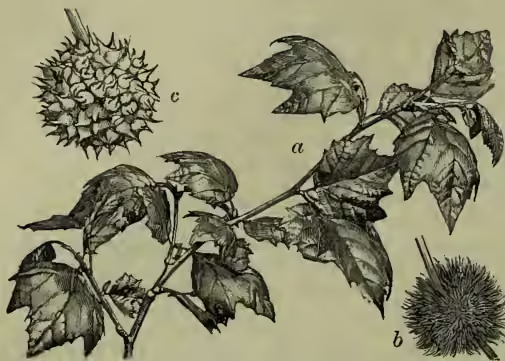
a, branch; b, flower, and c, fruit, on larger scale than a.
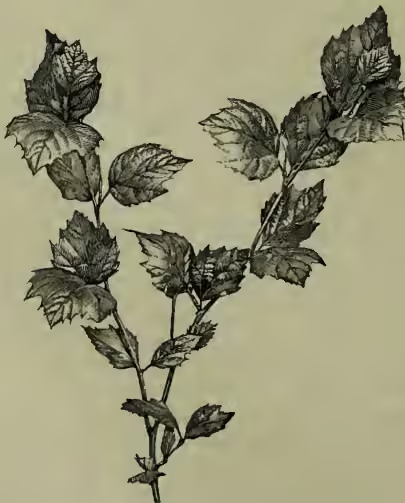
Plane (Platanus), the sole genus of trees of the natural order Platanaceæ. The species of plane are few; natives of temperate climates in the northern hemisphere; tall trees, with deciduous large palmate leaves and smooth whitish bark, which annually scales off in large pieces.—The Oriental Plane (P. orientalis), a native of Greece and the East, was planted by the Greeks and the Romans as an ornamental tree, no other tree, indeed, commanding equal admiration; and for centuries the youth of Greece assembled under its shade in the groves of Academus to receive lessons in philosophy. The plane is still planted for shade and ornament in the south of Europe. Many fine trees exist in England, but they were at one time much more numerous, great part having died in the end of the 18th century. The spring frosts and the insufficient duration of the summer for the proper ripening of the wood render Scotland less suitable for its cultivation, yet there is a tree at Gordon Castle 66 feet high. No tree better endures the atmosphere of a large city, and there are no finer trees within the precincts of London than its plane-trees. Noble specimens are to be seen in Hyde Park and Russell Square, in London, and the avenue of the Thames Embankment is formed with this tree. In the East the plane attains an immense size. One tree in the meadow of Buyukdere, on the banks of the Bosphorus, is 141 feet in circumference at the base, extends its branches 45 feet from the trunk, and is believed to be more than 2000 years old. The wood of the plane, when young, is yellowish white; when old it is brownish, fine grained, takes a high polish, and is esteemed for cabinet-making. A rich alluvial soil and the vicinity of water are most suitable to this tree. The North American Plane, or Buttonwood (P. occidentalis), is a very similar tree. It is the largest deciduous tree of the United States, and abounds on the banks of the great rivers of the middle states. Its timber is not very valuable, and is very liable to decay. A tree of this species on the bank of the Thames, in Chelsea Hospital gardens, is 115 feet high, with a trunk 5 feet in diameter.—The name plane-tree is commonly given in Scotland to what in England is known as the Sycamore (Acer pseudo-platanus), which resembles the true planes in its foliage, but is neither a plane nor a true sycamore, being really the Greater Maple. See MAPLE.