Planets (Gr. planētes, 'a wanderer') are those heavenly bodies (including the earth) which belong to our solar system, and revolve in elliptic orbits round the sun. They are often denominated primary planets, to distinguish them from their moons or satellites, which are called secondary planets. The name planet is of considerable antiquity, and was applied to these dependents of the sun to distinguish them from the myriads of luminous bodies which stud the sky, and which present to the naked eye no indication of change of place (see STARS). The planets at present known are, in the order of their distance from the sun, Mercury, Venus, the Earth, Mars, the Planetoids (q.v.), Jupiter, Saturn, Urann, and Neptune. Six of these, Mercury, Venus, the Earth (which was not, however, then reckoned a planet), Mars, Jupiter, and Saturn, were known to the ancients; Uranus was discovered by Sir William Herschel (q.v.) in 1781; and Neptune, after having its position and elements determined theoretically by Leverrier and Adams, was discovered by Professor Challis and Dr Galle in 1846. The Planetoids, of which some 300 are now known, have all been discovered since January 1, 1801. Six of the planets, the Earth, Mars, Jupiter, Saturn, Uranus, and Neptune, are attended by one or more satellites; Uranus (generally), Neptune, almost all the Planetoids, and all the satellites except the Moon are invisible to the naked eye. The visible planets can be at once distinguished from the fixed stars by their clear steady light, while the latter have a sparkling or twinkling appearance. The planets, as observed from the Earth, move sometimes from west to east, sometimes from east to west, and for some time remain stationary at the point where progression ends and retrogression commences. This irregularity in their movements was very puzzling to the ancient astronomers, who invented various hypotheses to account for it. See PROLEMAIC SYSTEM. The system of Copernicus, by assuming the sun, and not the earth, as the centre of the system, explained with admirable simplicity what seemed before a maze of confusion.
The planetary orbits differ considerably in their degrees of eccentricity, the Planetoids, Mars, and Mercury being most, and the larger planets least eccentric. No two planets move exactly in the same plane, though, as a general rule, the planes of the larger planets most nearly coincide with that of the ecliptic. The latter are consequently always to be found within a small strip of the heavens extending on both sides of the ecliptic; while the others have a far wider range, Pallas, one of them, having the angular elevation of its orbit no less than above the ecliptic. According to Kepler's Laws (q.v.), the nearer a planet is to the sun the shorter is the time of its revolution. The arrangement of the planets in the solar system bears no known relation to their relative size or weight, for though Mercury, Venus, and the Earth follow the same order in size and distance from the sun, yet Mars, which is farther from the sun, is much less than either the Earth or Venus, and the Planetoids, which are still farther off, are the least of all. Jupiter, which is next in order, is by far the largest, being about times as large as all the others together; and, as we proceed farther outwards, we find Saturn less than Jupiter, and Uranus than Saturn, though Neptune, the remotest, is somewhat larger than Uranus.
With reference to their distance from the sun, as compared with that of the Earth, the planets are divided into superior and inferior; Mercury and Venus are consequently the only 'inferior' planets, all the others being 'superior.' The inferior planets must always be on the same side of the Earth as the sun is, and can never be above the horizon of any place (not in a very high latitude) at midnight; they are always invisible at their superior and inferior conjunctions, except when, at the latter, a transit (see SUN) takes place. The superior planets are likewise invisible at conjunction, but when in opposition they are seen with the greatest distinctness, being then due south at midnight. The time which elapses from one conjunction to its corresponding conjunction is called the synodic period of a planet, and in the case of the inferior planets must always be greater than the true period of revolution. the superior to at the inferior conjunction. Its greatest elongation varies from to , and therefore it can never be above the horizon for much more than three hours after sunset, or the same time before sunrise. While moving from the inferior to the superior conjunction Venus is a morning star, and during the other half of its synodic period an evening star. When this planet is at an elongation of its brilliancy is greatest, far surpassing that of the other planets, and rendering a minute examination through the telescope impossible. At this period it sometimes becomes visible in the daytime, and after sunset is so bright as to throw a distinct shadow. Astronomers have repeatedly attempted to ascertain the nature and characteristics of its surface, but its brightness so dazzles the eyes as to render the correctness of their observations at best doubtful. From the changes in the position of dusky patches on its surface, which have been frequently noticed, it is concluded that it revolves on its axis, and that its equator is inclined to the plane of its orbit at an angle of ; but many astronomers doubt these conclusions. Its year is 224.7 days. Professor
Schiaparelli has shown reason for believing that both Mercury and Venus always present the same face to the sun. Both Venus and Mercury necessarily exhibit phases like the moon. For transits of Venus, see SUN.
The Earth, the next planet in order, will be found under its own name; it has a single satellite, the Moon (q.v.). Its year is 365.256 days.
Mars, the first of the superior planets, is much inferior in size to the two previous, its volume being about th of the Earth's, and, after Mercury, its orbit is much more eccentric than those of the other planets. When it is nearest to the Earth (i.e. in opposition) its apparent angular diameter is ; when farthest from it (i.e. in conjunction), not more than . Mars revolves on its axis (which is inclined at an angle of ) in 24 hours 37 minutes, and its year is 687 days long. In 1877 Hall of Washington discovered that it had two satellites, now named Phobos and Deimos. It shines with a fiery red light, and is a brilliant object in the heavens at midnight when near opposition; when seen through the telescope its surface appears to be covered with irregular blotches, some of them of a reddish, others of a greenish colour, while at each pole is a spot of dazzling white. The red spots are surmised to be land; the green, water; but the markings on Mars appear to have changed considerably since they were first observed. The white spots at the poles are with some reason supposed to be snow, since they decrease when most exposed to the sun, and increase under the contrary circumstances. The Phases (q.v.) of Mars range between full, half, full (in conjunction, if visible), and half.
The Planetoids.—After Mars in order come the Planetoids (see below), formerly but improperly called Asteroids.
Jupiter, the next in order, is the largest of all the planets, its bulk being more than 1400 times that of the Earth, though, from its small density, its mass is only 300 times more. After Venus it is the brightest of the planets and the largest in apparent size, its angular diameter varying from to .
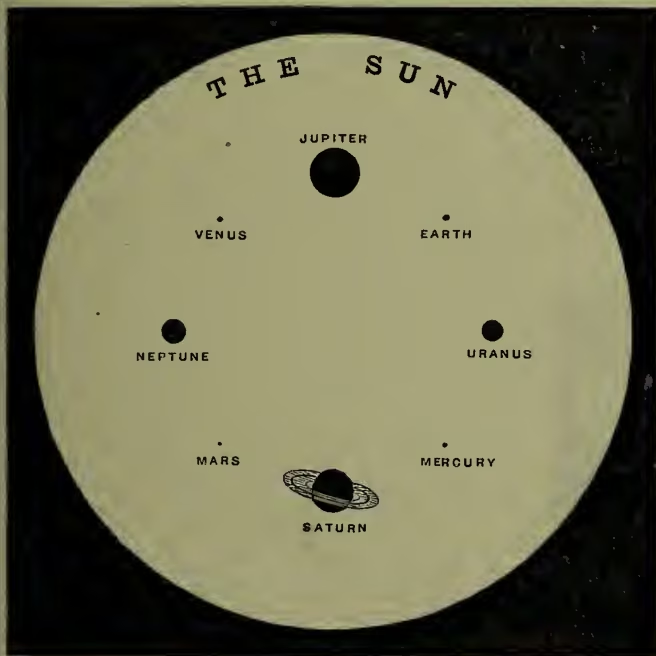
Mercury, the planet which is nearest the sun, is also, with the exception of the Planetoids, the smallest (being only three times the bulk of the moon), and performs its revolution round the sun in the shortest time. Its greatest elongation is never more than , and consequently it is never above the horizon more than two hours after sunset, or the same time before sunrise; on this account, and from its small apparent size ( to ), it is seldom distinctly observable by the naked eye. It shines with a peculiarly vivid white or rose-coloured light, and exhibits no spots. Its year (or sidereal period of revolution round the sun) is 87.969 days.
Venus, the next in order of distance and period, is to us the most brilliant of all the planets. Its orbit is more nearly a circle than any of the others, and when at its inferior conjunction it approaches nearer the Earth than any other planet. Its apparent angular dimensions thence vary from at
When looked at through a telescope it is seen to be considerably flattened at the poles, owing to its rapid revolution on its own axis; and its surface is crossed in a direction parallel to its equator by three or four distinct and strongly-marked belts, and a few others of a varying nature. Spots also appear and remain for some time on its surface, by means of which its revolution on its axis has been ascertained. Separate spots give, however, slightly different periods (some even move past one another), but a period of 9 hr. 55 min. 21 sec. is generally accurate. Jupiter has five satellites—the fifth discovered by Barnard at Lick Observatory in 1892. The four discovered by Galileo, easily observable through an ordinary telescope, have rendered immense service in the determination of longitudes at sea, and of the motion and velocity of light. They were proved by Sir William Herschel to revolve on their own axes in the same time that they revolve round their primary. The smallest is about the same size as our Moon, the others are considerably larger. The year of Jupiter is 4332.584 days.
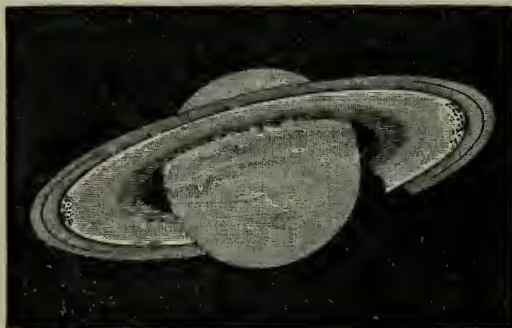
Saturn, next in position, is about 745 times larger in volume, though only about ninety times greater in mass, than the earth. Its apparent diameter when in opposition is 20.3", and there is a considerable flattening towards the poles. Its surface is traversed by dusky belts much less distinctly marked than those of Jupiter, owing doubtless in great part to its inferior brightness; its general colour is a dull white or yellowish, but the shaded portions, when seen distinctly, are of a glaucous colour. The most remarkable peculiarity of Saturn is its ring, or series of concentric rings, each one parallel and in the same plane with the others and with the planet's equator. The ring is distinctly separable into three parts; the two outermost are bright like the planet itself, while the innermost (called the 'Dusky' or 'Crape' ring) is of a purplish colour, and is only discernible through a powerful telescope. They are most probably composed of a multitude of small satellites in rapid revolution round the planet. They are not always visible when Saturn is in the 'opposite' half of its orbit, for when the plane of the rings (whose outer diameter is 166,920 miles) passes between the Earth and the Sun, their dark surface is turned towards us, and when the sun is in their plane only the narrow edge is illuminated; in both of these cases the ring is invisible from the Earth. Its plane being inclined at an angle of 28° to the ecliptic, we see the two surfaces of the ring alternately for periods of fifteen years at a time; and at the middle of each period the rings attain their maximum obliquity to the ecliptic, and are then best seen from the Earth. It is hardly necessary to remark that at the end of each period they become invisible. Saturn has also no less than eight satellites, seven of which revolve round it in orbits little removed from the plane of the ring, while the eighth, which is the second in size, is considerably inclined to it. Two of the satellites were discovered by Herschel in 1787 and 1789, four by Cassini in 1672 and 1684, one by Huyghens in 1655, one by Mr Lassell in England and Professor Bond in America in 1848. The satellites are all situated outside of the ring, and the largest of them is nearly equal to the planet Mars in size. The year of Saturn is 10,759.219 days.
Uranus, the next planet in position, was discovered accidentally by the elder Herschel on 13th March 1781, and was named 'the Georgium Sidus' and 'Herschel,' but these names soon fell into disuse. It is about seventy-two times greater than the Earth in volume, and thirteen times in mass; but, though so large, its distance is so much greater in proportion that astronomers have been unable to gain much information concerning it. No spots or belts have hitherto been discovered on its surface, and consequently its time of rotation and the position of its axis are unknown. It is attended by a number of satellites, but so minute do these bodies appear that astronomers hitherto have been unable to agree as to their exact number; Sir William Herschel reckoned six, while other astronomers believe in the existence of four, five, and eight respectively. That there are at least four is beyond doubt. The year of Uranus is 30,686.820 days.
Neptune is the next and outermost member of the solar system, and, at a distance of nearly 3000 millions of miles from the centre of the system, slowly performs its revolution round the sun, accomplishing the complete circuit in about 165 solar years. It is about ninety times larger than the Earth, but from its extreme remoteness is of almost inappreciable magnitude when seen through an ordinary telescope. It was the disturbance in the motion of Uranus caused by the attractive force of this planet which led Leverrier and Adams to a calculation of its size and position, on the supposition of its existence; and the directions which were given by the former to Dr Galle of Berlin, specifying its exact position in the heavens, led that astronomer to its discovery on 23d September 1846 (see ASTRONOMY). Mr Lassell of Liverpool discovered that Neptune is attended by one satellite. The satellites of Uranus and Neptune differ from the other planets, primary and secondary, in the direction of their motion, which is from east to west, and in the case of the former in planes nearly perpendicular to the ecliptic. Both Uranus and Neptune were observed long before the times of Herschel and Leverrier, but they were always supposed to be stars. Uranus is known to have been observed by Flamsteed between 1690 and 1715, and Neptune by Lalande in 1795.
In astronomical tables, almanacs, &c. the planets are for convenience denoted by symbols instead of their names, as follows: Mercury, ♁; Venus, ♀; Earth, ⊕; Mars, ♂; the Planetoids, in the order of their discovery, ♀, ♁, ♀, &c.; Jupiter, ♂; Saturn, ♃ or ♃; Uranus, ♃; Neptune, ♃ or ♃; the Sun, ☉; the Moon, ☾.
MINOR PLANETS, the name given to that numerous group of very small planets which is situated in the solar system between Mars and Jupiter. Till the 19th century they remained undiscovered; but for some years before their existence had been suspected, mainly owing to the remarkable hiatus in the series of the planetary distances when compared with the law of Bode (q.v.). On 1st January 1801 the first of them (Ceres) was detected by Piazzi of Palermo, and his success roused his brother astronomers to search for more planets. Their search was success- ful, for Olbers (q.v.) discovered two (Pallas and Vesta) in 1802 and 1807, and Harding one (Juno) in 1804; but, as all researches for some time subsequent to 1807 were unavailing, astronomers gradually allowed themselves to settle down into the belief that no more planetoids remained to be discovered. But the detection of a fifth (Astræa) by Hencke in 1845 revived the hope of fresh discoveries, and from this period no year (excepting 1846) has passed without adding to the list. The number known at the beginning of 1851 was 13, of 1861 was 62, of 1871 was 112, of 1881 was 219; in 1898 there were 430. This great success of the astronomers of our time is due to the systematic manner in which the zodiacal belt has been explored, and the place and apparent size of every star of this region distinctly determined; so that the presence of a wandering body can at once be detected. Among the most successful of the discoverers of planetoids have been Palisa of Vienna, and C. H. F. Peters (1813-90) of Hamilton College, U.S. The former, since 1872, has discovered more than 80, on one occasion as many as 5 in a week; while the latter, after 1861, discovered 48.
The magnitudes of these celestial bodies have not been accurately ascertained, but it is certain that they are exceedingly small as compared even with Mercury, the least of the other planets; the diameter of the largest among them being generally believed not to exceed 450 miles, while most of the others are very much smaller than this. They also differ, generally speaking, from the rest of the planets in other respects; their orbits are of greater eccentricity, are inclined to the ecliptic at a greater angle, and are interlaced in a most intricate manner, crossing each other so frequently as to form, when viewed perpendicularly, a kind of network. The consequence of this is that a planetoid which is nearest the sun at one part of its orbit is, when at another part of its orbit, farther from it than are several of the others, and a mutual eclipsing of the sun at different periods by two planetoids must be of very frequent occurrence. The mean orbit of the first 251 planetoids coincides, however, within 30' with that of Jupiter. Of the planetoids of which the elements had by 1891 been satisfactorily calculated, Medusa (No. 149) has the shortest period of revolution, 1137.69 days, and Hilda (No. 153) the longest, 2869.92 days. The corresponding mean distances from the sun, expressed in parts of the earth's mean distance, are respectively 2.13275 and 3.95228. Till 1876 the extremes known in this respect were Flora and Sylvia respectively. The nearest approach to the sun is made by Phoebe (perihelion distance, 1.787). Freia recedes farthest from him (aphelion distance, 4.002). Polyhymnia's orbit has the greatest eccentricity, amounting to 0.33998; Lomia's the least, 0.2176. Massalia's orbit makes a smaller angle—only 41' 7"—with the ecliptic than that of any other planet in the solar system, while the inclination of the orbit of Pallas is no less than 34° 42' 41". After the first two or three of these bodies had been discovered the opinion was propounded by Olbers that they were but the fragments of some large planet; and this hypothesis received corroboration from the intimate connection which was shown to subsist among them; but of late years it has fallen out of favour with astronomers. Some infer that the planetoids are best accounted for by the nebular hypothesis. It has been calculated that the combined mass of all the planetoids cannot exceed one-fourth of the earth's mass.
For a Table of the periods, distances, size, density, &c. of the planets, see SOLAR SYSTEM. See also PHOTOGRAPHY, and SPECTRUM.