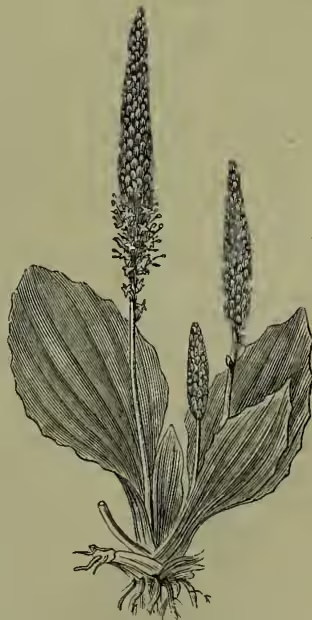
Plantain. For the tropical plantain (Musa), see BANANA. The English plant so called belongs to the Plantaginæ or Plantaginaceæ, a natural order of exogenous plants, mostly herbaceous and without stems; the leaves forming rosettes, flat and ribbed, or taper and fleshy; the flowers usually in spikes, and generally hermaphrodite; the calyx 4-parted, persistent; the corolla hypogynous, membranous, persistent, its limb 4-parted; the stamens four, inserted into the corolla, with long filaments; the ovary free, of a single carpel, 1—4-celled; the cells containing one, two, or many ovules; the fruit a membranous capsule with a lid. The testa of the seeds abounds in mucilage, which is easily extracted by boiling water. There are about 120 known species, diffused over all parts of the globe, but most abundant in temperate and cold countries. The most important genus is Plantago, the species of which often receive the English name Plantain. Five of this genus are found in the United Kingdom, the chief of which are the following: the Greater Plantain, or Waybread (Plantago major), one of the most common of British plants; a perennial, with broad ovate stalked leaves and long cylindrical spikes, growing in pastures, waysides, &c. It is very widely diffused over the world. Its seeds are a favourite food of birds, and the gathering of the spikes to feed cage-birds is familiar to every one. The leaves are applied to wounds by the peasantry in many districts. They are said also to be a useful application to ulcers and indolent scrofulous tumours.—The Ribwort Plantain, or Ribgrass (P. lanceolata), is another very common British plant, forming no small part of the herbage of many meadows and pastures, and sometimes sown by farmers, but with doubtful wisdom. Its leaves are lanceolate, and taper at both ends; its spikes are short, ovate or cylindrical, and placed on long angular stalks. Its seed is acceptable to cage-birds. This is the plant commonly known as 'bullies,' or 'sodgers,' the striking off the heads (or spikes) of which is such a favourite amusement of children.—The mucilage of the seeds of P. ispaghula and of P. psyllium is much used in India in catarrhs and other complaints; and P. psyllium—called Fleawort, and its seeds Fleasced—is cultivated in France for the sake of this mucilage, which is used by paper-stainers in preference to that obtained from linseed, and is also extensively used by muslin manufacturers for stiffening their goods. The plant has a branched spreading stem, and recurved leaves.