Pleurisy, or inflammation of the investing membrane of the lung (pleura), is one of the most serious diseases of the chest. It is very often, but by no means invariably, associated with inflammation of the substance of the lung, commonly known as Pneumonia (q.v.). Pleurisy without pneumonia is much more common than pneumonia without pleurisy. When both are present, but pneumonia preponderates, the correct term for the affection is pleuro-pneumonia, although it is frequently spoken of simply as pneumonia, probably in consequence of the remedies being applied mainly to it, as the more important of the two elements in the compound malady.
The pleura being a serous membrane, its inflammation is attended by the same course of events as have been already described in our remarks on the two allied diseases, Pericarditis and Peritonitis. The inflammation is of the adhesive kind, and is accompanied by pain, and by the effusion of serum, of fibrinous exudation, or of pus into the pleural cavity. In the last case it is called empyema. In consequence of the anatomical relations of the pleura—one part of the membrane (the parietal) lining the firm walls of the chest, while the other part (the visceral) envelops the soft and compressible lung, and these opposed surfaces being freely movable on one another—it follows that very different effects may be produced by its inflammation. For example, the visceral layer may be glued to the parietal layer, so as to prevent all gliding movement between them, and to obliterate the pleural cavity (similarly to what often happens in Pericarditis, q.v.); or the two surfaces which are naturally in contact may be abnormally separated by an effusion of serum between them; or, from a combination of these results, the opposite surfaces of the pleuræ may be abnormally united at some points, and abnormally separated at others.
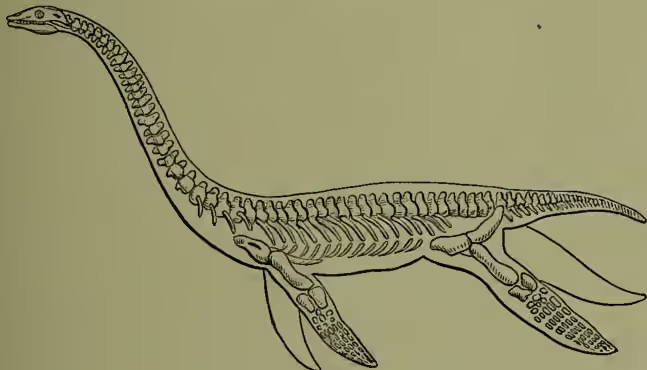
The general symptoms of pleurisy are rigors, pain in the side, fever, difficulty and rapidity of breathing, cough, and an impossibility of assuming certain positions; and of these the most marked is the pain or stitch in the side, the Point de côté of the French writers. The pain, often very severe, and often limited to one small spot, is usually at the lower part of the affected side; but is occasionally felt in other parts—as in the shoulders, in the hollow of the armpit, beneath the collar-bone, along the breast-bone, even in the loins, simulating lumbago; or, in the abdomen, so as to suggest peritonitis or hepatitis. In some cases it is altogether absent. The pain is increased by percussion, by pressure between the ribs, by a deep inspiration, by cough, &c.; and the patient is often observed never to draw more than a short and imperfect inspiration. Cough is not invariably present, although it is an ordinary symptom. It is small, suppressed as far as possible by the patient, and is either dry or accompanied by the expectoration of slight catarrh. If much frothy mucus is brought up it is a sign that Bronchitis (q.v.) is also present, and the appearance of rust-coloured sputa indicates the co-exist- in the Jurassic and Cretaceous strata of Europe, North and South America, and New Zealand, attained a length of between 30 and 45 feet. Pliosaurus was another genus, with a shorter neck (the vertebræ twelve in number) and a comparatively larger head than Plesiosaurus. In this genus the lower jaw was sometimes nearly 6 feet long. See the Manual of Palæontology, by Nicholson and Lydekker (1889).