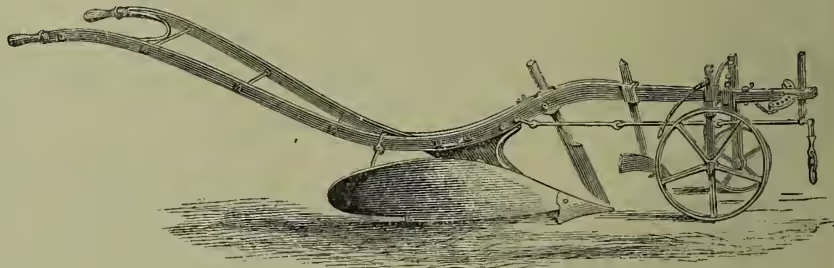
Plough. The first in order and importance of agricultural operations is the breaking up of the soil, and the implement employed most largely for this purpose is the plough. The general form of the plough is known to every one, and to the unobservant eye it appears to be a very simple and even primitive tool; nevertheless, much mechanical skill and ingenuity have been expended in perfectly adapting it to its work. It is a combination of instruments (fig. 1) fastened to a beam,
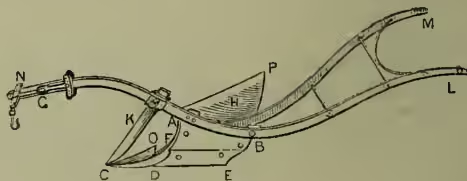
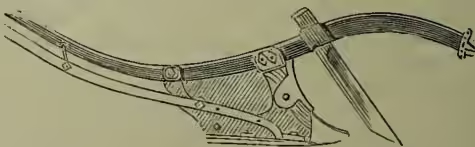
GBL; the coulter, K, is an iron knife-blade, for cutting the sod vertically; the share, CFD, which is merely a socket fitted on and not fastened to the body of the plough, has a sharp point, C, and a projecting horizontal edge, CO, on its right-hand side, its part of the work being to separate the under surface of the sod from the subsoil; by means of the mould-board, H, the slice, now wholly separated from the firm ground, is raised up and turned over by the forward motion of the plough; and the stilts, or handles, one of which, BL, is a continuation of the beam, the other, M, being fastened partly to the former by rods, and partly to the lower portion of the framework (fig. 2, which also shows the point of the plough with the share removed), are for the purpose of guiding the implement. The front part of the beam is formed with an upward curve; at its extremity is placed the bridle, N, to which the horses are attached by means of swing-trees and chains or traces, and the object of which is to enable the workman to elevate or depress the line of draught, or move it to the right hand or the left, as may be found necessary. The left sides of the coulter, share, and framework ADEB should evidently be in the same vertical plane. The form of the mould-board is of the utmost importance, and has chiefly attracted the attention of agricultural machinists since the time when improvements on the plough were first projected. Its office being to raise and turn the sod, it is necessary that the surface should slope upwards and outwards from the front, so as to apply a pressure in both directions, and, accordingly, the surface is so shaped that from the point of the share, where it is horizontal, it gradually curves upwards, till, at the extremity, P, it inclines over away from the body of the plough. The gradual change produced on the position of the furrow-slice is seen in fig. 3, where ABCD on the left-hand side two furrows at one operation, and which, although used on many farms, has not become so popular as was at one time expected. Of each of these ploughs there are many varieties, each maker having generally some peculiar views regarding the form and proportion of some parts of the instrument. For those who wish to study minutely the best form of plough it will be necessary to consult works on agriculture and agricultural implements.
The operation of ploughing can only be briefly referred to. Wherever the soil has been efficiently drained the ridges can be made wider and ploughed on the flat, high ridges being no longer necessary for carrying off the water. It is found in practice that the fewer the open furrows the better, particularly when the land is intended for a grain crop which is to be sown by drill or broadcast with machinery, and when the crop is to be cut with a reaping-machine, as is now almost universally the case. It is curious to notice how one improvement in farm practice leads on to another. The most common mode of ploughing with horses is now simply by casting the soil two ridges in and the next two out, beginning always with the two ridges where last time was left the open furrow.
The process of feering or commencing a ridge differs according to the state of the land to be turned over. If there exists an old furrow or hollow, as is generally the case in lea, two shallow furrows are turned, the one against the other, and so on; along each side of this commencement the plough moves, adding furrow after furrow, and increasing in depth until the third or fourth round is reached. This constitutes what is technically called the gathering system. In newly-cleaned land, or where a hollow does not appear to turn the first furrows into, two furrows are thrown out and then turned lightly in. The most common system, however, is what is known as casting or cleaving. That is, after one feering is accomplished, another is made at the other side of the ridge, and furrow after furrow is turned towards the inside of each of these feerings until the whole ridge is ploughed, and then in the centre is formed the finish or mids—a furrow or trench into which the feering is turned the next time the land is ploughed.
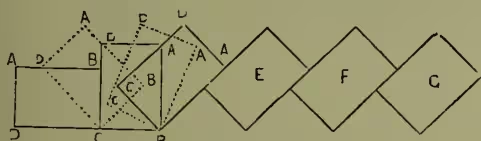
The plough is one of the most ancient of implements, and is mentioned in the Old Testament at a very early period, iron shares being also incidentally noticed more than seven centuries B.C. Dr E. B. Tylor has in his Anthropology clearly shown how the plough arose by gradual development out of the hoe, and that out of the pick or hatchet. represents the slice untouched by the plough, AD being the line of section by the coulter, DC by the share, BC the open side from which the previous furrow (E) to the right hand side has been separated, and the four successive rectangles, ABCD to the right, illustrate the successive changes of position of the furrow as the mould-board is pushed forward under and on its left side, till it is finally left, as represented in ABCD, on the right hand; E, F, G are furrows which have previously been laid in their proper position. The modern plough is wholly formed of iron, and in nearly all the English and several of the Scotch and Irish made ploughs wheels are attached at or near the front end of the beam, a contrivance which renders the implement more steady in its motion, more easily managed, and capable of doing better work in the hands of an inferior workman. The usual dimensions of the furrow-slice in lea or hay-stubble are 8 or 9 inches in breadth by 6 in depth, and in land for green crop 10 or 11 inches in breadth, and 7 to 9 in depth. Shallower ploughing is not unfrequently adopted, especially on thin soils, and in various parts of England. Nor is it uncommon to plough stubble-land 10 inches or more in depth.
Other kinds of ploughs are used for special purposes, such as trench-ploughs, which are made on the same principle as the common plough, but larger and stronger, so as to bring up a portion of the subsoil to the surface; subsoil ploughs, some patterns of which have no mould-board, and merely stir and break up the subsoil, thus facilitating drainage; double mould-board ploughs, which are merely common ploughs with a mould-board on each side, and are employed for drilling turnip or potato land, for water-furrowing, and for earthing up potatoes; turn-wrest ploughs, which have the mould-board so arranged that in going in both directions the furrow is turned to the side; American Chill ploughs, which are exceptionally light in draught, go over the ground rapidly, and break up the surface soil more finely than the ordinary plough; the double-furrow plough, which turns
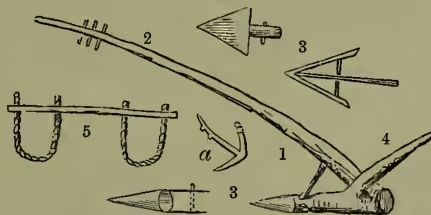
1, Plough still used in Asia Minor; 2, its pole, where the oxen are attached; 3, shares of various forms; 4, the tail or handle; 5, the yoke; a, early Greek plough.
The fields of Sweden were formerly tilled with the 'lack,' of which specimens were still seen in the 19th century. The lack was simply a 'stake of spruce-fir with a bough sticking out at the lower end cut short and pointed.' This implement was gradually made heavier, and dragged by men through the ground, so as to make a simple furrow. Next it 'was made in two pieces, with a handle for the ploughman and a pole for the men to drag by, the share was shod with an iron point, and at last a pair of cows or mares were yoked on instead of the men.' The development of the Egyptian plough was similar. The ancient Egyptian plough was wholly of wood, and in some instances consisted of little more than a pointed stick, which was forced into the ground as it was drawn forward; though there seems to have been ploughs with handles, and with metal socks. The Aryan peoples took pride in their being the ploughing (arare; see AGRICULTURE, Vol. I. p. 98) peoples. The earliest form of the
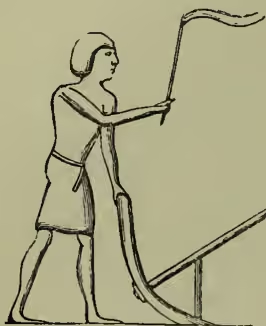
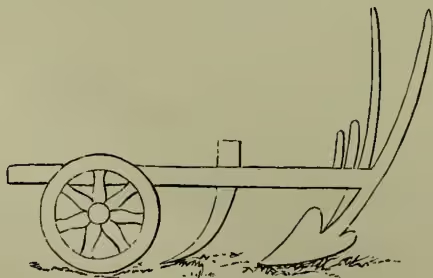
Greek plough, the auto-guon (fig. 4, a), is an example of this; it was merely the trunk of a small tree, which had two branches opposite to each other, one branch forming the share and the other the handle, while the trunk formed the pole or beam. The more improved form, the pehton, in use among the Greeks, was not substantially different from the modern form in use in some parts of Asia Minor (fig. 4). The ancient Egyptian plough in one of its early stages is represented in fig. 5. The Romans, an essentially practical nation, largely improved on the plough, adding to it the coulter and mould-board, and occasionally attaching wheels to the beam to prevent the share from going too deep into the earth (fig. 6). The plough was almost unknown among the American aborigines, though Prescott describes a mode of ploughing practised among the Peruvians, which consisted in the dragging forward a sharp-pointed stake by six or eight men, its sharp point, which was in front, being kept down in the ground by the pressure of the foot of another man who directed it. The ancient heavy plough dragged by eight oxen was still in use in Aberdeenshire well into the 18th century. In Britain the most important amendments on the plough are not two centuries old, and some of them were doubtless borrowed from the careful agriculture of Holland. England took the lead in improvement, followed some time later by Scot- land, in which the chief improvers were James Small (the inventor of the Scotch swing plough), Wilkie, Gray, and Sellar. In England the improvers have chiefly been Ransome of Ipswich (the patentee in 1785 of the cast-iron share), Howard of Bedford, Hornsby of Grantham, and Bnsby of Bedale, the last of whom gained a medal for his mould-boards at the Great Exhibition of 1851. Ransome's wheel-plough has long finely-made mould-boards, rather short broad shares, straight coulter, and with the two wheels on level land can almost move unattended. Ancient types, however, still survive; the East Anglian plough has only one (wooden) stilt, and is very heavy, but makes good work. There are many specially American types of plough. In the Sulki plough wheels support the weight of the plough and of the furrow-slice, decreasing friction, and saving labour to the ploughman, who has a seat on the implement; the disadvantage is the much greater cost of this kind of plough, and the cumbrous size. The Double Michigan plough has a small paring plough on the beam in front of the other; the small plough pares off the surface and throws it into the previous furrow, and the large one completely buries it under a heavy furrow-slice. Reversible ploughs, like the Oneonta Clipper, have the share and mould-board, so that they can be easily changed from one side to the other; these are also called swivel ploughs or side-hill ploughs.
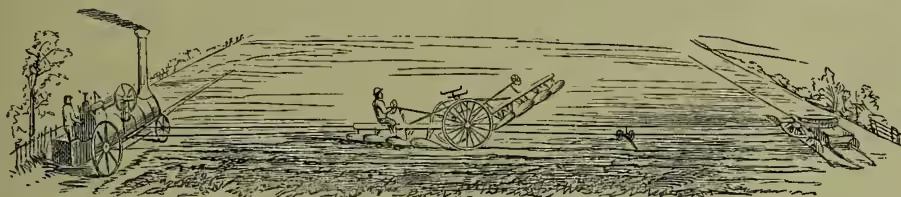
Steam-ploughing.—It has been alleged that the cultivation of the land by steam had been contemplated as far back as the 17th century. So long ago as 1618 David Ramsey and Thomas Wild- gosse took out letters-patent for engines and machinery to plough the ground without the aid of oxen or horses, and the attempt has been made to show that steam was the motive power intended to be employed; but, as the first patent was taken out nearly forty years before the Marquis of Worcester described the steam-engine in his Century of Inventions, the grounds for such an opinion do not seem quite satisfactory. In 1769, however, after the steam-engine had been applied to other purposes, there was lodged in the Patent Office a specification for a new machine or engine, to plough, harrow, and do every other branch of husbandry, without the aid of horses. The patentee was Francis Moore; and so confident was he of the merits of his plan that he sold all his own horses, and persuaded his friends to do the same; 'because the price of that noble and useful animal will be so affected by the new invention that its value will not be one-fourth of what it is at present.' Moore, like many who followed in his wake, was much too sanguine. The truth is that even yet steam-power has only to a very small extent supplanted horse labour in the cultivation of the soil. Early English patentees were Pratt in 1810, and Heathcote in 1832. But the first steam cultivating apparatus which gave anything like satisfac- tory promise of success was that for which Messrs Fisken of Stamfordham, Newcastle-upon-Tyne, took out a patent in 1855. Mr Fowler of Leeds, and Messrs Howard of Bedford, and others followed with apparatuses of various patterns. The different inventions brought into notice from time to time have included plans for engines travelling over the surface of the ground, drawing ploughs or other cultivating implements along with them; engines working on tramways and drawing implements after them; engines moving along opposite headlands, and working implements between them by means of wire-ropes, and stationary engines driving implements also by means of wire-ropes. Only two of these systems got beyond the experimental stage. These are what are called the direct and round-about—the former where the pull of the implement is directly to and from the engine, or between two engines, one at each end of the furrow; and the latter where the implement is drawn at right angles. The best known of the apparatuses now in use are those made by Fowler, Howard, and Barford and Perkins, of Peterborough.
The ploughs used in the various systems are very similar in construction, some taking four and others six furrows at each time. Fowler's apparatus is shown at work in figs. 8 and 9.
It has to be noted, however, that, with all the ingenuity and capital expended on the perfecting of the appliances, steam-power has not been employed in the cultivation of the soil anything like so advantageously or extensively as was at one time expected by the advocates of the practice. The great agricultural depression following the disastrous year of 1879 gave the system its first serious check. The injury unwittingly done to large extents of land by excessively deep-ploughing—by burying the good soil and bringing bad material to the surface—also tended to discredit steam-cultivation. It has as a rule been found in practice that moderate ploughing and deep stirring are preferable to deep ploughing, and steam-power is now more largely employed in stirring and harrowing the soil than in turning it over in furrows. Upon