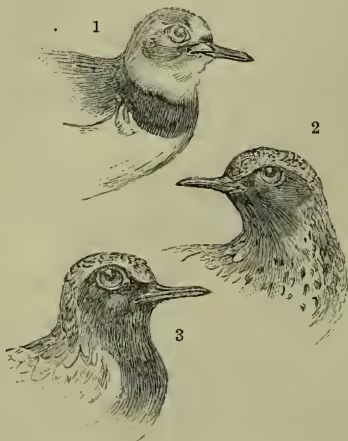
3, Golden Plover.
Ploughgate, in the law of Scotland, is an expression denoting a quantity of land of the extent of 100 acres Scots. See CARUCATE. nostrils are longitudinally cleft near the base; the legs, which are not very long, are naked a little above the tarsal joint; with one exception there is no hind-toe; the wings are rather long and pointed, the first quill-feather is the longest. The species are numerous, and are found in every quarter of the globe; many of them are birds of passage. They chiefly frequent low, moist grounds, where they congregate in large flocks, and feed on worms, molluscs, insects, &c.; but some of them visit mountainous regions in the breeding season. They fly with great strength and rapidity, and run with much swiftness. The flesh and eggs of many of them are esteemed delicacies. A common British species is the Golden Plover (Charadrius plumbeus), a handsome bird, of a blackish colour, speckled with yellow at the tips and edges of the feathers; the throat, breast, and belly black in summer, whitish in winter. The golden plover is a bird of passage, visiting in summer the northern parts of Europe, of the west of Asia, and of North America, and migrating to the south in winter. It is known in most parts of Europe, and is common in many districts of Britain, breeding in the northern counties. Great numbers frequent the sandy pastures and shores of the Hebrides and of the Orkney and Shetland Islands. It makes an artless nest, little more than a slight depression in the ground, and lays four eggs. The parent birds show great anxiety for the protection of their young, and use various stratagems to divert the attention of an enemy. The golden plover exhibits great restlessness on the approach of wet and stormy weather, whence its specific name pluvialis. The Ringed Plover (Aegialitis hiatricula), locally called Stone-hatch or Sandlark, a much smaller bird, not so large as a song thrush, is found at almost all seasons on the shores of the British Islands, frequenting sandy and shingly flats, from which the sea retires at ebb-tide. It is often to be seen also on the banks of large rivers, and not unfrequently by lakes and ponds. It is found in most of the northern parts of Europe and Asia, and in Iceland and Greenland. It is grayish brown above, whitish beneath, with a collar of white round the neck, and below it a black—in winter a brown—collar; the head marked with black and white; a white bar on the wing. Very similar, but smaller, and with an incomplete collar, is the Kentish Plover (A. cantiana); and also similar in form and habits is the smallest of the British species, the Little Ringed Plover (A. curonica). Both of these are rare in Britain. The Gray Plover (Squatarola helvetica), a species somewhat larger than the golden plover, is distinguished by black axillaries, white tail-coverts, and the presence of a hind-toe. North America has a number of species of plovers, such as the Kildeer Plover (A. vocifera), abundant on the great western prairies, and not unfrequent in the Atlantic states. It utters, when approached by man, a querulous or plaintive cry, like the lapwing, the Green Plover. See DOTTEREL, and LAPWING; and for the so-called Stilt Plover, see STILT.
Plover's eggs are sold in enormous quantities in London and other large towns, and command an extraordinary price, eighteen shillings a dozen or even more, being sometimes given for them, and the cost is seldom less than threepence or sixpence per egg. These are supposed all to be plover's eggs, or, really, lapwing's eggs; but doubtless the eggs of many other birds are substituted, those of the red-shank being very similar in appearance and flavour. Rook's eggs are too decidedly unlike the plover's to be put in their place. Some sea-birds' eggs are occasionally passed off under the name; and it is said that eggs outwardly unlike plover's have been skilfully painted by hand in order to deceive. Scotland, Ireland, and Holland are all laid under contribution to produce the tens of thousands of dozens of genuine plover's eggs which it is computed are annually consumed in London.