Plymouth, one of the most famous of English seaports, an ancient parliamentary, municipal, and county borough, lies in the extreme south-western corner of Devonshire, 246 miles by rail (216 by road) WSW. of London, 128 SW. of Bristol, and
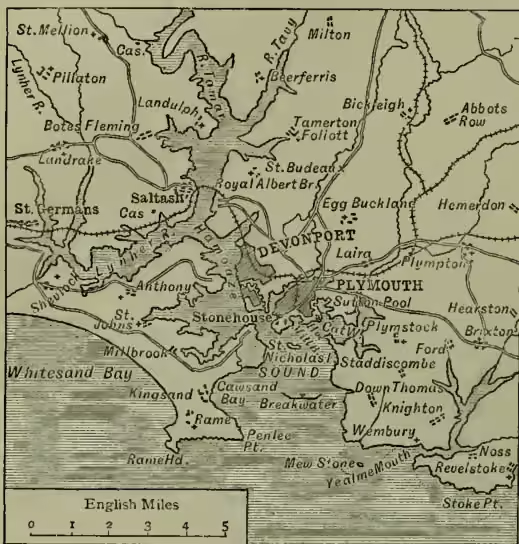
53 SW. of Exeter. It occupies the northern shore of Plymouth Sound (see below), immediately at the mouth of the Plym. The remaining space between it and the Hamoaze, the estuary of the Tamar, is occupied by the sister but much smaller town of Stonehouse (q.v.), while still farther to the west, along the Hamoaze itself, stretches the third of the 'Three Towns,' Devonport (q.v.). They are all, however, so united now by continuous lines of houses that, with their respective suburbs, they have lost their individuality, and to the stranger appear one great community. The chief government establishments are at Devonport—the dockyard, gun-wharf, steam-factory, and principal barracks; while Stonehouse has its quota in the victualling yard, marine barracks, and naval hospital. Plymouth, which is more populous than the other two together, is at once the chief seat of commerce, trade, and manufacture, and within the 19th century displayed an enterprise which gives it a high place among provincial centres. The site is a very fine one. Between the two natural inlet harbours of Sutton Pool and Mill Bay stretches the bold rocky ridge of the Plymouth Hoe, the eastern end of which is occupied by a citadel built by Charles II. Northward the ground rises in a series of long hills, along which the town stretches until it passes into a suburban hill of singular attractiveness. From the Hoe there are magnificent views both seaward and landward. Here, according to tradition, the captains of the fleet which assembled to meet the Armada whiled away the time by playing a game of bowls, which was interrupted by the news of the approach of the enemy; and here stand a tercentenary memorial to the Armada heroes (1890), and a statue (1884) of Sir Francis Drake (one of Boelm's finest works). The upper portion of the lighthouse erected by Smeaton on the Eddystone (q.v.) was also rebuilt here in 1882-84. Old Plymouth is chiefly clustered round the shores of Sutton Pool—a dingy unattractive set of narrow streets; but of recent years miles of excellent thoroughfares and many handsome buildings have been erected, chief among them a noble Gothic guildhall, opened in 1874 by the Prince of Wales, Lord High Steward of the borough. The principal antiquity is the fine 15th-century church of St Andrew, Perpendicular in style, and restored in 1874-75 by Sir Gilbert Scott; Charles Church (1646-58) is a singularly good example of post-Reformation Gothic; the Roman Catholic cathedral is an effective Early English edifice (1858). The Cottonian collection of sketches by the leading continental masters is at the Proprietary Library; there is a good local museum at the Athenæum; and among the numerous charitable institutions the first place is taken by the South Devon Hospital, opened in 1884 at a cost of £40,000. The town is served by both the Great Western and London and South-Western Railways. In Mill Bay are the Great Western Docks, now the property of the former company, which are capable of taking the largest merchant-vessels. Sutton Pool, the ancient tidal harbour of Plymouth, in addition to a large general trade, is the seat of the fisheries of the port, which are very important. Manufactures, mainly chemical, are carried on—at Cattedown chiefly, but also at Mill Bay. There is a large foreign, and a very extensive coasting trade, and the port is used by lines of passenger-steamers to almost every quarter of the globe.
Though only a fishing-village at the Conquest, under the name of Sutton, Plymouth has for centuries played a leading part in the nautical life. It was the favourite port of the Black Prince; the chief Elizabethan rendezvous of Drake, Hawkins, Grenville, Raleigh, and their fellows; the final port of departure of the Mayflower with the Pilgrim Fathers. In the civil wars it sided with the parliament, and successfully endured a series of sieges and blockades extending over four years, sharing with Hull the honour of saving the parliamentary cause. It was also the first town to declare for William of Orange. In the great French war it rivalled Portsmouth in naval activities. Among its more distinguished natives are Sir John Hawkins, Sir Richard Hawkins, Sir Thomas Edmonds, Joseph Glanvill, R. S. Hawker, Lord Monkswell, Sir W. Snow Harris, F.R.S., W. Elford Leach, F.R.S., with Northcote, Haydon, S. Prout, Sir C. Eastlake, P.R.A., and S. Hart, the artists. It is now an important scientific centre in connection with the Marine Biological Laboratory (opened in 1888), which publishes a Journal. Plymouth was first incorporated by Henry VI. in 1439, and has since always returned two members to parliament. Pop. (1801) 43,194; (1851) 52,221; (1871) 70,091; (1881) 76,080; (1891) 87,307.