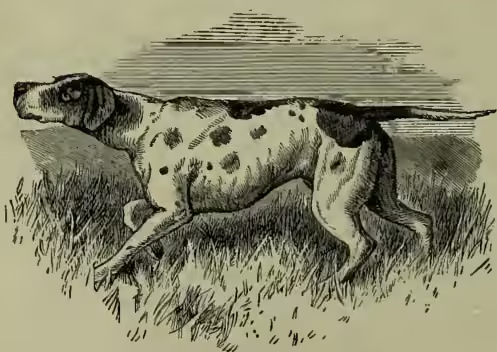
Pointer, a breed introduced from Spain about the middle of the 18th century. The Spanish pointer was a larger and much slower dog than the modern English pointer, rather wanting in stamina, and inclined to 'knock up' with a hard day's work; but, if not hurried, was possessed of wonderful nose and powers of scent. As shooting became more common, and guns approached nearer to perfection, the Spanish pointer was found to be too slow and soft. With the object of removing these defects, crosses with the greyhound to improve the speed, and with the bulldog to get courage, were tried, but with little success, until about the beginning of the 19th century the well-known Colonel Thornton tried a cross with the lighter variety of foxhound. He soon succeeded in breeding a light and active dog, capable of ranging at a fast pace for a considerable time, and though possibly not with the nose of the old Spanish pointer, yet with sufficient for the purpose. Other breeders followed suit, and a distinct strain known as the English Pointer was soon established. By careful selection the hound tendency to hunt a foot-scent was eradicated, or nearly so, while some of the speed and staying powers of the hound were retained. The act of 'pointing' when the game is first scented was at first carefully taught, but gradually became instinctive. until now well-bred puppies of a few months old may be seen pointing at any object which excites them. In general appearance the pointer somewhat resembles the foxhound, though he is a lighter and more active dog, with a finer coat. The head of the pointer should be fairly large, with an intelligent expression; a small eye or too much lip greatly detracts from the appearance. The shoulders should be sloping and powerful, as the dog has often to stop suddenly on a 'point' when at full speed. The body should be built on graceful and racing lines, chest not too wide, but very deep, feet round and compact. Liver and white, and lemon and white, are the popular colours, as they are easily seen in heather or turnips, but whole black or liver has many admirers. Owing to the changed conditions of agriculture, the pointer is not now used so extensively for partridge shooting, but is still used for grouse. In hot weather, where water is scarce, the pointer has a great advantage over the setter, but succumbs sooner to cold and wet than the heavy coated setter. As the pointer is seldom kept as a companion, his intelligence is not of a high order, but he is easily kept in command, and is generally good-tempered.