Poland (called by the natives Polska, a word of the same root as Pole, 'a plain'), a former kingdom of Europe, was, immediately previous to its dismemberment, bounded on the N. by the Baltic Sea from Danzig to Riga, and by the Russian provinces of Riga and Pskov; on the E. by the Russian provinces of Smolensk, Tchernigoff, Poltava, and Kherson; on the S. by Bessarabia, Moldavia, and the Carpathian Mountains; and on the W. by the Prussian provinces of Silesia, Brandenburg, and Pomerania. Its greatest length from north to south was 713 English miles, and from east to west 693 miles, embracing an area of about 282,000 English sq. m. (40,600 larger than Austria-Hungary is now); an area which has a population of over 24,000,000. This extensive tract forms part of the great European central plain, and is crossed by only one range of hills, which rise from the north side of the Carpathians and run north-east through the country, forming the watershed between the rivers which flow into the Baltic and Black Sea. The soil is mostly a light fertile loam, well adapted for cereals, though here and there occur extensive barren tracts of sand, heath, and swamp, especially in the eastern districts. Much of the fertile soil is rich pasture-land, and much is occupied with forests of pine, birch, oak, &c. Rye, wheat, barley, and other cereals, hemp, timber, honey and wax, cattle, sheep, and horses, vast mines of salt, and a little silver, iron, copper, and lead constitute the natural riches of the country; and for the purposes of commerce the Vistula, Dnieper, Dwina, and their tributaries afford great facilities.
The kingdom of Poland, during the period of its greatest extent, after the addition of the grand-duchy of Lithuania at the close of the 14th century, was subdivided, for purposes of government, into about forty palatinates (Pol. województwa), which were mostly governed by hereditary chiefs. The people were divided into two great classes—nobles and serfs. The noble class, which was the privileged and governing class, included the higher nobles, the inferior nobles (a numerous class, corresponding to the knights and gentry of other countries), and the clergy, and numbered in all 200,000; the serfs formed the agricultural labourers, and were attached to the soil. Their condition is described by all travellers as a very pitiable one. Such trade as the country had was mostly in the hands of the Germans and Jews. The nobles were the proprietors of the soil, and appropriated the larger portion of its products, the serfs being left with a bare maintenance. The former were brave and hospitable, but quarrelsome, and generally preferred their own interests to that of their country; the serfs (originally called Kmieci; Lat. Kmetones) were sunk in poverty and ignorance. The present population of the provinces included in the Poland of former days consists of Poles, Lithuanians, Germans, Jews, Malo-Russians, Romanians, Gypsies, &c. The Poles, who number 10,000,000, form the bulk of the population; the Lithuanians, 2,100,000 in number, inhabit the north-east of the country; the Germans, of whom there are 2,000,000, live mostly in the towns; the Jews are very numerous, being reckoned at 2,200,000. Of Roman Catholics there are about 9,400,000; of members of the Greek Church (including Uniates), 7,900,000; of Protestants, 2,360,000; the rest are Jews, Armenians in Galicia, &c.
History.—The Poles are ethnologically a branch of the Slavs (q.v.). The name appears first in history as the designation of a tribe, the Poliani, who dwelt between the Oder and the Vistula, surrounded by the kindred tribes of the Masovii, Kujavii, Chrobates, Silesians, Obotrites, and others. In course of time the name Poliani became predominant. There is no real Polish history till the reign of Mieczyslaw (962–992); up to the period of this sovereign we have only fables. He became a convert to Christianity, and Poland took rank as one of the political powers of Europe. Mieczyslaw acknowledged himself to be the feudatory of Otho of Germany. In his time the first Polish bishopric was founded at Posen. He was succeeded by his son Boleslas I. (992–1025), who extended his kingdom beyond the Oder, the Carpathians, and the Dniester. He was recognised as king by the German emperors. After a period of anarchy he was succeeded by his son Casimir (1040–58), whose reign, and that of his warlike son Boleslas II. (1058–1101), although brilliant, were of little real profit to the country. The latter monarch having murdered the Bishop of Cracow with his own hand, Poland was laid under the papal interdict, and the people absolved from their allegiance, whereupon Boleslas fled to Hungary. For two hundred years from this time Poland was only a duchy. Boleslas III., surnamed the 'Wry-mouthed' (1102–39), an energetic monarch, annexed Pomerania.
In the time of Casimir II. (1177–94) we have the senate established, which was formed from the bishops, palatines, and castellans. His death was the signal for a contest among the various claimants for the throne, which was speedily followed, as usual, by a division of the country, and during this disturbance Pomerania emancipated itself from Polish rule. In 1226 the Teutonic Knights were summoned by the Duke of Masovia to aid him against the pagan Prussians; but they soon became as formidable enemies to Poland as the Prussians, and conquered a large part of Podlachia and Lithuania. The Mongols swept over the country in 1241, committing great devastations, and defeated the Poles in a battle at Liegnitz. Many districts of the country were now colonised by Germans, and numbers of Jews took refuge in Poland. The Germans obtained great privileges from the Polish king, and were governed by the Jus Magdeburgicum. The reign of Ladislaus Lokietek ('the Short') is important (1305-33), because in his reign the first Polish diet (1331) was summoned at Checiny. In conjunction with Gedymin, Grand-duke of Lithuania, a vigorous war was carried on of the Jagellons (q.v.; 1386-1572), and first united Lithuania and Poland, thus doubling the extent, though not the population, of the kingdom. In 1410 the Teutonic Knights were defeated at the battle of Grunwald. His son, Ladislaus, who was also chosen king of Hungary, fell at the battle of Varna in 1444 fighting against the Turks. Casimir, who succeeded, recovered West Prussia from the Teutonic Knights and compelled them to do homage for East Prussia. In 1454 was held the diet of Nieszawa, at which the celebrated statute was enacted which conferred great privileges upon the Polish nobility. The brief reigns of Casimir's two sons were marked only by the increased power of the diet, which had by this time absorbed all but the symbols of supreme authority, and had turned Poland from a monarchy into an oligarchy. The king thus possessed but little power beyond what his personal influence gave him.
Sigismund I. (1506-48), also son of Casimir IV., had a long and prosperous reign, Poland being at that time the dominant country of eastern Europe. Very different opinions have been held about this monarch, some Polish historians praising his government, while Bobrzynski and others consider him to have been a weak man. His court was filled with factions fomented by his wife, Bona Sforza, daughter of the Duke of Milan, a malignant and avaricious woman. The doctrines of the Reformation penetrated to Poland, and were a source of fresh discontents. In a war with Basil, the Grand-duke of Russia, Sigismund lost Smolensk, but he was partly compensated by obtaining lordship over Moldavia. In 1529 Sigismund issued a legal code for Lithuania in the White-Russian language, which forms an important monument of Polish law. In 1537 occurred the first rokosz, or rebellion of the nobility against the kingly authority. Sigismund was about to set out to Wallachia, and was obliged to make several concessions before they would accompany him. In 1548 the king died at the advanced age of eighty-two.
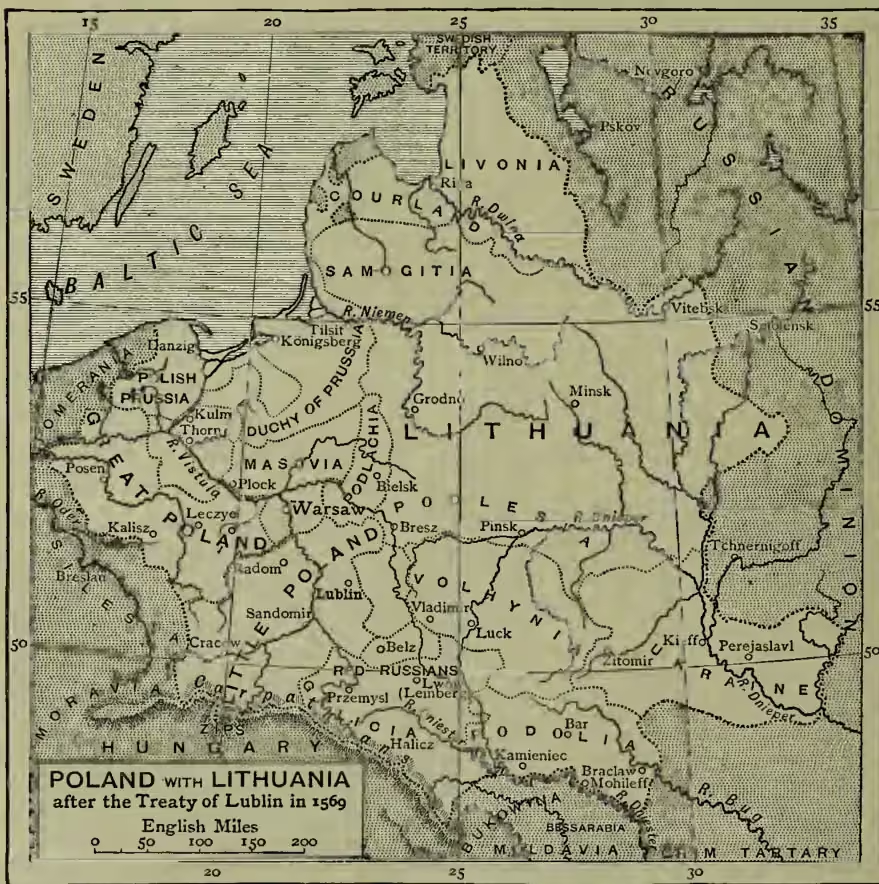
He was succeeded by his son, Sigismund II. (1548-72), otherwise called Sigismund Augustus, but this prince was not elected till a debate had taken place about his marriage. He had secretly espoused as a widower a widow of the great house Radziwill, and the nobles required the union to be annulled, because they fancied that the country against the Teutonic Knights. His son, Casimir the Great (1333-70), increased the prosperity of Poland. Commerce was active, and Danzig and Cracow joined the league of the Hansa. In 1347 was enacted the celebrated Statute of Wislica, the foundation of Polish law; in this reign also Galicia was united to Poland. With Casimir the dynasty of the Piasts became extinct, after a rule of 510 years, according to the old Polish chroniclers. His nephew, Louis, king of Hungary, succeeded him by the will of the deceased monarch and the election of the diet. On his death without male heirs the succession fell to his daughter Jadwiga or Hedwig, who was induced by the diet to marry Jagiello, Grand-duke of Lithuania, who founded the dynasty would gain more by a foreign alliance. Sigismund, however, carried his point, and his wife was crowned in 1550, but died soon after, not without suspicions of having been poisoned by her mother-in-law, Bona, who in this reign left Poland for her native country, carrying with her a vast amount of treasure. The quarrels between Protestants and Romanists now raged fiercely, and the Reformed faith spread rapidly in Poland. We hear of persons being burned to death for their adhesion to it. Sigismund showed great indecision in the matter. In 1569, by the diet of Lublin, Lithuania was finally joined indissolubly to Poland, and from this time there was to be but one diet for the united realm, and Warsaw, for greater convenience, became the capital. Poland also gained Livonia. In 1572 the king died. In the diet held the year after at Warsaw it was enacted that there should be toleration for all religious opinions, but the nobles were still to have power over their serfs in spiritual matters.
The population almost doubled itself, but the nobles became every year more impatient of restraint, and the crown was now virtually elective. The members of the diet, consisting of the palatines and the posly, or deputies of the lesser nobility, together with the higher nobility, sat in one chamber. The king had the right of summoning the diet, which only lasted for six weeks, and its decisions were required at a later stage, as we shall see, to be unanimous. This idea of unanimity in voting is thoroughly Slavonic, and is to be found in the old Russian folk-motes. The right of forbidding the passing of any measure was called in Poland the liberum veto (in Polish, nie pozwalam), and brought all legislation to a standstill. It was employed by many of the corrupt Polish nobles to avoid the detection of their malpractices or to gratify their private malice, and hastened the ruin of the country.
The diet of 1573 elected Henry of Valois (III. of France, q.v.), a worthless man, who fled in the most ludicrous fashion from the country after a reign of about five months, and was succeeded by Stephen Batory (1575-86), voivode of Transylvania, one of Poland's best kings, who carried on war successfully against the Russians, and compelled Ivan IV. to sue for peace; he also organised the Cossacks of the Ukraine into regiments of frontier soldiers. Batory, who had no heirs, was succeeded by Sigismund III. (1586-1632), the son of Catharine, sister of Sigismund II., who had married John Vasa, king of Sweden. He signed the pacta conventa, as the agreement between the Poles and their king was named, and an alliance offensive and defensive was made between Poland and Sweden. Constant disputes took place between the king and the diet, and he was a great persecutor of the Dissidents, as the Protestants were called. Sigismund assisted the claims of the false Demetrius, who was assassinated at Moscow in 1606, and we find the Poles afterwards taking that city and causing Ladislaus, the son of Sigismund, to be crowned czar; but he was soon obliged to resign, and ultimately the family of the Romanovs ascended the throne in the person of Michael. Nor was Sigismund successful in his attempts to get the crown of Sweden. He died in 1632, and was followed by his sons Ladislaus IV. (1632-48) and John Casimir (1648-68). During the reign of this dynasty Wallachia and Moldavia were taken by the Turks from the Polish protectorate, Livonia was conquered (1605-21) by Sweden, and Brandenburg established itself in complete independence (1657). In 1652 Sicinski, the deputy for Upita, first put an end to the diet by the liberum veto. The Cossacks had been goaded into rebellion by oppression and religious persecution, as they were members of the Greek Church, and finally went over to Russia in 1654. This occurred in the unfortunate days of John Casimir; and during the same reign Poland was attacked simultaneously by Russia, Sweden, Brandenburg, and the Cossacks; the country was entirely overrun, Warsaw, Wilno, and Lemberg taken, and the king compelled to flee into Silesia. Many of the Polish nobles behaved with great treachery, but the invaders were finally driven out. In 1660 Livonia was ceded to Sweden. In 1667, by the treaty of Andruszowo, the territory beyond the Dnieper was ceded to Russia. John Casimir abdicated in 1668, and retired to France, where he died in 1672.
Michael Wisniowiecki (1668-74), son of a famous general, was a weak and very insignificant man, was elected king—it is said almost against his own will. He was a mere puppet in the hands of his subjects. A war with Turkey was concluded by the ignominious peace of Buczac in 1672, by which the town of Kamieniec remained in the hands of the Ottomans. But the senate rejected the treaty; the Polish army was reinforced, and the command given to the celebrated John Sobieski, who routed the Turks at Choczim the following year. Michael died suddenly in 1674. After some dissensions concerning the election of a successor, John Sobieski (q.v., 1674-96) was chosen, but his reign, although adorned by the splendid triumph at Vienna (1685), was productive of little good to his country, chiefly through the continual dissensions of the nobles. As Sobieski's successor the Prince of Conti was legally elected and proclaimed king; but Augustus II. of Saxony, whose cause was supported by the House of Austria, entered Poland at the head of a Saxon army, and succeeded in obtaining the throne. Augustus showed little sympathy with his Polish subjects; he promised to reconquer for Poland her lost provinces, but this promise was chiefly made as an excuse for keeping his Saxon army in the country, in violation of the pacta conventa. His war with the Turks restored to Poland part of the Ukraine and the fortress of Kamieniec; but that with Charles XII. brought nothing but misfortune. Cracow was taken in 1702; Augustus was deposed, and Stanislaus Leszczynski, palatine of Posen, elected in his place. All the courts of Europe acknowledged Stanislaus, except that of Peter the Great; and, when the latter defeated Charles at the battle of Pultowa in 1709, Leszczynski was compelled to leave the country, and Augustus returned. In this reign Poland lost Courland, one of its fiefs, which was given by the Empress Anna to Biron, her favourite. Religious fanaticism was also rampant. The Dissidents were very much persecuted, and a riot having taken place in 1724 at Thorn, several of the leading citizens, including the burgomaster, were put to death. In 1733 a law was passed excluding them from all public offices. This same year the contemptible Augustus died. At the instigation of some of his supporters, Stanislaus Leszczynski, who was then residing in Lorraine, was induced to return to Poland and was elected king; but his election was opposed by Austria and Russia, and in his place was chosen Augustus III. (son of the last sovereign), a weak and incapable man. The condition of the country was now deplorable. Towards the end of his reign the more enlightened Poles, seeing the radical defects of the constitution, the want of a strong government, and the dangers of the liberum veto, entered into a league for the establishment of a well-organised hereditary monarchy. The conservative party, however, was strong, and relied on Russian influence, while the reformers supported the Jesuits in their exclusion of dissenters from public offices. In 1764 Stanislaus Augustus Poniatowski was elected king, chiefly through the intrigues of the Empress Catharine. Although a man of refined manners, he was weak, and not fitted to serve the country at such a crisis. The reforming, or Czartoryski party (so called because it was headed by a member of this celebrated family), had succeeded in abolishing the liberum veto, and effecting many other improvements; but they at the same time more severely oppressed the Dissidents, whom the Russians pretended to protect.
The Confederation of Bar (so called from Bar in Podolia) was now (1768) formed by a few patriots, an army of about 8000 men was assembled, and war declared against Russia. But they were not successful, and a bold attempt to carry off the king also failed. Frederick the Great of Prussia, who had formerly gained the consent of Austria to a partition of Poland, made the same proposal to Russia in 1770, and in 1772 the first partition was effected. The territories seized by the three powers were as follows:
| English sq. miles. | Population. | |
|---|---|---|
| Russia ..... | 42,000 | 1,800,000 |
| Prussia ..... | 13,000 | 416,000 |
| Austria ..... | 27,000 | 2,700,000 |
The whole country was now aroused to a sense of its danger; and the diet of the diminished kingdom laboured to amend the constitution. In 1788 a remarkable diet was opened which lasted four years. Many changes were introduced. The liberum veto was formally suppressed, and the throne was declared hereditary. The burghers were to send deputies to the diet on the same terms as the nobles; the peasants were not set free, but their condition was improved; and the Dissidents were granted complete toleration, although the Roman Catholic was declared to be the dominant religion. In this they were encouraged by Prussia, whose king, Frederick-William, swore to defend them against Russia. The new constitution was promulgated May 2, 1791. But some of the nobles were discontented at the loss of their privileges by the new order of things, and formed in 1792 the Confederation of Targovica (q.v.), and at their instigation Russian troops invaded Poland and Lithuania. Prussia now joined the Russians, and a second fruitless resistance to the united troops of Prussia and Russia, which was headed by Joseph Poniatowski (q.v.) and Kosciusko (q.v.), was followed by a second partition (1793) between those two countries as follows:
| English sq. miles. | Population. | |
|---|---|---|
| Russia ..... | 96,000 | 3,000,000 |
| Prussia..... | 22,000 | 1,100,000 |
which the diet was forced to sanction at the point of the bayonet. The Poles now became desperate; a general rising took place (1794), the Prussians were compelled to retreat to their own country, and the Russians were several times routed. But
Austria now appeared on the scene; her army advanced, and fresh Russian troops also arrived. Kosciusko was defeated at the battle of Maciejowice and taken prisoner. Suvorov (Suvarrow), the Russian general, took Warsaw, and the Polish monarchy was at an end. The third and last partition (1795) distributed the remainder of the country as follows:
| English sq. miles. | Population. | |
|---|---|---|
| Russia ..... | 43,000 | 1,200,000 |
| Prussia..... | 21,000 | 1,000,000 |
| Austria..... | 13,000 | 1,000,000 |
King Stanislaus resigned his crown, and died at St Petersburg in 1798. He lies buried in the Roman Catholic church there.
The main causes of the fall of Poland appear to have been (1) the want of patriotism and cohesion among the nobles, each pursuing his own interests, and the country thus being divided among a number of petty tyrants; (2) the want of a national middle class, the trade of the country being almost entirely in the hands of Jews and Germans; (3) the intolerance of the Jesuits, who persecuted on the one hand the Dissidents, which caused them to sympathise with Prussia, and on the other persecuted also the Orthodox inhabitants of the eastern provinces and the Cossacks, who thus looked to Russia; (4) in a less degree than the first three causes, the weakness of character of the kings—though with such a turbulent nobility it must be confessed that they had no fair play; (5) the want of natural frontiers.
The subsequent success of the French against the Russians and the promises of Napoleon to reconstitute Poland rallied round him the Poles, who distinguished themselves in several campaigns against their old enemies; but all that Napoleon accomplished in fulfilment of his promise was the establishment, by the treaty of Tilsit (1807), of the duchy of Warsaw, chiefly out of the Prussian share of Poland, with a liberal constitution and the Elector of Saxony as its head. In 1809 Western Galicia was taken from Austria and added to the duchy, but the advance of the allied army in 1813 put an end to its existence. After the cessions by Austria in 1809 the duchy contained 58,290 English sq. m., with a population of about 4,000,000. Danzig was also declared a republic, but given back to Prussia (February 3, 1814).
The division of Poland was rearranged by the Congress of Vienna in 1815; the original shares of Prussia and Austria were diminished, and that part of the duchy of Warsaw which was not restored to Prussia and Austria was united as the kingdom of Poland to the Russian empire, but merely by the bond of a personal union (the same monarch being the sovereign of each), and the two states being wholly independent of each other. The remaining parts of Poland were incorporated with the kingdoms which had seized them. The partition of Poland as thus finally arranged was as follows:
| Eng. sq. mi. | Pop. | Present Political Divisions. | |
|---|---|---|---|
| Russia.... | 220,500 | 16,000,000 | Provinces of Courland, Vitebsk, Grodno, Minsk, Mohileff, Volhynia, Kieff, Podolia, and the Kingdom of Poland (see below). Of these portions of the original kingdom of Poland now belonging to Russia it must be remarked that Courland was ceded to Russia in the reign of Catharine by the free action of the inhabitants; Kieff had belonged to Russia by conquest since 1667. |
| Prussia.... | 26,000 | 3,000,000 | |
| Austria.... | 35,500 | 5,000,000 | Posen, most of West Prussia, and several districts of East Prussia. Galicia, Bukowina, Zips, &c. |
Cracow, with a small surrounding territory, was declared independent under the protection of Austria. Alexander I. gave the Poles a constitution, including biennial diets, a responsible ministry, a separate army, and liberty of the press. General Zajaček was appointed viceroy, and the Grand-duke Constantine took command of the army. For some time matters seemed to go on smoothly, but a spirit of discontent soon developed itself. Complaints were made that the freedom of the press was interfered with, and secret societies were formed. An insurrection broke out in November 1830; the grand-duke was obliged to quit the city, and General Chlopicki was appointed dictator. Early in 1831 a large Russian army, under Diebitsch, entered the country. Chlopicki resigned his dictatorship, and Prince Czartoryski was appointed president of the provisional government. From January 1831 till 8th September of the same year a series of sanguinary engagements took place, in which the Poles were at first successful. On the 8th of September, however, Paskevitch (q.v.), who had succeeded Diebitsch, took Warsaw, and the insurrection was virtually at an end. The Poles had not succeeded in obtaining any assistance from foreign powers. From this time the independence of Poland was suppressed, and in 1832 it was declared an integral part of the Russian empire, with a separate administration, headed by a viceroy chosen by the czar; the constitution was annulled, and a strict censorship of the press was established. Many of the literary treasures were carried off to the public library of St Petersburg. Slight outbreaks occurred in 1846, which were severely repressed. Simultaneous disturbances in the Prussian and Austrian portions of Poland met with the same fate. Their leaders in Prussia were imprisoned, but released by the revolution of 1848 at Berlin. In no part of the lost provinces has the work of denationalisation been more complete than in Prussian Poland. It has proceeded quietly, but thoroughly. In Galicia the peasants at the same time massacred many of the nobles. On the 6th of November 1848 the republic of Cracow was incorporated with Austria.
After the accession of Alexander II. in 1855 the condition of the Poles was considerably ameliorated. An amnesty brought back many of those who had been expatriated, and various other reforms were hoped for. On the 29th November, on the thirtieth anniversary of the insurrection, many political manifestations took place, both in the churches and elsewhere. On these occasions riots took place, and some persons were unfortunately killed. Warsaw was now declared in a state of siege. In June 1862 an attempt was made to assassinate General Luders, the governor, who was succeeded by the Grand-duke Constantine, the brother of the emperor, the Marquis Wielopolski being appointed chief minister. Meanwhile Alexander II. had made great concessions; the public offices of the country were to be filled by Poles; the Polish language was to be the official one, and municipal institutions were granted to Warsaw and the chief cities. The people, however, received these overtures sullenly, and on the night of January 15, 1863, a secret conscription was held, and those suspected of disaffection to the government were seized in their beds to be enlisted. Attempts were made to assassinate the grand-duke and other Russian officials, and Lithuania and Volhynia were also declared in a state of siege. The committee of the National government issued its first proclamation in February 1863; and a week afterwards Mieroslawski raised the standard of insurrection in the north-east, on the frontier of Posen. The committee (Rząd) had secret sessions, and was for a long time able to defy the Russian government: its emissaries, called stiletcziki, put to death many obnoxious persons and Russian spies. It also issued proclamations from time to time; and many districts of Augustovo, Radom, Lublin, Volhynia, and Lithuania were speedily in insurrection. It was a mere guerilla war, and no great or decisive conflicts took place; but the sympathy of Europe was largely enlisted on behalf of the Poles. Incendiarism and murder were rampant; and at last, with the assistance of Prussia and the secret support of Austria, the czar's troops succeeded in trampling out (1864) the last embers of insurrection. Langiewicz, one of the leaders who had directed the struggle, held out for some time, but at length made his escape into Galicia. From the time of the suppression of the insurrection the kingdom of Poland has disappeared from all official documents. All education in the university and the schools is now carried on in the Russian language.
Among histories may be recommended Histoire de Pologne, by Lelewel (Paris, 1844); Geschichte Polens, by Röppel and Caro (vols. i.-vi., Gotha, 1840-88); Dzieje Polskie w Zaryzzie ('Sketch of the History of Poland'), by Bobrzynski. See also Count Moltke's Poland (Eng. trans. 1885), and the present writer's Poland (1893). For maps of Poland at various dates, see, besides that given above, the historical maps of Europe, Vol. IV. p. 466.
RUSSIAN POLAND.—The so-called 'Kingdom of Poland,' united to Russia in 1815, had its own constitution till 1830, and a separate government till 1864, when, after the suppression of the revolt, the last visible remnant of independence was taken away. The administration was at first given to eight military governors, and then to a commission sitting in St Petersburg. Finally, in 1868, the Polish province was absolutely incorporated with Russia, and the ten governments into which it was divided are grouped with the governments of Russia proper. In 1867 the area of the 'kingdom' was about 49,000 sq. m., with a population of about 5,700,000, of whom 4,330,000 were Roman Catholics, 780,000 Jews, 260,000 Greek Catholics (mostly United), and the rest Lutherans or other Protestants. In 1890 the ten Polish provinces—Kalisz, Kielce, Łomza, Lublin, Piotrkow, Płock, Radom, Sielce, Ssuwalki, and Warsaw—had a collective population of 8,105,000. The several areas and populations of these governments will be found in the table at RUSSIA. About 10,000,000 still here and in Prussia and Austria speak the Polish tongue. The surface and soil of the Russian Polish provinces resembles that of the rest of old Poland; the commerce is still mostly in the hands of the Jews.
POLISH LANGUAGE AND LITERATURE.—The Polish language is one of the most widely-spread branches of the Slavonic family; it forms the western branch together with Bohemian and Sorbish or Lusatian Wendish. Like all the Slavonic languages, it is highly inflected, having seven cases, and, by means of the so-called 'aspects,' expressing very delicate distinctions of meaning in the verb. Like Russian, however, it lacks the imperfect and aorist which are found in Bulgarian and Serbian. It has a rich vocabulary and great power of compounding words. It resembles the Old Slavonic in having two nasals, like the French on and in; these are found nowhere else among Slavs except in a Bulgarian dialect. After the introduction of Christianity Latin exercised a great influence on its vocabulary and literature, and subsequent to the 14th century it adopted into its vocabulary numerous German words. Already in the 16th century Polish was a highly cultivated language, and began to supplant Latin, until then the language of the state and of the learned. The best Polish grammars are those of Malecki, Gramatyka Historyczno-Porównawcza Języka Polskiego ('Historico-comparative Grammar of the Polish Language,' Lemberg, 1879), and C. W. Smith, Grammatik der polnischen Sprache (Berlin, 1845); the most comprehensive dictionary is that of Linde (new ed. Lemberg, 1854-60); that of Bandtke (2 vols. Breslau, 1806) is good, and so also is the English-Polish dictionary published at Berlin in 1849.
The history of Polish literature is divisible into five distinct periods. (1) From the earliest times to the middle of the 16th century, the epoch of the Reformation. The Poles, unlike most of their Slavonic kindred, are poor in legendary and popular poetry, and much of their early literature is in Latin. Casimir III. (q.v.), surnamed 'the Great,' did more than any other early Polish monarch for the encouragement of literature, and among other things founded the university of Cracow, which has continued to be the centre of intellectual life and culture in Poland. Among the very oldest literary monuments is a hymn to the Virgin Mary, ascribed to St Adalbert. The MS. in which it is preserved is dated 1408. Belonging to the middle of the 14th century is the so-called psalter of Queen Margaret, discovered at the convent of St Florian in 1826, which has been edited by Professor Nehring; there is also the Bible of Queen Sophia, which has come down in an imperfect copy, and is said to have been written about 1455; it has been edited by Professor Malecki. Writers of Latin chronicles were Martin Gallus, who flourished between 1110 and 1135, Kadlubek (1160-1223), and Jan Długosz or Longinus (1415-80), all of whom were ecclesiastics. The last is also worthy of remembrance as an able diplomatist. Jan Laski, Archbishop of Gnesen (1457-1531), published a valuable collection of the oldest Polish laws, Commune Inelyti Poloniae Regni Privilegium. In 1474 the first printing-press was established at Cracow by Günther Zainer; the first book in the Polish language was published there in 1521. In 1543 died the great astronomer Nicholas Copernicus. Some other specimens of Old Polish before the 16th century will be found collected in the valuable work of Nehring, Altpolnische Sprachdenkmäler (Berlin, 1887).
(2) The second period of Polish literature embraces that which is called the golden age (1548-1606). The series of poets begins with Nicholas Rej (1505-69), commonly called the 'father of Polish poetry,' who spent his life at the courts of the Sigismunds. He was a Protestant. His best work is Zwierciadło albo żywot Poezycowego Czlowieka ('The Mirror: or the Life of an Honourable Man,' 1567); he also wrote a play on the subject of Joseph. Although his language is rough and careless, there is much shrewdness and satire in his writings. Jan Kochanowski (1530-84), called the prince of Polish poets, has left a great deal of verse, the most beautiful of which are his Treny or Lamentations on the death of his daughter Ursula. His nephew Peter translated the Jerusalem Delivered of Tasso. Szarzynski (died 1581) introduced the sonnet into Polish. Szymonowicz (1557-1629) was a writer of good pastorals (Sielanki), as was also Zimorowicz (died 1629), a native of Lemberg. Sebastian Klonowicz, called Acernus (died 1602), is celebrated as a satirist and descriptive poet. The Reformation made rapid progress in Poland; many of the nobility were Calvinists, and the Socini came to reside in the country. Translations of the Bible appeared, but the Jesuit reaction soon made itself felt, especially under the influence of Skarga (1552-1612), renowned for his pulpit eloquence. Among the historians of this period the most celebrated are Martin Bielski, whose Chronicle was continued by his son Joachim; Lukas Górnicki (died 1591), author of a history of the Polish crown (Dzieje w Koronie Polskiej, Crac. 1637); Strykowski (died 1582), whose Chronicle of Lithuania (Königsb. 1582) is an admirable work; and Paprocki (died 1614).
(3) The third period of Polish literature, also called the Macaronic (1606-1764), is coincident with the rule of the Jesuits, who first obtained a footing in Poland about 1566, through the influence of Cardinal Hosius, soon got possession of the schools, and seriously checked the intellectual development of the nation. The literature of the period is for the most part poor, consisting mainly of bombastic panegyric; the language being corrupted by Latinisms and frequently by the introduction of whole Latin sen- tences—hence the term Macaronic. To this period belong Casimir Sarbiewski, known by his Latin name Sarbievius (1595-1640), a celebrated writer of Latin odes; Wacław Potocki, now known to have been the author of the poem Wojna Chocimska, or War of Chocim, long preserved in manuscript; Kochowski (died 1699), a soldier-poet, who has left some sprightly odes; Twardowski (died 1660), a very prolific writer, author of a poem on Ladislaus IV.; Opalski (1609-1656), who has left some bitter satires reviling his countrymen, whom he betrayed to the Swedes; Chroscinski, the translator of Lucan; Morsztyn, the translator of Corneille; and Elizabeth Drużbacka (died 1760), whose writings show some feeling for nature. History again took a Latin form, in spite of its having been written in the golden age in Polish: we may mention Starowolski (died 1656), author of Polonia, sive Status Regni Poloniae Descriptio (Wöfenbuttel, 1656), and other works; Kojalowicz, a Jesuit (died 1677), who wrote a History of Lithuania; and Kaspar Niesiecki, a Jesuit (died 1744), whose Korona Polska (4 vols. Lemb. 1728-43) is the most important work on Polish heraldry.
(4) The fourth period is that of the reign of Stanislaus Poniatowski and the dismemberment of Poland, till the rise of romanticism (1764-1822); it owes its characteristics partly to the influence of French culture, partly also to the patronage of literature and science by King Stanislaus, the princes Czartoryski, Jabłonowski, and other noblemen, and the educational reforms of Stanislaus Konarski (1700-73). The good work begun by Konarski was carried on by Kopczyński (1735-1817), who was the first to establish on a scientific basis the grammar of the Polish language in his Grammatyka Narodowa; other authors were Bohomolec and Zablocki, who adapted a great many French pieces for the stage. But the best writer for the stage was Fredro, who belongs to a later period. The most noted dramatist, however, of this time, who may perhaps be called the real founder of the Polish stage, was Bogusławski (1759-1829), who wrote above eighty plays, the majority of which, under the title of Dzieła Dramatyczne, were published at Warsaw (9 vols. 1820). The most conspicuous poet of this time was Ignacy Krasicki (1735-1801), who tried all kinds of literature—an epic on the war of Chocim, a weak production, and some satires and fables. We must also mention Trembecki; Cajetan Wegierski, the satirist; Godebski, and Wezyk. Adam Naruszewicz was but a mediocre poet, but he wrote a valuable Historiya Narodu Polskiego ('History of the Polish People'), which he carried down to the year 1386. In 1801 the historian Tadeusz Czacki, Franciszek Dmochowski, and Bishop Jan Albertrandy founded at Warsaw the 'Society of the Friends of Knowledge,' which especially under the auspices of Staszyc bore good fruit till it was dissolved in 1832, when its library of 50,000 volumes was carried off to St Petersburg. At the same time Jozef Ossolinski, Hugo Kollataj, and Stanislaus Potocki by word and writing exercised a great influence on the renovation of the national spirit. Karpinski (1745-1825) was a very popular poet as a writer of sentimental elegies and idylls, and Woronicz (1757-1829) was celebrated both as a poet and divine. Niemcewicz (1757-1841) was a statesman and soldier, and is remembered for his historical songs (Spiewy Historyczne). Lastly, as the great precursor of the romantic school, must be mentioned Kasimir Brodzinski (1791-1835), whose idyll Wiesław has been much admired.
(5) The fifth period comprises from 1822 to the present time; the era of romanticism, dating from the appearance of Mickiewicz, the greatest Polish poet. At Wilno, which after 1815 became the centre of Polish literary activity, several young men united, with Adam Mickiewicz (1798-1855) at their head, in a crusade against the still dominant French school of literature. After a short stay in Russia, Mickiewicz emigrated and spent the latter part of his life at Paris. He died at Constantinople, whither he had gone on a political mission at the time of the Crimean war. We have only space to mention some of his chief works, his Ballads, Sonnets, Konrad Wallenrod, and Pan Tadeusz; the last probably the most popular poem in the Polish language. Anton Malczewski (1792-1826), remembered by his Maria, a pathetic story of the Ukraine, was a prominent poet of what has been called the Ukraine school; Goszczynski (1806-76) was author of the narrative poem Zamek Kaniowski; Bohdan Zaleski, author of Duch od Stepu; others are Odyniec, the friend of Mickiewicz, Siemienski, Garczynski, Gaszynski. The two names most worthy to be placed by the side of that of Mickiewicz are those of Sigismund Krasinski (1812-59), author of the strange poem Nieboska Komedia (the 'Undivine Comedy'), and Julius Slowacki (1809-49). Most of these men belonged to what was called the 'Polish Emigration,' whose headquarters were at Paris. Of the Polish novelists we have only space to mention the prolific Jozef Ignacy Kraszewski (1812-87), whose works amount to 312, and Henry Sienkiewicz. The most original writer for the stage whom the Poles have produced is Count Alexander Fredro (1793-1876); he is a thoroughly national writer; although French influence is visible in his pieces, the characters are Polish. Many distinguished historical writers belong to this later period, of whom we may mention Joachim Lelewel (1786-1862), the author of many works of the greatest value, Szujski, Schmitt, Szajnocha, and Michael Bobrzynski, professor in the university of Cracow. By these men the history of Poland has been treated in all its details with great vigour. Among later poets may be mentioned Pol, Ujejski, and Lenartowicz; Adam Asnyk, the most popular of recent Polish poets; and the poetesses Gabriele Zmichowska (1825-78) and Marya Konopnicka.
The history of Polish literature has been written by Bentkowski and Wiszniewski. Mention may also be made of Nitschmann's Geschichte der Polnischen Literatur (1884), and the present writer's Early Slavonic Literature (1883) and Poland (1893).