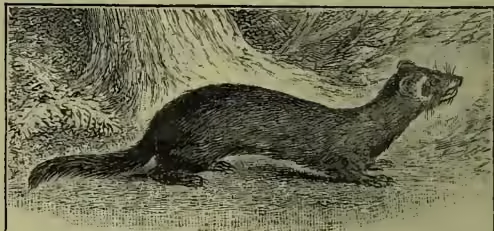
Polecat, or FITCHET (Mustela putorius, or Putorius fetidus), a quadruped of the Weasel family (Mustelidæ), and commonly referred to the same genus with the weasel, stoat or ermine, &c. It is the largest of the six British species of that genus, the length of the head and body being about 1½ foot, the length of the tail more than 5 inches, the form stouter than that of the weasel or of the ermine. Its colour is a deep blackish brown; the head, tail, and feet almost black, the under parts yellowish, the ears edged with white, and a whitish space round the muzzle. The hair is of two kinds—a short woolly fur, which is pale yellow, or somewhat tawny, and long shining hairs of a rich black or brownish-black colour, which are most numerous on the darkest parts. The nose is sharp, the ears short and round, the tail pretty equally covered with longish hair. There is a pouch or follicle under the tail, which exudes a yellowish, creamy substance of a very fetid odour; and this odour is particularly strong when the animal is irritated or alarmed. Hence, apparently, its name Foumart ('Foul Marten'), which, with various provincial modifications, as Fulimart, Thoumart, &c., is prevalent in most parts of Britain. The origin of the names Polecat and Fitchet is much more uncertain.
The polecat was much more common in Britain in former times than now, and is almost extirpated from some districts, through the constant war waged against it by gamekeepers and others; and yet it is very prolific, bearing five, six, or even seven young at one birth. It is extremely destructive in the poultry-yard, the abundance present there inviting it to drink blood and eat brains, which seem to be its favourite luxuries. The rabbit is followed by the polecat into its burrow, and its ravages among poultry are partly compensated by its destruction of rats. The taming of the polecat does not seem to have been attempted. The smell prevents it. The skin is imported from the north of Europe under the name of fitch, and is used as a kind of fur, similar but inferior to that of the Marten (q.v., and see FURS). To artists the hair of the fitch or fitchet is well known as that of which their best brushes are made; the hairs used for this purpose being the long hairs already noticed, which grow through the lighter-coloured fur of the animal. The Ferret (q.v.) is supposed by some to be a mere variety of the polecat. A dark-coloured kind of ferret is commonly regarded as a cross between the polecat and the ferret, and is sometimes called the polecat-ferret.