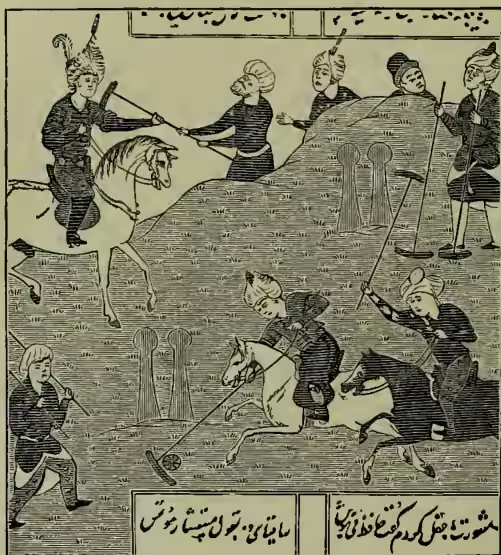
Polo, an equestrian game, which may be shortly described as hockey on horseback. It is of oriental origin and of high antiquity; indeed, it has been claimed that it can be traced back to 600 B.C. The accompanying illustration is from a beautifully illuminated Persian MS. of the poems of Háfiz, executed in the year 956 of the Hegira or 1549 of the Christian era, and now in the Bodleian Library, Oxford, by the permission of whose authorities it has been specially photographed to illustrate this article. It bears the following legend: 'Welcome to the meidán, thou chief of horsemen: strike the ball.' Polo was first played by Europeans in 1863 in Calcutta, whither it had been brought by officers who had been stationed in Cachar in Assam, where polo has been played since time immemorial by the hill-tribe of Manipuris. Almost the same game exists in Tibet; whilst native equestrian games more or less closely resembling polo are played in Japan and other parts of the East. Since 1871 many polo clubs have been started in Britain and, since 1876, in America, as well as wherever Britons are found in the East. The principal British club, which makes the rules of the game, is at Hurlingham, near London. The following is a short description of polo: An oblong space of turf is marked out, of which the proper size is 300 yards by 200 yards; at each end in the centre of the line two poles are fixed 22 feet apart, forming the goals through which it is the object of the opposing sides to strike the ball. The players are mounted on ponies, the size of which, according to rule, should not exceed 14 hands; and each player is armed with a polo-stick, consisting of a strong cane about 4 feet long with a cross head about 8 inches long, with which to strike the ball of light wood. The proper number of players is four a side, each of whom has a definite place (numbered one, two, three, and back) in relation to friends and opponents; and in polo, as in most games, combination is perhaps the first condition of success. The ponies have to be carefully trained, and some acquire wonderful cleverness in under- standing what is required of them. It is part of the game so to ride alongside an opponent as to prevent him from hitting the ball, but it is not allowed to ride across in front of an opponent. To become a good player requires strength, good horsemanship, a quick eye, and much practice.
See Captain G. F. Younghusband's Polo in India (1890), and the chapter on 'Polo' by J. Moray Brown in Riding (Bodminton Library, 1891).