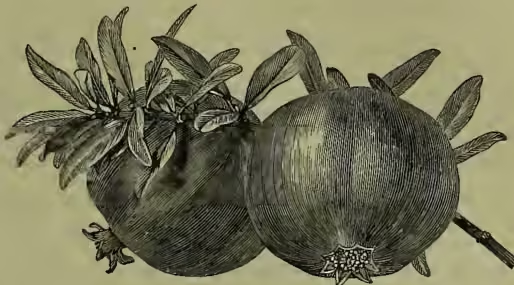
Pomegranate (Punica granatum), a fruit much cultivated in warm countries, and apparently a native of the warmer temperate parts of Asia, perhaps also of the north of Africa. It has been cultivated in Asia from the most ancient times, and is frequently mentioned in the Old Testament. It has long been naturalised in the south of Europe. In a wild state the plant is a thorny bush, in cultivation it is a low tree, with twiggy branches, flowers at the extremities of the branches, the calyx red, the petals scarlet. It is generally referred to the natural order Myrtaceæ. The calyx is leathery, tubular, 5- to 7-cleft; there are 5 to 7 crumpled petals; the fruit (technically called balausta) is as large as a medium-sized orange, having a thick leathery rind of a fine golden yellow, with a rosy tinge on the sunny side, not bursting when ripe; the cells filled with numerous seeds, each of which is surrounded with pulp, and separately enclosed in a thin membrane; the upper and lower series of carpels being differently attached. Thus the pomegranate appears to be formed of a great number of reddish berries packed together and compressed into irregular angular forms. The pulp is sweet, sometimes subacid, and of a pleasant delicate flavour, very cooling, and particularly grateful in warm climates. It is often used for the preparation of cooling drinks. A kind of pomegranate without seeds is cultivated and much prized in India and Persia. Pomegranates have long been imported in small quantities into Britain from Portugal and the north of Africa, but have never become an article of general demand and commercial importance like oranges. There is an ornamental variety of the pomegranate with double flowers. The rind of the fruit is very astringent, and a decoction is used as a gargle in relaxed sore throat, and as a medicine in diarrhoea, dysentery, &c. Deriving its astringency from tannin, it is used to tan leather. The finest Morocco leather is said to be tanned with it, and small quantities are imported into Britain from the north of Africa for the preparation of the finest kinds of leather, under the name of Pomegranate Bark. The bark of the roots is used as an anthelmintic, and is often successfully administered in cases of tapeworm. It contains a peculiar principle called punicin, having the appearance of an oleo-resin, an acrid taste, and affecting the nostrils like Veratria (q.v.). Its value was known to the ancients, and it has long been in use in India. The pomegranate tree is occasionally cultivated in hothouses or greenhouses in Britain. It bears the winters of the latitude of London in the open air, and is very ornamental, but the fruit is worthless. In some parts of the south of Europe it is used as a hedge-plant. In northern Mexico it grows to great perfection, and in some of the southern states of the American Union; even as far north as New York it will, if protected in winter, bear fruit, and in some seasons ripen it.