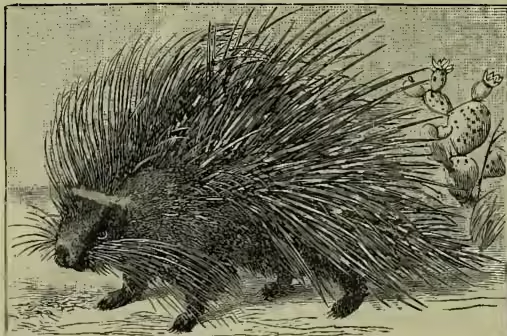
Porcupine, a name given to all the members of a family of Rodentia—the Hystricidæ. This family contains a number of well-defined genera, which include a good many species. The Common Porcupine (Hystrix cristata) is found in southern Europe, as well as in Asia and Africa, and is one of the largest of rodents; it has a heavy aspect and a grunting voice, whence the name Porcupine (from the French porc, 'a hog,' and épin, 'a spine'). The porcupines of the New World are sometimes included in a separate family; they comprise two well-marked forms—the Urson (Erethizon dorsatus) of North America and the Prehensile-tailed Tree Porcupines (Cercopites) of South America. The most marked peculiarity of the porcupine is of course the presence of the quills, which are simply thickened hairs; gradations between ordinary hairs and the thickest and longest spines exist to prove this statement. Occasionally the spines end in a peculiar cup-shaped extremity. The armature of spines is of the greatest value to the porcupine, though their use is entirely for defensive purposes. It is hardly necessary to deny the popular belief that the animal can shoot out its quills like so many arrows; the notion has arisen from the fact that when the animal erects its spines loose ones sometimes fall out. See ECHIDNA, GLOBE-FISH.