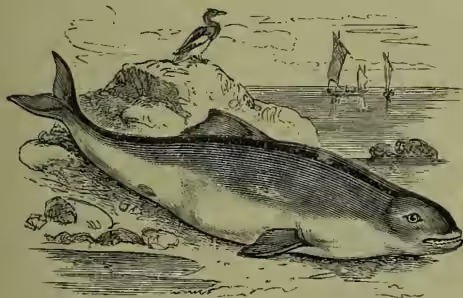
Porpoise (Phocæna), a genus of Cetacea in the family Delphinidae. The species are like dolphins, but have shorter snouts. The Common Porpoise (P. communis) is the most familiar Cetacean on the British coasts, especially to the west of Ireland and Scotland. It is found also on all the coasts of Europe from the Mediterranean northwards, on the coasts of North America, and in the Arctic regions. It is one of the smallest of the Cetacea, its average length not exceeding four feet, although individuals may measure six feet in length. The body is spindle-shaped, its greatest diameter being near the triangular dorsal fin. The skin is perfectly smooth, and destitute of hair. The upper surface is black with a bluish shimmer, but the under side is grayish white. There are from forty to fifty teeth in each jaw, not conical, as in most of the Cetacea, but compressed. The eye is small; the opening of the ear is very minute, like a hole made with a pin. The crescent-shaped blow-hole, with the horns of the crescent directed forwards, is situated exactly over the eyes.
The porpoise is gregarious, and large numbers are often seen together, sometimes swimming in file, when their backs, appearing above the surface of the water, suggest the idea of a great sea-serpent; sometimes gamboling in fine weather, or when a storm is approaching, or even in the midst of a storm. They feed on fish, which the teeth are admirably adapted to catch, and schools of porpoises pursue the vast shoals of herring, mackerel, &c. into bays and estuaries. They sometimes ascend rivers, apparently in pursuit of salmon, as far as the water is brackish, and are not unfrequently caught on such occasions. The skin, the oil, and the flesh are all useful. The skin is nearly an inch thick, but is planed down until it becomes translucent, and is made into excellent leather, which is used for covering carriages and for other purposes. But much 'porpoise' leather is obtained from the Beluga (q.v.), or white whale, whence come also the so-called 'porpoise laces.' Under the skin is a layer of fat, about an inch in depth, which yields oil of the finest quality. The flesh was in former times highly esteemed, and reckoned fit for the table of royalty, perhaps partly because among Roman Catholics it was accounted fish. In the time of Queen Elizabeth it was still used by the nobles of England, and was served up with bread-crumbs and vinegar. It is now used only in very northern regions. An entirely black Porpoise (P. melas) from Japan has no dorsal fin and only seventy-two teeth in all. The name porpoise is from the old French porpeis, from the Latin porcus, 'hog,' and piscis, 'fish,' corresponding therefore in meaning to the modern French marsouin, a corrupt form of the German meerschwein ('sea-hog').