Potato (Solanum tuberosum; see SOLANUM), one of the most important of cultivated plants, and in universal cultivation in the temperate parts of the globe. It is a perennial, having herbaceous stems, 1 to 3 feet high, without thorns or prickles; pinnate leaves with two or more pair of leaflets and an odd one, the leaflets entire at the margin; flowers about an inch or an inch and a half in breadth, the wheel-shaped corolla being white or purple, and more or less veined, followed by globular, purplish fruit, of the size of large gooseberries; the roots producing tubers. The herbaceous has a slightly narcotic smell, although cattle do not refuse to eat a little of it, and the tender tops are used in some countries like spinach. The tubers are, however, the only valuable part of the plant.
It was long customary to speak of the potato as a native of mountainous districts of tropical and subtropical America; but it has never been clearly determined where it is really indigenous, and where it has spread after being introduced by man. Humboldt doubted if it had ever been found truly wild; but subsequent travellers, of high scientific reputation, express themselves thoroughly satisfied on this point. It has been rendered certain that long before the Spaniards reached the New World the potato was cultivated by the Incas and other Andean nations. It seems to have been first brought to Europe by the Spaniards, from the neighbourhood of Quito, in the beginning of the 16th century, and to have spread from Spain into the Netherlands, Burgundy, and Italy, but only to be cultivated in a few gardens as a curiosity, and not for general use as an article of food. It is said to have been brought to England from Virginia by Sir John Hawkins in 1563; and, again, in 1586 by
Sir Francis Drake, to whom indeed a statue, as the introducer of the potato, was erected at Offenburg, in Baden, in 1853. Anyhow, it cannot have attracted much notice; and though Raleigh is believed to have planted potatoes both at his Devonshire birthplace Hayes, and on his Munster estates, it was a long time before they began to be extensively cultivated. It long received throughout almost all European countries the same name with the Batatas or Sweet Potato (q.v.), which is the plant or tuber meant by English writers down to the middle of the 17th century in their use of the name potato. Gerard, in his Herball, published in 1597, gives a figure of our potato under the name of Batata Virginiana; but so little were its merits appreciated that it is not even mentioned in the Complete Gardener of Loudon and Wise, published more than a century later, in 1719; whilst another writer of the same time says it is inferior to skirret and radish! It began, however, to be imagined that it might be used with advantage for feeding 'swine or other cattle,' and by-and-by that it might be useful for poor people, and for the prevention of famine on failures of the grain-crops. The Royal Society took up this idea, and in 1663 adopted measures for extending the cultivation of the potato, in order to the prevention of famines. To this the example of Ireland in some measure led, the potato having already come into cultivation there to an extent far greater than in any other European country, and with evident advantage to the people. From Ireland the cultivation of the potato was introduced into Lancashire about the end of the 17th century, soon became general there, and thence spread over England; so that before the middle of the 18th century it had become important as a field-crop, which it became in the south of Scotland some twenty or thirty years later, about the same time in Saxony and some other parts of Germany, but not until the later part of the century in some other parts of Germany and in France. In France the potato was long supposed to cause leprosy and fevers, and the extension of its culture was mainly due to the exertions of Parmentier (1778). In Prussia Frederick the Great took an interest in it, and promoted it by compulsory regulations.
The potato is of great importance as affording food both for human beings and for cattle; and next to the principal cereals is the most valuable of all plants for human food. It is also used for various purposes in the arts. No food-plant is more widely diffused; it is cultivated in subtropical countries, and struggles for existence in gardens even within the Arctic Circle, yielding small and watery tubers, although the effects of late spring frosts, or early autumnal frosts, upon its foliage often prove that it is a plant properly belonging to a climate milder than that of most parts of Britain. No more important event of its kind has ever taken place than the general introduction of potato culture into the husbandry of Britain and other European countries. It has exercised a beneficial influence on the general welfare of the people, and has increased the national wealth, notwithstanding the occasional occurrence of famine and distress (notably in the years 1846 and 1847) in Ireland and elsewhere from the failure of the crop. The results—due mainly to excessive and imprudent cultivation of the potato—confirmed two great laws, that plants long very extensively or almost exclusively cultivated in any district, however successfully they may be cultivated for a time, are sure to fail at last; and that the exclusive, or almost exclusive, dependence of a people on one source or means of support is unfavourable to their welfare in respect to all their interests.
Humboldt calculates that the same extent of ground which would produce thirty pounds of wheat would produce one thousand pounds of potatoes. But potatoes are not nearly so nutritious as wheat, and the constant employment of them as the chief article of food is not favourable to the development of the physical powers, and is consequently in its protracted influence unfavourable to mental energy. All this is too well illustrated in Ireland and the Highlands of Scotland, in a race capable of the highest development. It is calculated that 100 parts of good wheat-flour, or 107 parts of the grain, contain as much actual nutriment as 613 parts of potatoes. The inferiority of the potato in nutritious power is very much owing to the comparatively small quantity of nitrogenous substances which it contains, in consequence of which it is most advantageously used along with some very nitrogenous article of food, in Britain generally with animal food, in some parts of Europe with curds or with cheese. The potato tuber, in a fresh state, contains about 71 to 80 per cent. of water; 15 to 20 of starch, 3 to 7 of fibre or woody matter, 3 to 4 of gum, dextrine, and sugar, and 2 of albumen, gluten, and casein. There are considerable differences, however, in different varieties, in different stages of maturity, and in different soils and seasons.
Potatoes are used, both raw and boiled, for the feeding of cattle. For human food they are variously prepared by roasting or boiling, but now chiefly by boiling, a process by which they are freed from all that is narcotic and noxious in their juice. The water in which potatoes have been boiled is not wholesome.
The herbage or haulm of the potato has been used for making paper, but the results were not encouraging. Potato pulp produces a kind of celluloid or vegetable ivory, and from potato-leaves passable or even excellent cigarettes may be manufactured. The berries yield by distillation a tolerable spirit.
The varieties of the potato in cultivation are extremely numerous—500 were exhibited at the Westminster Tercentenary Exhibition (1886). Any enumeration or classification of them is impossible. New ones are continually appearing, and old ones passing away. Those most advantageously cultivated in particular soils and climates are often found to degenerate when removed to a small distance. Potatoes differ considerably in the character of their herbage—which is sometimes erect, sometimes straggling—and in the size and colour of their flowers, but are more generally distinguished by the size, form, and colour of their tubers, which are round, long, or kidney-shaped, white, red, dark purple, variegated, &c.
New varieties of potato are produced from seed; but potatoes are ordinarily propagated by planting the tubers, or cuttings of the tubers, each containing an eye or bud. Much has been written by gardeners and agriculturists on the comparative advantages of planting whole tubers or cuttings; but the latter method generally prevails.
Potatoes are planted in drills, made either by the spade or plough, or in lazy beds, which are always made by the spade, and are beds in which the sets of potatoes are covered over with earth dug out of the alleys. The alleys serve, although imperfectly, for drains in undrained land. The cultivation of potatoes as a field-crop seems to have been first attempted in lazy beds. They are still common in many parts of Ireland, but are now scarcely ever seen in England or Scotland. They are very suitable for strong, heavy, and somewhat moist land, and are profitably used in reducing some kinds of soil to cultivation, but are generally unsuitable for field-culture, owing to the expense of labour required. In strong, heavy land potatoes are cultivated in raised drills; in lighter and drier soils the raising of the drills is unnecessary. Manure is invariably given, consisting generally of farmyard dung and artificial manures. Common dressings consist of from fifteen to twenty-five tons of dung per acre, with from five to ten cwt. of artificial manure, such as guano, dissolved bones, superphosphate, a little potash, and perhaps nitrate of soda or salts of ammonia instead of guano. The cultivation of potatoes, after they are planted, whether in the field or garden, consists chiefly in keeping the ground clear of weeds, and in earthing up the plants, to promote the formation of tubers. Potatoes are taken up by the fork, by turning over the drills with the plough, or by an implement specially designed for the purpose, known as a potato-raiser. Where the crop is grown extensively this implement is now almost universally used, and performs its work expeditiously and thoroughly. Garden potatoes are generally used long before they are really ripe, forming a favourite dish in a very unripe state, when they are far from being a safe article of food, and contribute not a little to the prevalence of cholera and kindred diseases in summer. In recent years the growing of early potatoes for use in the large towns has been prosecuted to a large extent and with much success on the coast of Ayrshire and other similar parts favoured with a genial climate. To facilitate this the seed is forced in small boxes in which it is placed over winter, and from which it is taken in spring when the shoots are 2 to 4 inches long and planted in well-manured drills. Potatoes from seed thus prepared may be dug about three weeks earlier than if the seed had not been sprouted. The main field-crop is allowed to ripen thoroughly, and is capable of being stored for winter and spring use. The planting of potatoes in the open air cannot be successfully practised in most parts of Britain before February or March, and in many seasons the later-planted are found as early as the earlier-planted, and more productive. The storing of potatoes is variously accomplished in dry lofts or sheds, in airy cellars or barns, and in pits, which are sometimes holes excavated to a small depth in the earth, with the potatoes piled up above the surface of the ground, in a conical, or in a roof-like form, sometimes mere heaps of one or other of these forms upon the surface of the ground, and covered with straw and earth to keep out light and frost. Potato-pits should always be well ventilated by means of pipes or otherwise, as without ventilation the potatoes are apt to heat and sprout. Potatoes taken from the ground before they are quite ripe are extremely apt to heat and sprout.
The potato crop is now an important one in almost all the rotations practised in Britain, although its cultivation is in most districts not quite so extensive as before its failure from the potato disease in 1845 and subsequent years, and farmers are more careful not to depend too much upon it. It very commonly succeeds a grain-crop, but sometimes is advantageously planted on land newly broken up from grass.
But, besides its value as a culinary vegetable, the potato is important in other respects. Its starch is very easily separated, and is in large proportions; hence it is cheaper than any other kind. It is manufactured on a very large scale. It is chiefly used in textile manufactures under the name of farina, which is converted into dextrine or British gum (see STARCH). In Holland and in Russia, where there is much difficulty in keeping potatoes through the winter, and there is consequently a necessity for using the crop quickly, large quantities of starch are made, and this is converted into sugar or syrup (see SUGAR). The refuse of the starch-manufactures is all utilised; it is pressed out from the water, and used either for pig-feeding or for manure. In the north of Europe much spirit for drinking is made from potatoes; it is called Potato-brandy.
The potato is subject to several diseases, the chief of which is that serious fungous affection now commonly known as the potato disease. This disease was first observed in Germany; the earliest known outbreak of a grave character occurred at Liège in 1842. It broke out in Canada in 1844, and at once proved very destructive. In the following year it made its appearance in the British Isles, having been first observed in the Isle of Wight. Its ravages in Ireland in 1846 and 1847 brought a terrible famine upon the small farmers of that country, and at frequent intervals since it has caused great loss in the potato crop.
It has been proved beyond doubt that a particular fungus always accompanies this peculiar and destructive disease. The point is still doubted by some, but it is now very generally believed that this fungus is the main cause of the disease. This mysterious fungus, Phytophthora infestans, runs through a strange life-cycle every year, and is by no means easily kept at bay. It is believed that, except in temperatures below 40° and above 77° F., it is always present, ready to pounce upon a weak potato-plant, and liable to develop into an epidemic should the climatic conditions be favourable to fungus-life. These conditions are damp, dull, calm weather, and a moist or wet soil, enveloped in mists morning and evening. The fact that the fungus is unable to bear a temperature above 77° or below 40° is of practical importance. The tomato is also subject to the attacks of the Phytophthora, but the ravages of the fungus may be stopped by raising the temperature of the tomato-house to over 77° F. On the potato crop the fungus generally makes its appearance about the third week in July, almost invariably beginning its attack in the leaves of the potato-plant. There it is first seen in a delicate white bloom, accompanied by dark blotches, caused by the spawn of the fungus having pierced the leaf and set up putrefaction. With favourable climatic conditions it will now develop with great rapidity—a single germ multiplying ten thousand times in a few days in a temperature from 60° to 68° F. The fungus ramifies throughout the leaves, blasting them as it proceeds, and causing an offensive odour which is now unfortunately familiar to the farmer. The spores of the fungus are so light and fine that they float through moist air, and are carried about and spread from one patch of potatoes to another by insects and birds. From the leaves the germs spread to the leaf-stalks, the stems, and the tubers. The spawn readily pierces the skin of the tuber, consuming or rotting the cells, and corroding the starch, and ultimately reducing the potato to a black mass of rottenness. In this last stage of its yearly course of destruction the fungus provides means of continuing its curious life. It produces some kind of 'resting-spores,' which, possessed of amazing vitality, lie dormant during winter and spring, and carry on the disease to the crop of the succeeding year, which in its turn passes the fungus through another round of its mysterious life, to be handed on again from crop to crop as before. There is still uncertainty as to the precise character of these spores; but, be what they may, their tenacity of life is great.
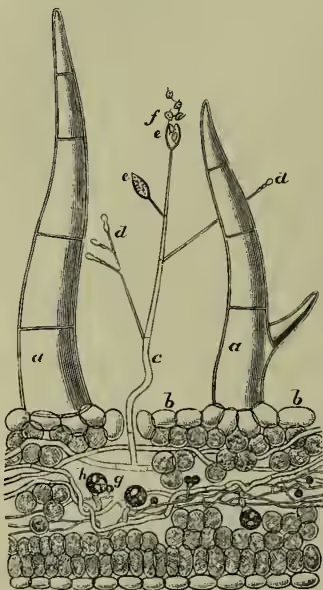
Of the many remedial measures that have been tried, the following have been found most useful in preventing or mitigating the onslaught of the fungus: (1) Earthing up the drills with a deep covering of earth, with the view of preventing the fungus from passing down the stem, or through the soil to the tubers; (2) cutting off the diseased potato-tops before the fungus reaches the tubers; (3) removing and burning all dead and decaying potato stems, leaves, and tubers, especially after a crop which has been attacked by the disease; (4) planting varieties which have been known to be exceptionally successful in resisting the disease; (5) growing the potato crop under such general cultural, sanitary, and manurial conditions as will ensure to the fullest extent possible the healthy and vigorous development of the crop; (6) careful selecting and storing of potatoes to be used as seed; and (7) dressing the potato-tops, both before and after the appearance of the disease, with sulphate of copper. No certain prevention or absolute remedy has as yet been discovered, but all these measures have been carried out with advantage. The discovery of the copper remedy is likely to be of great importance to potato growers. This is the mixture—about 3 to 6 parts of sulphate of copper and quicklime to 100 parts of water—which proved so effectual in combating the allied parasite fungus, Peronospora infestans, that attacks the vines, and there is good reason to believe that it will be almost equally successful in averting the potato disease. It is well known that a vigorous variety of potatoes grown under conditions favourable to its healthy development is most successful in resisting the fungus. It is with the potato as with a human being—deprive it of wholesome food and healthy sanitary surroundings, and disease will speedily ensue. The prevalence of this particular disease in recent years is a sure indication of a deterioration in the constitutional vigour of the cultivated potato. The other diseases from which the potato crop is liable to suffer are Curl, Scab, Dry Rot, Wet Rot, and a fungus known as Peziza postumum. Curl is a disease affecting the foliage and general health of the potato-plant, and does not seem to be necessarily connected with the presence of any vegetable parasite or insect enemy.—Scab is a disease of the tubers, which become covered with brown, oblong, and finally confluent and cup-shaped spots, whilst under the surface is a powdering of minute olive-yellow grains, a fungus called Tubercinia scabies, of the division Hyphomycetes.—Dry Rot is also ascribed to the growth of a fungus of the same order, Fusiporum solani, and attacks the tubers either when stored for winter or after being planted. It was first observed in Germany in 1830, and caused great loss in that country throughout many years. The tissues of the potato-tuber become hardened and completely filled with the mycelium. of the fungus, which at last bursts forth in little cushion-shaped tufts loaded with fructification.—Wet Rot differs from dry rot in the tubers becoming soft and rotten instead of hard and dry, and is always characterised by the presence of a fungus referred by Fries to his genus Periola, but which Berkeley regards as another form or stage of the same fungus which causes or is inseparably connected with dry rot. Both dry rot and wet rot have often been observed along with the potato disease, which, however, is always characterised by the presence of another peculiar fungus.—Peziza postuma has occasioned heavy losses, chiefly in Ireland, by destroying the leaves before the crop has matured. See books on potato-culture by Pink (1879), Cox (1880), Fremlin (1883), and Ward (1891), and on the potato-blight by Bravender (1880).