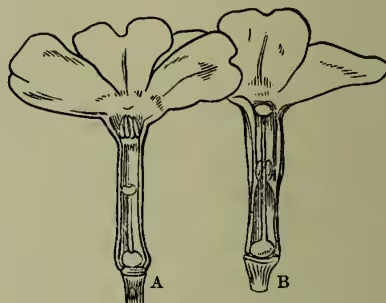
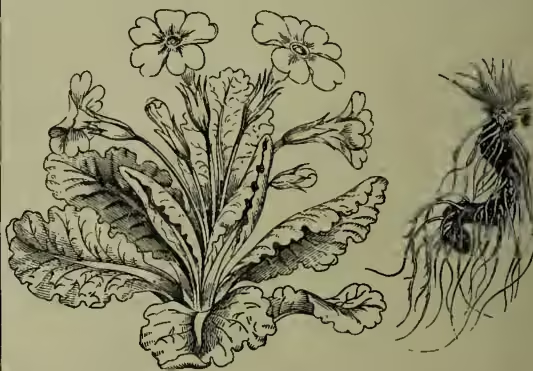
Primrose (Primula), a genus of plants of the natural order Primulaceæ, having a bell-shaped or tubular five-toothed calyx, a salver-shaped corolla with five segments, five stamens, a globose germin containing many ovules, and a many-seeded capsule opening by five valves, and generally with ten teeth at the apex. The dimorphism of the stamens and pistil of primrose, illustrated in the accompanying figure, is not uncommon in other species of the genus, and has given rise to the terms thrum-eyed (A) and pin-eyed (B) in the language of florists in describing varieties of the Auricula and Polyanthus. The distinction is of some practical importance in so far as fertilisation of the individual flowers is affected by the relative positions of the respective organs. The species are all herbaceous perennials, generally having only radical leaves; and the flowers in a simple umbel, more rarely with scapes bearing solitary flowers. Almost all of them are natives of Europe and the north of Asia. Some of them are among the finest ornaments of our groves and meadows; some are found in mountainous regions. Their fine colours and soft delicate beauty have led to the cultivation of some of them as garden flowers, probably from the very beginning of floriculture. The name Primrose (Fr. Primevère, Lat. Primula) is derived from the Latin primus, 'first,' and refers to the early appearance of the flowers of some of the most common species in spring. The Common Primrose (P. vulgaris), abundant in woods, hedgebanks, and pastures in Britain and in most parts of Europe, has obovate-oblong, wrinkled leaves, and single-flowered scapes; the flowers about an inch broad, yellowish white. This is the plant to which the English name primrose specially belongs. Akin to it is the Cowslip (q.v.), or Paigle (P. veris), and perhaps still more nearly related is the Oxlip (P. elatior), apparently wild in some parts of England, particularly in the eastern counties, but supposed by some botanists to be intermediate between the common primrose and the cowslip, which they therefore regard as extreme forms of one species. The Polyanthus (q.v.) is a cultivated variety of the cowslip. The Auricula (q.v.; P. auricula), an Alpine species, is a favourite garden flower. The Bird's-eye Primrose (P. farinosa) and the Scottish Primrose (P. scotica) are both flowers of exquisite beauty, found in the northern parts of Britain, the latter chiefly on the coasts of Sutherland, Caithness, and the Orkney Islands. The Alps and the Himalaya Mountains produce several species. The Chinese Primrose (P. sinensis) has for more than fifty years been very common in Britain, not only as a greenhouse but a window plant. It produces compound umbels of very numerous lilac, red, or white flowers, which are displayed in autumn, winter, and spring. Two varieties occur in the eastern states of the American Union—the Bird's-eye Primrose (P. farinosa) and P. mistassinica, both rare—and several varieties in the western states, the most conspicuous being P. parryi, with large purple flowers, which grows on the Rocky Mountains.