Printing is the art of taking, by pressure, prints or copies in reverse of an original design of a suitable character, coated with a pigment or ink. The word has a very wide application, and is used, for instance, in connection with such different processes as photographic 'printing,' in which no pressure is required, and calico-printing. A definition based upon pressure alone would bring within the category of 'prints' such operations as moulding, stamping, and embossing. The word has, however, acquired conventional limitations of meaning, and is now applied usually to the three methods of copperplate printing (see ENGRAVING), Lithography (q.v.), and letterpress printing. The first two being already described, the present article will be confined to a description of the latter.
There is no doubt the Chinese practised printing in some senses of the word many centuries before it was known in Europe, as has been noticed at CHINA, Vol. III. p. 196. The method commonly used down to the present time is one originally adopted by Foong Taou in the 10th century. A piece of pear-tree wood is cut up into boards of about half an inch thick, and these into blocks large enough for two pages of the book to be printed. The blocks are planed, squared, and sized or varnished. The design to be engraved is drawn or written on thin transparent paper, and transferred to the surface of the block by rubbing. The engraver next cuts away the field, leaving the transferred letters in high relief. Labour being cheap, a block of this kind can be cut at about the same expense as it could be set up in movable metal types, and it needs no proof-reading or correction. For printing no press is used, the block being adjusted on a table, before which the printer stands, having a bowl of fluid ink on one side and a pile of paper on the other. In his right hand he has two flat-faced brushes, fixed on the opposite ends of the same handle. One brush is dipped into the ink and swept over the face of the block, on which a sheet of paper is placed; the back of the paper is then swept lightly but firmly with the dry brush at the other end of the handle. This is all that is needed to fasten the ink on the paper—which is soft, thin, pliable, and a quick absorbent of fluid ink. Printing from movable types was, according to Professor Douglas, probably practised in China as early as the 12th or 13th century, as there are Korean books printed from movable clay or wooden types in 1317. But the Chinese still prefer block-printing; and printing from metal types in China is mainly practised for circulating the Bible and for newspapers, according to methods invented by Europeans. About 6000 Chinese characters suffice for a missionary printing-office; but for magazine work about 10,000 are necessary. For the baseless tradition that Marco Polo brought the knowledge of block-printing thence, see POLO.
The art of printing by the use of movable types was invented in Europe about the middle of the 15th century; but no more definite statement concerning its origin can be made with confidence. The name of the country in which the invention took place, the name of the inventor, the year of the invention are, up to the present time, matters of dispute. Modern researches have completely disposed of as a mere legend the widespread belief that the invention of movable metal types, cast in a mould from a matrix—the essential principle of typography—was preceded by or was the outcome of the use of wooden types, which it was formerly thought formed the link between the block-books common in the early part of the 15th century (see WOOD-ENGRAVING) and the earliest letterpress prints. Equally baseless is the belief that the first metal types were cut instead of being cast. The evidence on these two points is too minute and technical to be adduced here.
The controversy as to the invention of printing has lasted nearly four centuries, and it has unhappily been carried on with a vehemence and bitterness which perhaps no other controversy, not a religious one, has ever excited. Up to 1499 it was universally believed that typography was invented at Strasburg by Gutenberg (q.v.), who afterwards set up a press at Mainz, from which emanated the magnificent Latin Bible, for many years called the Mazarin Bible, owing to a copy having been discovered by De Bure in Cardinal Mazarin's library at Paris. Gutenberg's name does not appear in a single production of his press, and none of his associates mention his name as the inventor of printing. In 1499 there was published at Cologne the Cronica van der hilliger Stat van Coellen, since known as the Cologne Chronicle, in which one chapter is devoted to the origin of printing. The chronicler declares that the art was discovered first of all in Germany, at Mainz on the Rhine; that it took place about 1440, but that, although it was discovered at Mainz, the first 'prefiguration' was in Holland, in the form of the Donatuses which were printed before that time; that the circumstances of the origin had been communicated to the chronicler by Ulric Zell, a contemporary printer at Cologne. To these statements may be attributed the commencement of the controversy ever since carried on. In 1588 Adriaen de Jonghe ('Hadrianus Junius'), in his Batavia, printed in the Plantin office at Antwerp, gave the first circumstantial account of the alleged Dutch invention, which, he said, he had heard from old and trustworthy people. This was, it will be noticed, about a century and a half after the invention. Junius stated that in 1440 'Lourens Janszoon,' surnamed Coster (q.v.), lived at Haarlem; that he one day took a walk in the Hout, and cut letters on the bark of a beech-tree; that he printed these letters on paper for the amusement of children; that he invented a suitable printing-ink, and afterwards began to print whole sheets, with pictures; subsequently he used leaden letters, and then tin ones. Among his workmen was one Johannes—the surname was not given by Junius—who in 1441 stole the types and fled to Mainz, where he opened a workshop, and in 1442 published, with Coster's types, the Doctrinale of A. Gallus and the Tractatus of P. Hispanus. From this date, as already stated, the question whether printing was 'invented' in Holland or in Germany has been fiercely debated, and scores of books have been written upon it. The titles of these are given in Bigmore and Wyman's Bibliography of Printing (3 vols. Lond. 1880-86). The controversy was renewed with much vigour, and unfortunately with much acrimony, in 1870; and it has since been maintained, the balance of evidence, or rather of probability—for of evidence there is an extraordinary lack—oscillating from time to time to one side and then to the other. In 1870 the 'Costerians' included nearly all the leading bibliographers and typographical historians. An eminent Dutch investigator, Dr van der Linde, published a series of articles, since translated into English (Lond. 1871) under the title of The Coster Legend. The purport of the book was that the documents brought forward to support the claims of Coster were false, and that the arguments in his favour were devoid of any historical or bibliographical support. Van der Linde showed further that several of the documents on which the Costerians relied were actually frauds and forgeries. This exposure for a time completely routed the supporters of the Dutch claims. In 1878 the same author produced a companion volume, Gutenberg—Geschichte und Erdichtung aus den Quellen nachgewiesen, but there was little new in it. Mr Hessels of Cambridge, a native of Haarlem, next took up the subject on original lines, and issued the work Gutenberg: Was he the Inventor of Printing? (Lond. 1882). He maintained that Van der Linde was untrustworthy, and that his book presented a more complete chaos of error on the subject than its predecessors. Mr Hessels spent several years in examining in Germany all the documents extant connected with the history of Gutenberg, and exposed a number of falsifications and forgeries which had passed current. Space will not here suffice to recapitulate his discoveries; his book is indispensable to any one desiring an accurate knowledge of the subject. The result of his researches was more negative than positive. He said that he had not found anything which enabled him to answer in the affirmative or in the negative the question, Was Gutenberg the inventor of printing? Of the three principal documents relied upon by his supporters one is lost entirely, and the other two are only transcripts. Even if we accept these transcripts, he says, they point to Gutenberg only as a printer, but not as the inventor of printing. In 1886 Dr van der Linde wrote from the German side another book, Geschichte der Erfindung der Buchdruckerkunst. It was produced in magnificent style at the cost of the German government, but it added to our knowledge of the contention nothing of importance. Mr Hessels has since continued his investigations, and the result is indicated in the title of his book, issued in 1887, Haarlem the Birthplace of Printing, not Mainz. This important work virtually takes us back to 1499, when the Cologne Chronicle declared that the first idea of printing was found in Holland. The case now stands thus: very crude and clumsy specimens of printing—some of which have been quite recently discovered—are generally allowed to be 'Costeriana.' On the other hand, there is the magnificent Bible and Psalter undeniably printed by Gutenberg and his associates. It is difficult to believe that the masterpiece preceded the rude essays. It is more reasonable to conclude that, anterior to Gutenberg's press, there was a rude school of typography in existence. Important discoveries may at any time take place. The contents of many old continental libraries have even up to the present not been adequately examined. Possibly within some ancient bindings there exist at the present moment prints that would settle for all futurity the controversy which has raged for four centuries as to the 'origines typographici.'
It has been mentioned at GUTENBERG that after Fust had obtained possession by action at law of Gutenberg's office, and while he was carrying it on as a printing concern, Gutenberg, by the assistance of another capitalist, set up a second office. With two rival establishments in existence, it was impossible to keep secret the processes of printing. In 1462 the city of Mainz was sacked, and the catastrophe dissolved engagements between employers and employed, and caused many of the latter to migrate to other countries, taking with them, of course, their knowledge of the art. Printing spread with marvellous rapidity, considering the means of transport and of communication then in existence. For instance, before 1500 there were 16 master printers at Strasburg, 22 at Cologne, 17 at Nuremberg, 20 at Augsburg. By the end of the 15th century the business was carried on in about 60 places in central and northern Europe, 21 in the Netherlands, 32 in Italy, 31 in France, 22 in Spain and Portugal
(Henry Cotton's Typographical Gazetteer, 3d ed. Oxford, 1852-66).
Printing was brought to England in 1476 or 1477 by William Caxton (q.v.), who set up his office within the 'precincts' of Westminster Abbey—but not within the sacred building itself, as often erroneously stated. See William Blades's Biography and Typography of William Caxton (2d ed. Lond. 1882). The first hundred years of the history of printing in England was a period of great activity. In 1478 printing was done at Oxford by Theo. Rood; in 1480 at St Albans by an unidentified printer now called 'the School-master;' in the same year in the city of London by Lettou; in 1521 at Cambridge by Siberch. When the art had spread throughout the country, when education became more common, and men began to read about the questions and events of the day, it began to be seen by the authorities and rulers that a mighty power for good or evil had arisen in the land. Then it was deemed necessary to regulate the press. In 1530 censorship was established in England. It ushered in a period of lamentable decadence in the quality and quantity of the printing done. Printers were cruelly punished, especially during the existence of the unconstitutional Star-chamber (q.v.). Oppressed, abused, and often imprisoned, printers lost all enterprise and all social position. For many years there were no good printers at all. Censorship was abandoned in 1694. Then began a period of revival, greatly aided by the improvements in type-founding in the middle of the 18th century, and the prevalence of the 'Bibliomania' towards its close. The 19th century has been one of marvelous development, following the invention in 1814 of the steam printing-press.
It is believed that printing was introduced into Scotland in 1507. A patent has been discovered, of King James IV., which shows that a printing-press was established at Edinburgh during the year named. This patent was granted to two burgesses of the city of Edinburgh—Walter Chepman, a capitalist and speculator, and Andrew Myllar, a bookseller who had learned in France the art of printing. The 'prent and expert men' to use the press came from France. The office was in the Southgait, now the Cowgate. As early as 1508 several small publications were issued. After these came the great work for which the press was ostensibly established—the 'Aberdeen Breviary,' in two volumes, forming 1554 pages of small type. It was intended to become the standard Scottish service-book. Myllar was probably dead when it was completed, and with its publication Chepman's connection with typography came to an end. For many years subsequently all works of Scottish authors were printed in France. The next printer was Thomas Davidson, a practical man who in 1541 was chosen to print acts of the parliament of James V., which placed him in the position of king's printer. It is not necessary to catalogue the names or the works of his immediate successors. Up to 1600 the average workmanship of the Scottish printers was about as bad in quality as that of their later successors has been distinguished for its beauty, excellence, and accuracy. This is not the only noteworthy feature of early Scottish typography. The printers were astonishingly few in number; during 150 years after the introduction of the art there were only about a dozen master printers who were natives. During the first hundred years only twenty-five different works are known to have been printed in Scotland. See R. Dickson and J. P. Edmond, Annals of Scottish Printing from the Introduction of the Art to the Beginning of the 17th Century (4to, Cambridge, 1890)—a most exhaustive and trustworthy book.
The first printing-press set up in America was introduced by the viceroy of Mexico, Antonio de Mendoza, and the first book printed by it in the New World was La Escala de S. Juan Clímaco (1536). The earliest press in the British-American colonies was brought over for Harvard College in 1638. The Bay Psalm Book (1640) was its first important work (see ELIOT, JOHN); but in 1639 it printed the Frceman's Oath and an almanac. The first press in Philadelphia was set up in 1685, in New York in 1693. See I. Thomas, History of Printing in America (2d ed. Albany, 1874).
The practical art of letterpress printing consists essentially in coating certain relief surfaces with printing-ink, and then transferring that ink to the fabric, such as paper. The relief surface may be a forme of movable types or an engraved design cut in wood or metal, or a block cast or electrotyped from the type or the engraving; and the impressing is effected by the press or machine presently to be described.
Types are cut, cast, or otherwise formed from various materials, though the printer recognises only two kinds—wooden ones, which are cut to form the larger letters used in placards, and metal ones. All books and newspapers and the great bulk of jobbing work are done from the last named (see TYPE).
A complete assortment of type of any one particular style is called a 'fount,' and may vary in amount to any extent, according as it may be required in large or small quantities. The individual type is a piece of metal about 1 inch long with a letter, point, comma, or other printing device cut in relief on one end as shown in fig. 1. The notch shown on one side is to enable the compositor to place it right side up when 'setting' without the trouble of looking at the letter. The different founts are arranged in one or more pairs of 'cases,' a 'lower' and 'upper' case, the former holding the small letters (technically called 'lower case' letters in consequence), figures, commas and points, spaces to put between the words, 'quads,' &c. The upper case holds the capitals, small capitals, and the less often used 'sorts.'

The cases, wooden trays divided into 'boxes' by
Upper Case.
| A | B | C | D | E | F | G | P | Q | R | S | T | V | W |
| H | I | K | L | M | N | O | X | Y | Z | J | U | Æ | Œ |
| A | B | C | D | E | F | G | § | † | |||||
| H | I | K | L | M | N | O | || | ‡ | |||||
| P | Q | R | S | T | V | W | ¶ | * | |||||
| X | Y | Z | J | U | æ | œ | Æ | Œ | ] ! | ||||
| ff | & | fl | ffl | £ | HS | SP | — | : | § | ? |
| ' | k | g | 1 | 2 | 3 | 4 | 5 | 6 | 7 | 8 | ||
| z | e | i | s | f | w | 9 | 0 | |||||
| j | b | c | d | ; ) | ||||||||
| y | l | m | n | h | o | p | , | fi | N | M | ||
| fi | 5M | Q* | Q* | |||||||||
| q | v | u | t | 3 M | a | r | fi | 5M | Q* | Q* | ||
| x | SPACES | SP* | SP* | QUAD* |
Lower Case.
Fig. 2.—Cases.
thin slips of wood, are shown diagrammatically in fig. 2. The lower case is arranged not alphabetically, but so that the letters most used will be nearest the compositor's hand and have the largest compartments, an ingenious arrangement for saving labour. The arrangement of the lower case varies slightly in different places, but the principle is the same in all. The proportion of the different letters of the English language in a fount of types is rather curious, and is shown in the following table :
| a..... 8,500 | h..... 6,400 | o..... 8,000 | u..... 3,400 |
| b..... 1,600 | i..... 8,000 | p..... 1,700 | v..... 1,200 |
| c..... 3,000 | j..... 400 | q..... 500 | w..... 2,000 |
| d..... 4,400 | k..... 800 | r..... 6,200 | x..... 400 |
| e..... 12,000 | l..... 4,000 | s..... 8,000 | y..... 2,000 |
| f..... 2,500 | m..... 3,000 | t..... 9,000 | z..... 200 |
| g..... 1,700 | n..... 8,000 |
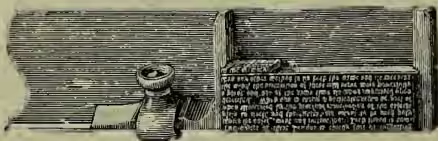
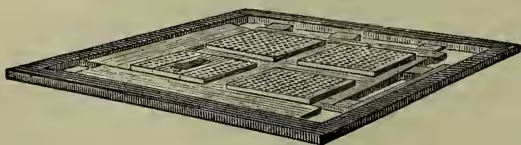
Provided with a metal instrument called a setting-'stick,' shown half-filled with type in fig. 3, and with his 'copy' before him, the compositor picks up the necessary letters, &c. one by one, arranging them in lines in the stick, which may be regulated to any width of line; each line is carefully spaced out to fit accurately into the stick before proceeding to the next, any italics or other sorts required being got from other cases. When the stick is full the matter is carefully lifted with the fingers, aided by the setting-rule, a piece of brass rule used in setting the lines, and shown in fig. 3, and put into a galley—a brass tray with wooden sides, about 18 or 20 inches long as used in setting such a book as the present work. This galley when filled contains about a page of matter in one long column, which is kept together by wedges driven in against the sides. A proof is taken at a hand-press, and this is read by a trained reader to correct any errors which the compositor may have made. These corrections are marked on the margin of the proof, and most of the signs and marks used are shown in the specimen given in the article PROOFS. When the printer's errors have been corrected by the compositor a 'clean' proof is taken for the author, and when his alterations are given effect to, the type is ready to be made into pages. If a short number of the book is required, say only a few hundreds, it is usually printed direct from the type; but where large numbers are required, or future editions expected, it is generally either Stereotyped (q. v.) or Electrotyped (see ELECTRO-METALLURGY), in either of which cases the type is not used for actual printing. In any case the type is taken from the galleys and arranged in pages, and the skill displayed by compositors in handling them without allowing any to drop out is very wonderful. The pages are 'locked' up by means of wedges in iron frames called 'chases' (Fr. châsse, 'a frame'), one of which with four pages is shown in fig. 4. Books are generally printed in sheets of sixteen pages, or multiples of sixteen (32, 64, or 128); in the latter case, however, they are cut into sheets of sixteen after being printed. In making up the pages to print a sixteen-page sheet, two formes, as the chases containing the type are called, are required, one for each side of the sheet. If a printed sheet of sixteen pages be opened out, the pages will be seen to be arranged in the following order :
Inside of Sheet.
| L | OI | II | 9 |
| 2 | 15 | 14 | 3 |
Outside of Sheet.
| 9 | ZI | 6 | 8 |
| 4 | 13 | 16 | 1 |
And the pages in the chase must be so arranged, or 'imposed' as it is called, that, when printed, they will so appear. When ready for printing or stereotyping, as the case may be, another proof is read for final correction. In some cases where great accuracy is required, such as in the present work, as many as six or eight proofs are 'read' at different stages.
When the types have been printed or electrotyped and returned to the caseroom they are distributed by the compositors into the cases again for further use; and this can be done with wonderful rapidity, though great care must be used to avoid putting the letters into the wrong boxes. Several very ingenious machines have been invented for setting type which have been more or less successful. They are worked something after the manner of Typewriters (q. v.), and are described in the article TYPE-SETTING MACHINES. Several of the latest of these cast and set the type by one movement. This saves the labour of re-distributing the types, as when done with they are melted again. These machines are used for newspaper work.
In most printing-offices the men govern themselves by a voluntary association called a 'chapel,' which, although often (but not necessarily) connected with the printers' society, is independent so far as the individual affairs of the office are concerned. The office-bearers are called the 'father' and 'clerk' to the chapel, and it has elaborate sets of rules for regulating trade and personal affairs within the office.
Letterpress printing surfaces are coated with ink (see INK) by means of 'composition rollers.' These consist of cylinders of small diameter covered with composition made according to various recipes. Amongst them are glue, treacle, and Paris white; glue, sugar, and glycerine; glue, glycerine, sugar, and india-rubber, &c. These are melted, mixed together, and cast in cylindrical moulds of various diameters, according to the requirements of the machine or press. The glue and treacle composition was first used for printing by the engineers Donkin and Bacon in 1813; up to this time the types having been inked by pelt balls. The present system of inking on machines was invented by Mr Edward Cowper in 1818. Leather and other substances were tried at first, and the machines in which they were used were discarded owing to the unsatisfactoriness of their rolling or inking arrangements. A good roller must be tenacious of ink, semi-elastic, and retain its suction. It must not shrink, become hard in cold weather or soft in hot weather. The recipe for making it is varied according to the machine for which it is required—whether working on fine surfaces such as engravings, or at a high speed, as for newspaper work.
The earliest known representation of a printing-press is dated 1507, and it pictures an apparatus which is little more than a modification of the ancient wine-press. The essential feature is a flat board, since known as a platen, which is movable vertically, and presses on a forme of type laid on an unresisting hard surface parallel to it. The two, between which was the paper, were brought together by a powerful screw, and thus the paper was squeezed down on the forme. This rudimentary appliance was improved from time to time, as is shown in various pictures of printing-office interiors. The wooden printing-press was brought to its ultimate degree of perfection in the later part of the 17th century. Moxon, the first technical writer on printing, described in 1683 what he called 'a newly invented press.' This was the old wooden press as improved by Blacu of Amsterdam (fig. 5).
This press continued to be generally used until the close of the 18th century. About 1800 Charles Mahon, third Earl Stanhope, was instrumental in producing a much improved printing apparatus.
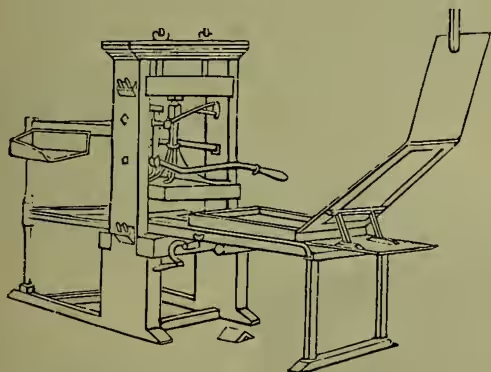
The press which bears his name was made entirely of iron, and the strength thus obtained enabled a forme to be printed on it double the size of that which could be done on a wooden press. There was a most ingenious system of links and levers, by means of which the approach to the type of the platen, and its withdrawal, were accelerated. The greatest leverage and consequently the greatest pressure were obtained when the forme and platen came into contact. These arrangements enabled the pressmen to print at the rate of 200 per hour on one side of the sheet or 100 per hour on both sides. After this several inventors turned their attention to the improvement of the hand-press. Clymer, an American, in his Columbian press, discarded the screw, the central feature of previous presses, and gained his power from a combination of powerful levers. About 1823 an excellent press, called the Albion, was brought out by Mr R. W. Cope of London, in which the pressure was gained by forcing an inclined bar of steel from a diagonal to a vertical position, forcing down the platen, the impression taking place when the piece of steel was brought into the vertical position. The Columbian and the Albion presses enabled the printer to print on one side of the paper at the rate of 250 sheets per hour. Such presses are now, except for peculiar kinds of work or when very few impressions of a forme are required, quite obsolete, being superseded by 'machines' on which the various operations of press-work are done more or less automatically.
The earliest inventors of 'printing' machines coupled together the two arts of printing on paper and on calico and other textile fabrics. Adkin and Walker in 1772 patented a machine which was the type of a modern rotary letterpress machine. It was 'for stamping and printing' on paper, cotton, and other cloths, 'whereby the printing on such materials would be greatly facilitated and rendered much less expensive, and more perfect and exact.' The words fully and clearly indicate the advantages of rotary over flat platen printing. Amongst other suggestions of a cognate nature made about this time the most remarkable was that of William Nicholson of London, the editor of a scientific journal. In 1790 he took out a patent which foreshadowed nearly every fundamental improvement even in the most advanced machines of the present day. He contemplated an apparatus in which formes or plates were to be fastened to the surface of a cylinder; the inking to be supplied by a roller and distributed by smaller rollers; the impression to be cylindrical, the paper being caused to pass between the printing cylinder and one covered with cloth or leather. Nicholson never actually constructed a machine, and although his patent was a marvellous forecast of the methods soon to be adopted in letterpress printing, he cannot be awarded the honour of being the inventor of the printing-machine.
Hitherto the evolution of the type-printing machine from the calico-printing machine has been completely overlooked by historians of printing, yet the connection is almost obvious. Nicholson's apparatus belonged to the same category. The distinction of first actually making a printing-machine was reserved for a German printer, Frederick König (q.v.), who commenced experiments with the modest, and, as it proved, mistaken view of accelerating by making more automatic the ordinary hand-press. He came to London in 1806, and patented a new platen-machine. The idea was but crude, and never put into execution. It is not unlikely that about this time König became acquainted with the ideas patented by Nicholson (see Goebel, Friedrich König und die Erfindung der Schnell-presse, Stuttgart, 1883). At any rate König abandoned his project for accelerating flat printing. In 1811 he took out a patent for what we would now call a single-cylinder machine—i.e. one in which the impression was given by a cylinder, the inking being done by rollers, and the paper carried through the apparatus on tapes. The type bed moved to and fro, and the cylinder had an intermittent or stop motion, affording time for the feeding of the sheets. The glue and treacle composition had not been discovered, and leather inking-rollers had to be used. Mr John Walter of the Times was so struck with the apparent possibilities of this method of printing that he engaged König to make for him a double-cylinder machine which should print two copies of a forme of the newspaper, but on one side only of the sheet at once. This was completed in 1814, and on the 28th November of that year a newspaper was for the first time in any country printed by a machine driven by steam-power. This machine printed 1800 impressions per hour, completing 900 sheets, and it was used by the Times for several years. In 1818 Edward Cowper invented several important improvements, including a flat ink-distributing table, with distributing-rollers, forme-inking rollers, and ink-fountain. These principles are still to be found in single-cylinder machines. Cowper was called upon to perfect König's machine and did so, mainly by taking away the old inking-apparatus and substituting his own. In the same year König patented a perfecting machine which resembled two single-cylinder machines placed with their cylinders towards each other. The sheet was conveyed from one cylinder to the other by means of tapes so arranged that in the course of its track it was turned over and the second side presented to the second cylinder. At the first cylinder the sheet received its impression from the first forme, and at the second cylinder it received its impression from the second forme. Cowper also improved on this machine, which printed 750 sheets on both sides of the paper per hour. The principle of the first perfecting machine has not been considerably departed from in subsequent machines of the same class, but improved methods have been devised for carrying the sheet from one cylinder to the other and turning it.
Reference, extremely brief and imperfect, has now been made to the origin of two out of the three distinct classes of printing-machines at present in use. These are, first, the single-cylinder machine, printing one side of the sheet at one operation, from a forme lying on a flat bed; second, the double-cylinder or perfecting machine, printing both sides of the sheet at once, also from a forme on a flat bed. The third class comprises the rotary machines, printing both sides, but from a circular forme—the impressing surface, as well as the printing and the inking surface, being cylindrical, and capable of continuous rotation. The machines of the first and second classes are adapted for single sheets of paper; the rotary machines print reels or continuous webs, the portion forming a sheet being severed after printing. It is in this latter class of machines that the greatest improve- ments—amounting almost to a revolution in the art of printing—have been achieved. (For a technical account of the several classes, see Principles and Progress of Printing Machinery, by the present writer, Lond. 1889.) Limitations of space preclude more being given here than a bare list of successive improvements.
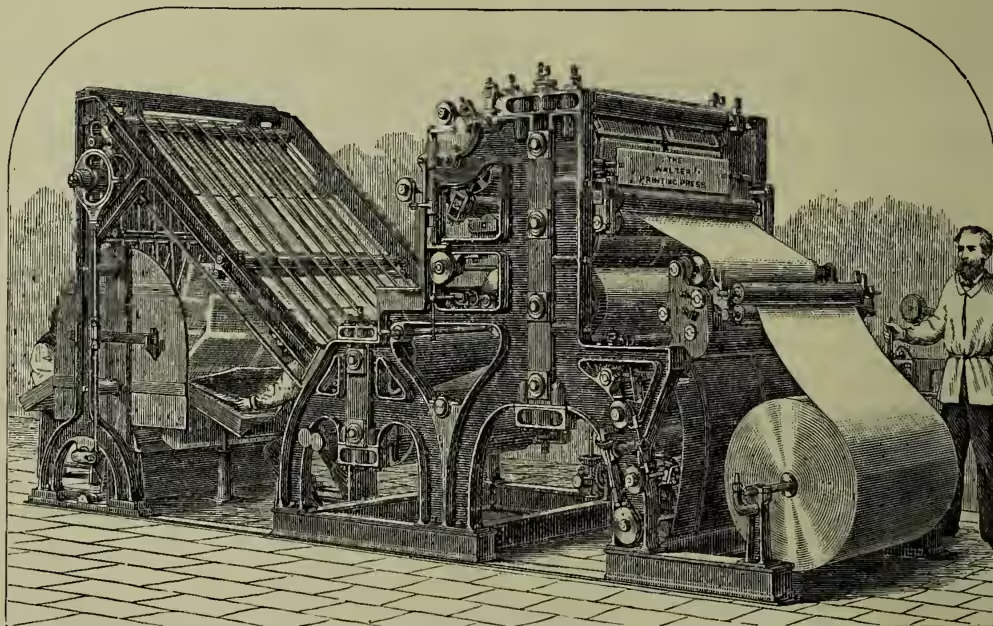
In 1790, as already mentioned, Nicholson patented a rotary machine, but he never constructed one. In 1813 Bacon and Donkin patented a machine in which the types were fixed on a revolving prism, the ink being applied by a roller, and the sheet of paper wrapped on another prism. The machine was a failure, although it embraced an important feature, the inking-roller made of composition. Three years afterwards Cowper patented a method for printing paper for paper-hangings and other purposes. This embodied another valuable feature—the taking a cast from the type and bending the cast round a cylinder. It was a far more practical idea than the subsequent one of Rowland Hill, who, to procure a curved printing surface, proposed the use of tapering types to be fixed on the cylinder. In 1848 Applegath invented a machine, the type-cylinder of which was vertical and nearly 6 feet in diameter, around it being placed eight other cylinders, containing sheets of paper to be printed. These were fed in from a horizontal position, and then brought to the vertical position. In 1857 the Times discarded this machine in favour of one patented by Hoe of New York, very similar in construction, but the cylinders were horizontal. It was found that the complication arising from eight or ten feeders was most objectionable, causing frequent stoppages, excessive waste of paper, and great risk to the machine and the material, while the working cost was heavy. Each of the machines printed on one side only. They were the first machines fitted with 'flyers'—a device for mechanically delivering or taking off the sheets. It was, however, considered at the Times office that the acme of improvement could only be obtained by constructing a machine simple in its arrangements, capable of printing both sides of the paper at one operation, and which could print, not single sheets, but continuous webs of paper, thus dispensing with layers-on. There were enormous difficulties in the way of printing, cutting, and delivering the paper, difficulties which the non-professional reader could by no means realise. In 1866 a machine of the kind was constructed under the superintendence of Mr J. C. Macdonald, the manager, and Mr Calverley, chief-engineer of the Times. The Walter Press, as this machine was named, has since been slightly improved, but remains practically the same, and is shown in fig. 6. The types are stereotyped by means of a papier-maché mould, which, being bent inside a hollow cylinder, produces, when cast, a stereotype which fits on the printing-cylinder of the machine. The paper, unwinding from the reel, first passes between damping-cylinders, then over the printing- cylinders, and is finally cut and delivered at the other end of the machine. Two boys and a man, who superintend the machine, supply all the manual labour required. The speed is about 10,000 perfect sheets per hour, equal to 20,000 impressions by the apparatus previously mentioned. The more recent machines have an attachment for folding, which make two, three, or four folds as required.
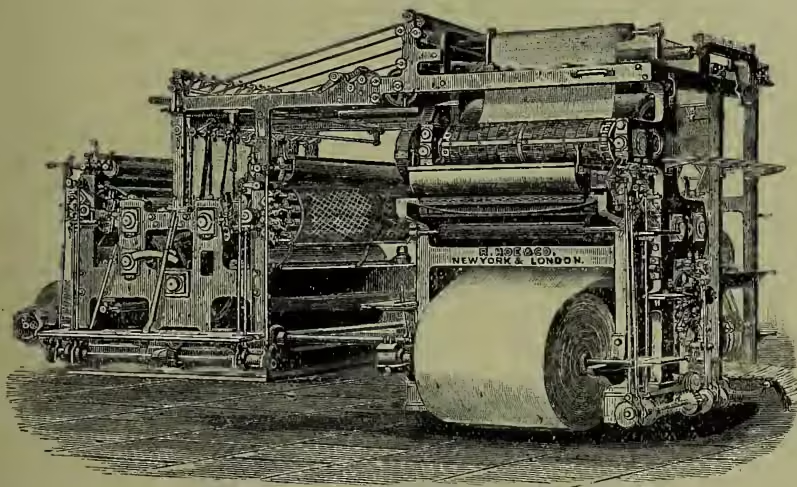
Mr Walter of the Times is entitled to the honour of being instrumental in introducing the bottom, turned out as compact as a pamphlet, and, by the addition of a device largely used in America, even folded and wrapped ready for post. This speed is effected by using a reel of paper of double width, about 8 feet wide, on which can be printed duplicate sets of plates. So greatly has the art of Stereotyping (q.v.) been improved that eight stereoplates from one forme can now be moulded, cast, and finished ready for the machine in eight minutes. Fig. 7 shows the double-web Hoe machine. system of rotary printing for news-work, just as his father deserves that of having introduced steam machine-printing. The Walter press was soon adopted as the pattern of a number of machines constructed in Britain and abroad. Some of these machines much developed the idea of the Walter, and embodied fresh and important improvements. In 1870 Messrs George Duncan and Alexander Wilson, of Liverpool, brought out their 'Victory' machine, which included the folding arrangement since added to the Walter press. By this apparatus newspapers of various sizes are printed, folded, delivered, and counted into quires or any portion required, at the rate of 200 per minute.
Since about 1870 the rotary system of printing has been gradually adopted in the offices of all newspapers having even moderately large circulations. Factories for producing rotary machines have been established in various parts of England, while many such machines have been imported from France, Germany, and America. The most improved and the fastest machines made up to the present time are those of Messrs Hoe & Co., of New York and London. The most improved of these machines print four or six page papers at the extraordinary speed of 48,000 per hour, or 800 per minute. Papers of eight, ten, or twelve pages can be printed at a speed of 24,000 per hour, and a sixteen page paper at 12,000 per hour. The papers can be pasted down the centre margins if required, and counted as delivered in quires of any number fixed upon. The machine delivers the papers, inset, pasted, cut top and man and compositor have utilised with intelligence and skill the materials at their command. Jobbing work is chiefly done on small platen-machines, invented by an American, G. P. Gordon, and introduced into Britain as 'Minerva Presses' in 1866. There are many varieties now made of this apparatus. Larger work is done on machines having one or two cylinders. Those of the 'Wharfedale' pattern, invented about 1860 by William Dawson and David Payne of Otley,
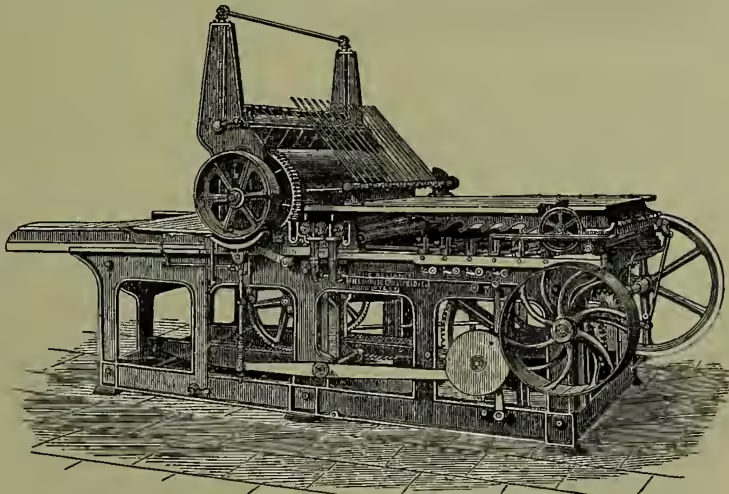
Wharfedale, Yorks, have one cylinder, and print only one side of the paper at a time.
The essential parts of the single-cylinder machine (fig. 8), now constructed by engineers in Europe and America with small alterations in pattern, may be regarded as five: the impression appliances of the cylinder; the arrangements for carrying the forme of type up to and under the cylinder, by contact of which it receives the impression; the inking of the type; the laying on of the sheet; the taking off or delivery of the sheet when printed. The cylinder, which is a hollow drum, having an opening on its under side, is placed almost in the middle of the machine. The table of the machine on which the forme is placed has racks on its under surface gearing into the traverse wheels, from which it derives motion to and fro. By means of racks it also causes the rotation of the cylinder by which the impression of the forme is effected. The inking system may be thus outlined. There is at the extremity of the machine and running across it a duct or ink reservoir, with an adjustable side-piece called the knife, which regulates the outflow of ink. A composition roller in motion, called a vibrator, takes a streak of ink periodically and transfers it to the ink-table, which forms part of the table and of course moves backward and forward. The ink is evenly spread or distributed over the ink-table by 'distributors.' The table then passes under the inking-rollers which alone touch the forme and give it the proper coating of ink. The distributors and rollers are coated with 'composition,' referred to on p. 410. The feeding apparatus is also ingenious. A pile of paper is laid on to the desk-like table shown at the right-hand side of the machine, and a boy stands at the end or at the front side of it and 'strokes' the sheets down till the front edge of one comes in contact with a series of metal fingers or clutches called grippers. These open and take a sheet by its edge, and hold it secure while the cylinder is turning round, and the printing taking place. At a certain point the grippers release the sheet, which then goes into the taking-off apparatus. A second set of grippers seize it and carry it round the wooden flyer cylinder, from whence it emerges on to travelling tapes. A large comb-like appliance called the gate oscillates up and down, having the sheet in front. The pressure of the air causes the sheet to adhere to this until it assumes a horizontal position, when it drops on to the taking-off board. While the first side of the sheet is being printed, two points, by an ingenious arrangement, make small holes in the paper; and when the sheet is turned to print the second side, these holes are again placed on the 'points,' thus ensuring correct register.
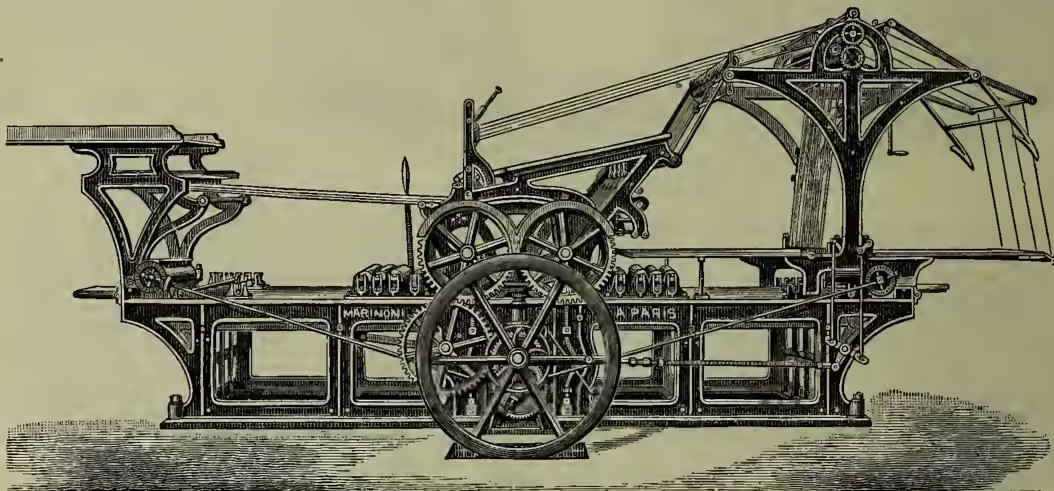
Machines with two cylinders are called perfecting machines because they perfect or print both sides of a sheet before delivering it. Generally they may be said to be duplicated single machines, with two printing-cylinders, two tables for type, and an inking apparatus at either end, much as described under the single-cylinder machine. The sheet is printed on one side at the first cylinder, when a set of grippers on the second cylinder take possession of it and print the second side, and it is delivered by the flyer as described. The varieties of these machines are numerous, and fig. 9 shows the Marinoni, a well-known type, used in the printing of the British editions of the present work. These machines can print in the very finest manner from 1000 to 1500 perfected sheets per hour, according as they may be complicated with illustrations or not.
When the types are to be printed from direct, as already mentioned, the chase containing the pages is put on the bed of the machine. When stereotype or electrotype plates are used they are carefully dressed to an exact size and thickness, the latter about ths of an inch. The requisite number of wooden blocks are then put on the machine-bed, locked in a chase. These blocks are of the proper thickness to make up the plates to type-height (about 1 inch). The plates are fastened to the blocks by brass catches at the sides and ends, and when locked up are as solid as type.
Before printing, however, a laborious process called making ready has to be gone through. When many wood-engravings are in the pages several days may be taken up making ready a single sheet. This process is for the purpose of making the impression equal all over and properly printing the wood-engravings, and can be judged of by comparing a carefully printed book with a daily newspaper, which is printed just as it comes without any making ready. It is too technical for detailed description within our limits.
It is not long since that it was a firm article of belief among printers that fine work could not be done except on a press provided with a platen. And up to quite recently all paper was first thoroughly wetted, then printed, then dried, and then pressed to restore the surface, of which the damping deprived it, and to give it a certain gloss. Between the forme and the platen of the press or the cylinder of the machine a thick, soft, yielding blanket was placed, which was supposed to produce a better impression from the inequalities of engravings and type. There has been a radical change in opinion and practice on these important points. It has been found, since machines have been brought to their present degree of perfection, that they give far superior results to those from presses—their impression is stronger, more solid, and more uniform, and the sheets can be laid on them with a precision unattainable with hand-presses. Paper is not now made spongy and stretchable by being wetted, and the result of working it dry is that the type is brought up with greater brightness, and the delicate lines of engravings are printed finer, clearer, and cleaner. Improvements in ink-making have much conduced to this desirable result. Paper has been produced for book-printing with a specially prepared surface, which admits of a far more excellent impression than that formerly procurable. The soft blanket has been discarded, and the packing or covering of the cylinder is now generally as hard as it can be got. The aggregate results of these alterations may be seen by a comparison of the present issues of an illustrated newspaper with those of fifty years ago. Up to about 1840 there was actually no press strong enough to properly print a woodcut of 48 square inches in superficies; now, woodcuts of 2000 square inches, or 50 inches by 40, are printed in the most perfect manner. The coloured supplements of the pictorial journals are often admirable reproductions of works of high art; it is within the memory of persons of middle age that the first crude attempts were made to print such pictures.
BIBLIOGRAPHY.—Historical: In addition to the works referred to in the text may be mentioned Karl Faulmann, Illustrierte Geschichte der Buchdruckerkunst (Vienna, 1882), his Die Erfindung der Buchd. nach der neuesten Forschungen (Vienna, 1891); Theo. de Vinne, The Invention of Printing (New York, 1877); and Van der Linde, Geschichte der Erfindung der Buchd. (3 vols. Berlin, 1886). There is no complete history of printing in the English language, but in Bigmore and Wyman's Bibliography of Printing (3 vols. 1880-86) some of the most useful books will be found under the names of Ames, Arber, Blades, Dibdin, Herbert, Hansard, Humphreys, Hessels, Luckombe, Ottley, T. B. Reed, Sotheby, Tinnerley, and Watson.
Practical.—Southward, Modern Printing (4 parts, 1898-1900), and Printinn Machines and Machine Printing (1888); Waldow, Illustrierte Encyklopädie der Graphischen Kunst (Leip. 1884); Desormes, Notions de Typographie (Paris, 1888); F. J. F. Wilson, Printing Machines (3d ed. 1885); F. J. Jacobi, Printing (1890); The American Dictionary of Printing and Bookmaking (1891-94); Ringwalt, American Encyclopedia of Printing (New York, 1871). Besides, a multitude of small yet useful books have been written on separate branches, and for the use of professional students of the art. See also the articles BIBLIA PAUPERUM, BOOK, BOOK-CLUB, ILLUSTRATION, LITHOGRAPHY, PAPER, PRESS (FREEDOM OF THE), PROOFS, STEREOTYPING, TYPES, WRITING.