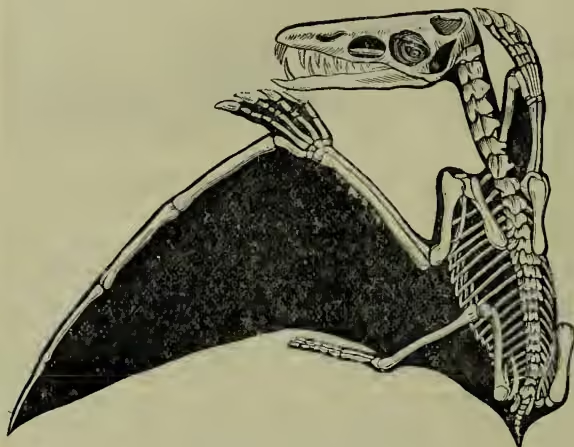
Pterodactyl (Gr., 'wing-finger'), a remarkable winged reptile, the remains of which are met with in the Jurassic and Cretaceous systems. There are numerous forms of Pterodactyl which are included in the extinct order Ornithosauria. The head was relatively large and snout-like, the long jaws being furnished with simple and pointed teeth, implanted in separate sockets. The eye-orbit was very large, the sclerotic having generally a ring of bony plates, and the nostrils approximated to the orbits. The neck was long and bird-like, consisting of procelous vertebrae which were longer than the dorsals—the latter varying from seventeen to twenty in number. From three to six vertebrae are ankylosed to form the sacrum. The tail is generally short, but long-tailed forms are also met with. The scapular arch and keeled sternum in their general characters resemble those of the carinate birds. There are four digits on each limb—the outer digit of the manus (corresponding to the fifth of the typical series) being immensely elongated for the support of a membranous expansion (patagium), which was also attached to the sides of the body to embrace the hind limbs and tail. The other digits of fore and hind limbs terminated in curved claws. Most of the bones are hollow like those of birds. The body was probably naked.
Many forms of Pterodactyl are known, in some of which the skull is less bird-like than that shown in the accompanying illustration. In Rhamphorhynchus the extremities of the jaws are usually edentulous, and were perhaps sheathed in horn; the base of the jaws, however, was furnished with teeth which were inclined forwards. In the same form the tail was long, and provided at the extremity with a leaf-like steering membrane. In Dimorphodon the jaws are provided with strong teeth in front and much shorter ones behind; and the tail was long.
Some pterodactyls were small—Ptenodraco being not larger than a sparrow. Others were about the size of a woodcock. Yet others, however, were much larger—some having a spread of wing of 5 or 6 feet, and even of 25 feet in the case of certain forms from the Cretaceous rocks of England. The form of its extremities shows that 'the Pterodactyl was capable of perching on trees, of hanging against perpendicular surfaces, and of standing firmly on the ground, when, with its wings folded, it might crawl on all fours, or hop about like a bird.'
Ornithosanrians are well represented in the Mesozoic strata of Europe and North America. One of the richest repositories of their remains is the famous lithographic stone of Solenhofen, in which the fossils usually occur in a fine state of preservation—even the impression of the membranous wing being sometimes clearly seen. See Nicholson and Lydekker's Palaeontology.