Ptolemy, properly CLAUDIUS PTOLEMÆUS, a celebrated astronomer and geographer, was a native of Egypt, though it is uncertain whether he was born at Pelusium or Ptolemais in the Thebaid. Nothing is known of his personal history, except that he flourished in Alexandria in 139 A.D., and there is probable evidence of his having been alive in 161. The chief of his writings are the Μεγάλη Σύνταξις τῆς Ἀστρονομίας, which, to distinguish it from the next mentioned, seems to have been denominated by the Greeks and by the Arabs after them megistē, 'the greatest,' whence was derived the name Almagest (with Arab article al, 'the'), by which it is generally known; the Tetrabiblos Syntaxis, with which is combined another work called Kurpos or Centiloquium, from its containing a hundred aphorisms—both works treating of astrological subjects, and held by some on this account to be of doubtful genuineness; a treatise on the phenomena of the fixed stars, or a species of almanac; and the Geographia, his great geographical work, in eight books. The rest of his works are of inferior importance, and consist of descriptions of various kinds of Projections (q.v.), the theory of the musical scale, chronological and metaphysical treatises, and a summary of the hypotheses employed in his great work, the Almagest.
Ptolemy, both as an astronomer and geographer, held supreme sway over the minds of almost all the scientific men from his own time down till the 16th–17th century; but, and in astronomy specially, he seems to have been not so much an independent investigator as a corrector and improver of the work of his predecessors. In astronomy he depended almost entirely on the labours of Hipparchus. But, as his works form the only remaining authority on ancient astronomy, the system they expound is called the Ptolemaic System, after the author.
As a geographer Ptolemy is the corrector and improver of the works of a predecessor, Marinus of Tyre, about whom, except from Ptolemy's writings, little is known. Ptolemy's improvements and suggestions are at once more valuable and correct; but it is sometimes difficult to separate his data from those of Marinus. His geography is divided into eight books, all of which, with the exception of the first, eighth, and a portion of the seventh, are nothing more than a catalogue of places, with their latitude and longitude (to 12ths of a degree), with a brief general description prefixed to each continent and country or tribe, and interspersed here and there with remarks of a miscellaneous character on any point of interest. The rest of the work contains details regarding his mode of noting the positions of places—by latitude (mēkos) and longitude (platos)—with the calculation of the size of the sphere of the earth, and of the extent of surface then known. The longitudes were calculated from Ferro (q.v.) in the Canaries, chosen as the westernmost part of the world; but he counted it only degrees W. of Cape St Vincent, instead of the real distance, . He took the parallel of Rhodes for his chief line of latitude, thinking it occupied the mean position in the zone of climate into which he divided the earth. He describes the mode adopted by him of projecting the surface of a hemisphere on a flat surface, and shows its superiority over the projections of Eratosthenes, Hipparchus, and Marinus. He also constructed a series of twenty-six maps, together with a general map of the world, in illustration of his work. See MAP.
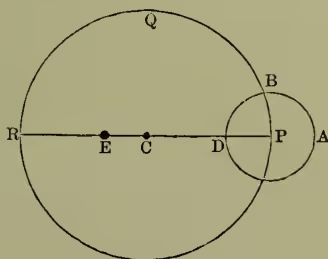
The PTOLEMAIC SYSTEM of astronomy, so called from Ptolemy, its chief expounder, was really originated long before his time, and was, in fact, merely an attempt to reduce to a scientific form the common and primitive notions concerning the motions of the heavenly bodies. It was implicitly adopted by Plato, Aristotle, Hipparchus, and (with the exception of the Pythagoreans, and probably of Pythagoras himself) all the eminent physicists and philosophers of ancient times; passing from them to the Byzantines and Arabs, who, especially the latter, were the means of disseminating it through western Europe, where it continued to be the universally established doctrine till the 16th century. The primary and fundamental doctrines of this system are that the earth is the centre of the universe, and that the heavenly bodies revolve round it in circles, and at a uniform rate. These notions, which are naturally suggested by the first general aspect of things, having, previous to any accurate observation, established themselves as unquestionable axioms, phenomena which were found on closer examination to be inconsistent with them were explained by the introduction of additional hypotheses. The belief that the earth is the centre of the universe was supported by its accordance with the relation of the primary elements of which the material world was supposed to be composed. Thus, earth, the most stable of the elements, held the lowest place, and supported water, the second in order; above water was placed air, and then fire, ether being supposed to extend indefinitely above the others. In or beyond the ether element were certain zones or heavens, each heaven containing an immense crystalline spherical shell, the smallest enclosing the earth and its superincumbent elements, and the larger spheres enclosing the smaller. To each of these spheres was attached a heavenly body, which, by the revolution of the crystalline, was made to move round the earth. The first or innermost sphere was that of the moon, and after it in order came those of Mercury, Venus, the Sun, Mars, Jupiter, Saturn and the fixed stars, eight in all. To this system later astronomers added a ninth sphere, the motion of which should produce the Precession of the Equinoxes (q. v.), and a tenth to cause the alternation of day and night. This tenth sphere, or primum mobile, was supposed to revolve from east to west in twenty-four hours, and to carry the others along with it in its motion; but the Ptolemaic astronomers do not venture to explain how this was done, although, since the axis of motion of the primum mobile was that of the equator, its extremities being the poles of the heavens, while that of the ninth sphere was the axis of the ecliptic, some explanation was certainly necessary. As observations of the heavens increased in accuracy it was found that the heavenly motions were apparently not uniform, and this was explained as follows: The acceleration of the sun on one side, and retardation on the other side of his orbit is only apparent, and results from the earth not being in the centre of the sun's sphere, C (see fig.), but at E, and consequently his motion appears to be slowest at P and quickest at R. The alter- native progression and regression of the planets was accounted for by supposing them to move, not directly with their crystalline, but in a small circle, whose centre was a fixed point in the crystalline, and which revolved on its axis as it was carried round with the latter; thus (fig.) the planet was carried round the small circle ABD, as that circle was carried round PQR (now supposed to represent the planetary crystalline). The planet while in the outer portion of its small circle would thus have a forward, and in the inner portion a backward motion. The larger circle was called an eccentric, and the smaller an epicycle. This theory of eccentrics and epicycles satisfied the early astronomers; but further investigation showed its incompleteness, and in later times it was found necessary to explain newly-discovered discrepancies by heaping epicycle upon epicycle till a most complex entanglement resulted. As soon as astronomers came to understand and test the Copernican Theory (see COPERNICUS), this venerable and disorderly pile of hypotheses, which had received the papal seal of infallibility, and had in various forms held supreme sway over the minds of men for twenty centuries, at once crumbled to atoms and sunk into oblivion. See ASTRONOMY.
The Almagest and the Geography were the standard text books to succeeding ages, the first till the time of Copernicus, the second till the great maritime discoveries of the 15th century showed its deficiencies. They have passed through numerous editions, the best of which are, for the Almagest and the most of Ptolemy's minor works, that by Halma (Paris, 4 vols. 1813-28); and for the Geography, the Latin versions of 1482 and 1490, published at Rome, the editio princeps of the Greek text by Erasmus (1533), the Elzevir edition (1619), those of Wilberg and Grashof (1844), Nobbe (1845), Müller (Paris, 1883), and the photographic reproduction of the MS. in the monastery of Mount Athos by Langlois (Paris, 1866). The catalogue of stars has been frequently reprinted separately, the best edition being that of Francis Baily, in vol. xiii. of the Memoirs of the Royal Astronomical Society (1843).