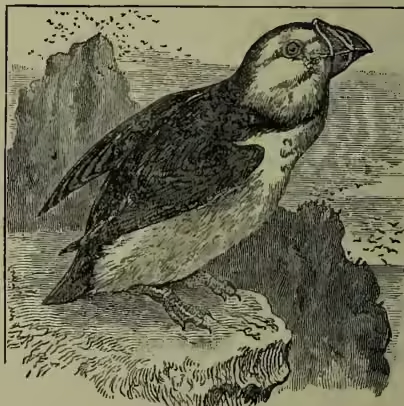
Puffin (Fratercula), a genus of birds of the Auk family, characterised by a gaily-coloured bill—red, orange-yellow, and bluish gray—with a horny frontal sheath divided by transverse grooves into several distinct pieces. At the end of the breeding season these furrows deepen, and the sheath is shed. There is in fact an annual moult of the bill-sheath and of the horny plates above and below the eyelids. In form, size, and colour the new bill-sheath differs markedly from the old one. The genus Fratercula embraces three species, of which only one, the Common Puffin (F. arctica), a bird a little larger than a pigeon, frequents the rocky shores of the Atlantic Ocean. It occurs in many parts of England and in Wales, while on the coast and islands of Scotland and Ireland it is often abundant, especially at the breeding season, when the birds congregate in large colonies. The egg, which is of a dull white marked with pale brown or lilac, is laid sometimes in a crevice of a cliff, sometimes in the burrow of a rabbit, or in a cavity made for the purpose. The nestling, which is covered with sooty black down, remains in the nest for three weeks, and is fed on small fishes. The adult birds feed on crustaceans and other marine animals. On land they waddle rather than walk, but they swim and dive well, and their flight is rapid though seldom high. In various localities the puffin is popularly called Sea-parrot, Coulterneb, and Tammienorie. In the Pacific the genus is represented by the Horned Puffin (F. corniculata). There also is found the closely allied genus Lunda, with bright yellow bill. The eggs of the puffin are much sought after, and the flesh of the young birds is used as food. For details as to the strange moulting and renewal of the bill, see Zoologist (July 1878).