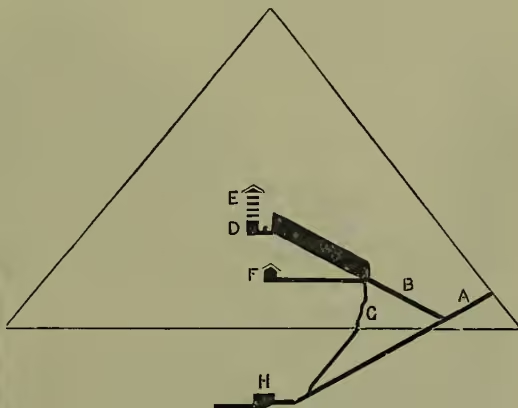
Pyramid, a structure of the shape of the geometric figure so called, erected in different parts of the Old and New World, the most important being the Pyramids of Egypt, which were reckoned among the seven wonders of the world. They are about seventy-five in number, of different sizes, situated chiefly between 29° and 30° N. lat., and are masses of stone (or rarely brick), with square bases and triangular sides. Although various opinions have prevailed as to their use, as that they were erected for astrological, astronomical, and metrological purposes, for resisting the encroachment of the sand of the desert, for granaries, reservoirs, &c., there is no doubt that they were really nothing more than the tombs of monarchs of Egypt who flourished from the first to the twelfth dynasty. With the exception of some very late pyramids in Nubia, none were constructed after the twelfth dynasty; the later kings were buried at Abydos, Thebes, and other places, in tombs of a totally different construction. The pyramids of Egypt may be described as monuments built over the sepulchral chambers of kings. The Egyptian monarch was ever careful to prepare his 'eternal abode.' For this purpose a shaft of the size of the intended sarcophagus was first hollowed in the rock at an incline suitable for lowering the coffin, and at a convenient depth a rectangular chamber was excavated in the solid rock. Over this chamber a cubical mass of masonry of square blocks was then placed, leaving the orifice of the shaft open. Additions continued to be made to this cubical mass both in height and breadth as long as the monarch lived, so that at his death all that remained to be done was to face and smooth the exterior of the step-formed mound by adding courses of long blocks on each layer of the steps, and then cutting the whole to a flat or even surface. This outer masonry or casing has in most instances been stripped off. Provision was made for protecting the vertical joints by placing each stone half-way over another. The masonry is admirably finished; and the mechanical means by which such immense masses of stone were raised to their places must have been powerful and elaborate. The finer stones were quarried at Tura and other places on the opposite bank of the Nile; sometimes, however, granite taken from the quarries of Syene was employed for the casing. The entrances were carefully filled up, and the passage protected by stone portcullises and other contrivances, to prevent ingress to the sepulchral chamber. The sides of the pyramids face the cardinal points, and the entrances face the north. The most remarkable and finest pyramids are those of Gizeh (Giza), situated on the edge of the Libyan Desert, near Memphis, on the west bank of the Nile. Of the three largest and most famous the First or Great Pyramid was the sepulchre of Chufu, the second king of the fourth dynasty (3733-3666 B.C. according to Brugsch). Chufu is the Cheops of Herodotus, the Chembis or Chemmis of Diodorus, and the Suphis of Manetho. Its height was originally 481 feet, and its base 774 feet square; in other words, it was higher than St Paul's Cathedral, on an area about the size of Lincoln's Inn Fields. Its slope or angle was 51° 50'. It has, however, been much despoiled and stripped of its exterior blocks for the building of the mosques and walls of Cairo. The original sepulchral chamber, 46 feet × 27 feet, and 10 feet 6 inches high, was hewn in the solid rock, and was reached by a passage, 320 feet long, which descended to it from the entrance at the foot of the pyramid. The excavations in this direction were subsequently abandoned, and a second chamber, with a triangular roof, was constructed in the masonry of the pyramid, 17 feet 19 feet, and 20 feet high. This was reached by a passage rising at an inclination of , terminating in a horizontal passage. It is called the Queen's Chamber, and occupies a position nearly in the centre of the pyramid. The monument—probably owing to the long life attained by the monarch—still progressing, a third chamber, called the King's, was then constructed by prolonging the ascending passage of the Queen's Chamber for 150 feet further into the very centre of the pyramid, and after a short horizontal passage, making a room 17 34 feet, and 19 feet high. To diminish the pressure of the superincumbent masonry on the flat roof five small chambers (E in fig.) were made vertically in succession above the roof, the apex of the pointed uppermost chamber (in which the name of Chufu is scrawled) being rather more than 69 feet above the roof of the King's Chamber. The end of the horizontal passage was carefully finished, and cased with slabs of red syenitic granite exquisitely fitted together; and in the King's Chamber is the broken red granite sarcophagus of King Chufu, 7 feet inches long, 3 feet 3 inches broad, and 3 feet 5 inches high, to contain which the pyramid was built. Piazzi Smyth fancied (for it is nothing more than fancy) that this coffer was not a sarcophagus, but a standard were opened by Belzoni in 1816. The masonry is inferior to the first, but it was anciently cased below with polished stones, some of which remain, while the top still retains its original casing.
The Third Pyramid, built by Menkaura, or Mycerinus (3633 B.C.), fourth king of the fourth dynasty, is much smaller than the other two, being only 215 feet high by 350 feet at the base. It has three chambers, the lowest of which, granite lined, held a sarcophagus of whinstone and a wooden coffin. The inscription on the coffin reads: 'Osiris, King of the North and South, Men-Kau-Ra, living for ever! The heavens have produced thee, thou was engendered by Nut (the sky), thou art the offspring of Seb (the earth). Thy mother Nut spreads herself over thee in her form as a divine mystery. She has granted thee to be a god. Thou shalt never more have enemies, O King of the North and South, Men-Kau-Ra, living for ever' (Budge, The Nile, 141-142). From this we may conclude that the Egyptian religion and the doctrine of immortality were fixed as early as 3600 B.C. Amongst the débris of the coffin and in the chambers were found the legs and part of the trunk of a body with linen wrapper, supposed by some to be that of the monarch, but by others to be that of an Arab. This body and fragments of the coffin were removed to the British Museum; but the stone sar- cophagus was unfortunately lost off Carthagenæ by the sinking of the vessel in which it was being transported to England. The masonry of this pyramid is most excellent, and it was anciently cased half-way up with granite, the remains of which are still visible. It was wantonly damaged by Saladin's nephew, El-Kâmil, in the 12th century, in the insane desire of destroying it. The Third Pyramid is regarded with superstitious dread by the natives, on account of a supposed lady's ghost, and there is a curious legend connecting it with the courtesan Rhodope.
There are six other pyramids of inferior size and interest at Gizeh; others at Abou Roâsh, six miles to the north-west of the same spot; and four (originally fourteen) at Abusir (Busiris), with the names of Sahu-ra and Usr-en-ra of the fifth and sixth dynasties. A group of eleven pyramids remains at Sak-kara, some of which were explored in 1880-81 by M. Maspero, such as those of Unas (3333 B.C.), Teta (3266), and Pepi (3233), all of the fifth and sixth dynasties. The so-called Step Pyramid at Sak-kara is believed to have been built by Uenephes of the first dynasty. Six pyramids still stand at Dahshûr; and that at Meydûm, with a peculiar construction in three stages, is supposed to be the tomb of Seneferu (3766 B.C.), Chufu's predecessor in the fourth dynasty. There are also pyramids in the Fayyûm, and some small ones of brick at Thebes. In Nubia, the ancient Ethiopia, are several pyramids, the tombs of the monarchs of Meroë from 600 to 100 B.C. and of some of the Ethiopian conquerors of Egypt. They are taller in proportion to their base than the Egyptian pyramids, and generally have a sepulchral hall, or propylon, with sculptures, which faces the east.
In Assyria the Birs Nimrûd, or Tower of Belus, was a kind of step-shaped pyramid of seven different-coloured bricks, dedicated to the planets by Nebuchadnezzar. The Mujelliba, another mound, was of pyramidal shape. The pyramid measure of capacity, of which the British quarter is the fourth part. As the heat of this chamber was stifling, two small air-channels, or chimneys, about eight inches square, were made, ascending to the north and south sides of the pyramid, which perfectly ventilate it. After the mummy was deposited in the King's Chamber, the entrance was closed with granite portcullises, and a well made at the junction of the upward-inclined and horizontal passages, by which the workmen descended into the downward-inclined passage. According to Herodotus, this pyramid took a long time in construction—100,000 men being employed on it for thirty years. The facing-stones were said to be inscribed with writing, probably of a religious character. The Great Pyramid was opened by the 'Abbaside Caliph El Mamûn in the 9th century.
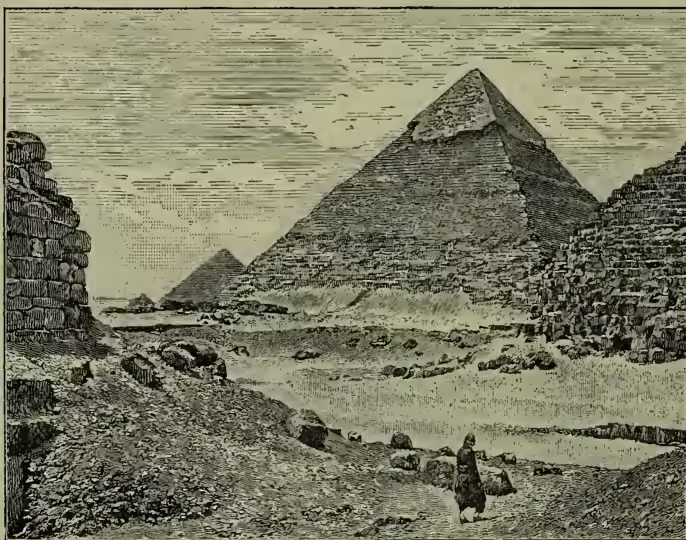
The Second Pyramid is situated on a higher elevation than the first, and was built by Chafra or Chephren (3666-3633 B.C.), third king of the fourth dynasty. It is 450 feet high, on a base of 700 feet, and has two sepulchral chambers, which also entered into the architecture of the tomb of Sardanapalus at Tarsus, and of the Mausoleum of Artemisia at Halicarnassus. A small pyramid, the sepulchre of C. Cestius, imitated from the Egyptian in the days of Augustus, still exists within the wall of Aurelian at Rome. Temples and other monuments of pyramidal shape are found in India, China, Cambodia, Java, the Polynesian Islands, and elsewhere. The Toltecs and Aztecs erected temples in Mexico, called Teocalli (q.v.), or abodes of gods, of pyramidal shape, with steps or terraces by which to ascend and reach an altar, generally placed on the summit, where human sacrifices and other rites were performed. These, however, are not true pyramids, the pure and simple form of which is restricted to Egypt. The pyramidal form entered extensively into the architecture of the Egyptians, and appears on the tops of obelisks and tombs as a kind of roof. Small models of pyramids, with inscribed adorations to the sun, or having royal names, were also placed in the tombs.
See Lepsius, Ueber den Bau der Pyramiden (1843); Wilkinson, Topogr. of Thebes 1835; Vyse, Operations carried on at Gizeh in 1837 (1842); W. Flinders Petrie, The Great Pyramid (1888). Ingenious fancies about the supposed metrological and astrological purport of the pyramids are given in Piazza Smyth's Our Inheritance in the Great Pyramid (1864), and R. A. Proctor's The Great Pyramid (1882). The astronomical data afforded by the orientation of temples and pyramids were in 1891 subjected to thorough investigation by Mr Norman Lockyer.