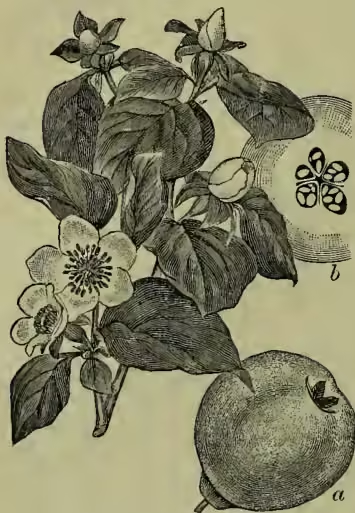
a, ripe fruit; b, section of do.
(Bentley and Trimen.)
Quince (Cydonia), a genus of trees and shrubs of the natural order Rosaceae, sub-order Pomeæ, nearly allied to Pyrus, with which many botanists have united it under the name P. Cydonia, but distinguished by having many instead of two seeds in each cell, and by their very mucilaginous nature. The Common Quince (C. vulgaris), a native of the south of Europe and temperate parts of Asia, is a low tree, with generally tortuous branches, ovate, entire, deciduous leaves, and rather large whitish flowers, which are solitary at the extremity of young branches. The fruit is in some varieties globose, in others pear-shaped, of a rich yellow or orange colour, with a strong smell. It is hard and austere, but when stewed with sugar becomes extremely pleasant, and is much used in this way either by itself or to impart a flavour to apple-pies. It is also much used for making a preserve called Quince Marmalade. A delicious beverage somewhat resembling cider is made from it. The seeds, which readily give out their mucilage to water, so that they turn forty or fifty times their amount of water into a substance as thick as syrup, have long been used in medicine. Quince mucilage or quince gum, Cydonin, is allied to Bassorin, but differs from it in being readily soluble in water (see GUM). The quince was cultivated by the ancient Greeks and Romans, and is at the present day cultivated in the south of Europe, in England, and generally in temperate climates. Its principal use in Britain in a commercial sense is as a stock on which to bud or graft the pear. Many choice kinds of pear succeed better when united to it than when they are grafted on the true pear-stock. In Scotland the fruit seldom ripens except on a wall. The Japanese Quince (C. japonica, better known by its older name, Pyrus japonica), a low bush, a native of Japan, but perfectly hardy in Britain, is often to be seen trained against walls, being very ornamental from the profusion of its beautiful flowers, usually a rich red in colour. See Meech's Quince Culture (New York, 1888).