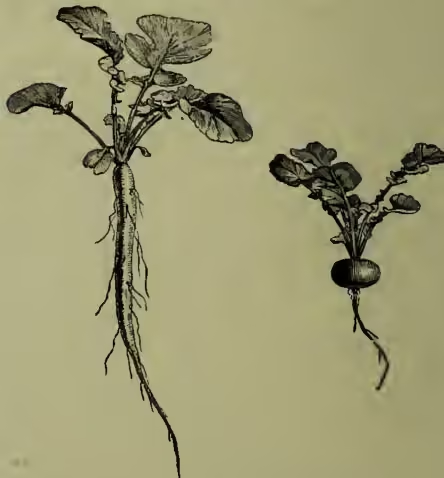
Radish (Raphanus), a genus of plants, of the natural order Cruciferae, having a spongy Silique (q.v.). The flowers are yellow, red, or purple. The Common Radish (R. sativus) has thick, round, tapering, and pointed pods, little longer than their stalks, very slightly contracted between the seeds, and not falling to pieces. It is not known in any country in a wild state, but has been cultivated from time immemorial in China, Japan, India, and in Europe. But some varieties of the Wild Radish found growing on the Mediterranean coasts resemble so closely the Garden Radish as to suggest the possibility that the latter may be but a cultivated race of it. Radish is a well-known salad root, much appreciated for its succulent roots with their warm pungent taste. In this way the young and tender leaves were also formerly used. The varieties of radish in cultivation are extremely numerous, but they are generally classed under the two heads of Long-rooted and Turnip-rooted Radishes, the roots of the former resembling the carrot in shape, and the latter the turnip. The varieties differ very much, not only in form of root, but in colour and size, a red colour generally prevailing. Some of the darker-coloured turnip-rooted radishes, such as the black Spanish, grow to a large size under good cultivation, and are grown in gardens chiefly for their usefulness in winter when the ordinary varieties cannot be grown. Radishes are sown at different seasons, and are generally used when young and small. The root of the radish possesses demulcent, stimulant, and diuretic properties, and is sometimes used in cases of atony, or of excessive secretion of mucus by the organs of digestion or the urinary organs. Radish-juice, mixed with sugar-candy, is a popular and useful German remedy for hoarseness and cough. Distinct from both the varieties above named is the Oil Radish, which has a slender—scarcely fleshy—root, a short much-branched stem, and many-seeded pods. It is cultivated in China for the oil of its seeds. Another species of radish (R. caudatus), a native of Japan, is there cultivated as an esculent. To this genus belongs the Jointed Charlock of the cornfields (R. raphanistrum), which has found its way from Europe to North America, and is a troublesome weed there also. The seeds, however, may be advantageously crushed for oil. The Sea Radish (R. maritimus) is a rarer British species, the roots of which are of fine quality and great pungency.