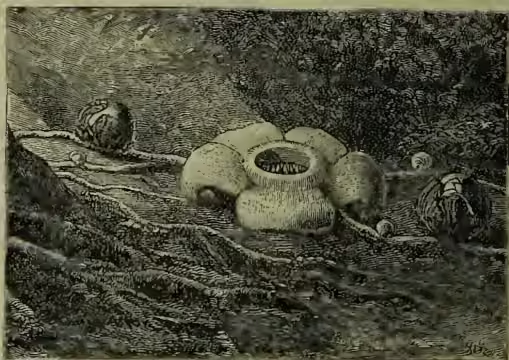
Rafflesia, a remarkable genus of plants belonging to the small natural order Rafflesiaceæ, an order composed entirely of parasitic plants, which consist merely of a flower, and form part of the Rhizophoraceæ (q.v.) of Lindley. The Rafflesiaceæ are natives partly of the Indian islands and partly of South America. The plants of the genus Rafflesia have neither stalk nor leaves, but are enormous flowers seated upon the roots of species of Cissus, making their appearance at first as a hemispherical swelling of the bark of the root, and, after the bark has broken, rising up in the form of a head of cabbage, whilst the perianth is covered with imbricated bractee, which are more or less recurved after it has opened. The perianth is thick, fleshy, and 5-partite. The ovule is inferior, and contains many ovules; and the anthers, which are numerous, are seated under the revolute margin of the top of the style column. After the flower has expanded it diffuses a carrion-like smell, that even attracts flies, and induces them to deposit their eggs. The largest and first-discovered species, R. arnoldi, was discovered in 1818 in Sumatra by Dr Arnold, and was sent to the eminent botanist, Robert Brown, by Sir Thomas Stamford Raffles (q.v.). Its flower measures fully 3 feet in diameter, is capable of containing almost 2 gallons of fluid, sometimes weighs 10 pounds, and is the largest of all known flowers. A smaller species, R. patma, whose flowers are 16 inches to 2 feet in diameter, is highly prized by the Javanese as a medicine, for its strong styptic powers. R. horsfieldii, another Javanese species, is still smaller, its flowers being only 3 inches broad.