Rainbow. The rainbow is the best known of all optical meteorological phenomena, consisting of a coloured arch formed opposite the sun on falling raindrops, and visible whenever the necessary conditions of a passing shower on one side and a clear and not too high sun on the other occur. Two bows are frequently seen, each exhibiting the full spectrum of colours from red to violet; but in the inner or primary bow the red is the outer edge and violet the inner, while in the outer or secondary bow the order is reversed, the red being inside and the violet on the exterior. The colours are always arranged in a definite order, that of the solar spectrum—viz. red, orange, yellow, green, blue, indigo, and violet, but shade imperceptibly into each other. The cause of this breaking up of the sunlight into its constituent colours is explained in most physical and meteorological text-books (see Light, by Professor Tait, chap. x., or Meteorology, by E. Loomis, par. 416), but may be briefly summarised as follows :
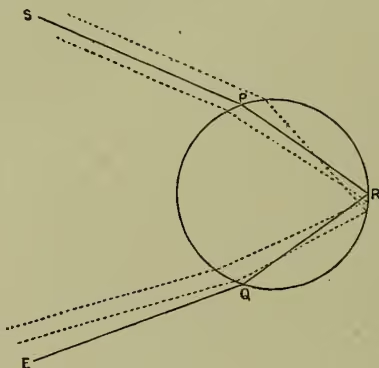
For the primary bow (fig. 1), let PQR represent the section of a raindrop, and SP a ray of light falling on it. The ray enters the drop at P, meets the surface again at R, is reflected to Q, where it leaves the drop in the direction QE. The ray is refracted or bent on entering the drop at P and again on emerging at Q—the amount of this refraction depending on the acuteness of the angle at which the ray meets the surface. Now it may be shown that there is a particular point P, such that any ray from S striking the surface below P emerges again above Q, and any ray above P also emerges above Q—the former owing to the more acute angle of the reflection, and the latter to the greater refraction on entering and leaving the drop. The course of two such rays is shown by the dotted lines in fig. 1. Q is thus a turning-point in the emerging rays, and near it a very large number of rays pass out, and an observer at E sees a bright image of S in the direction EQ. This statement applies to any one colour of sunlight; but, as the refrangibility increases from red to violet, the latter is bent more at P and Q, and the line EQ lies at a flatter angle. The observer, therefore, sees the violet rays reflected on drops at a less altitude than those that reflect the red, the other colours being intermediate. The raindrop being spherical, this reflection takes place in all directions, the fixed condition being the radius of the bow, that is the angle between the line from the observer to the bow and that passing from the sun to the observer, or, in other words, the observer's shadow. For red light this angle is , and for violet . If the sun were a luminous point each colour would be sharply defined, but as the disc of the sun subtends an angle of about each colour is broadened to this amount, and they overlap.
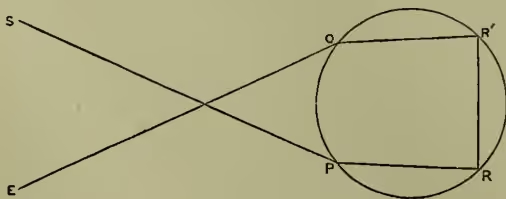
Exactly similar reasoning explains the secondary bow (fig. 2). The light that forms it has been twice reflected, at R and at R', the point Q lies above P, and rays entering either above or below P all emerge below Q. A glance at the diagram will show that the greater bending of the more refrangible rays makes the line EQ more nearly vertical, and therefore the violet rays form the outer edge and the red the inner of the secondary bow. The radius of the red is , and of the violet . The space between the bows gets no reflected light, but that inside the primary and outside the secondary is faintly illuminated by rays such as are indicated by the dotted lines in fig. 1 and their equivalents in fig. 2, which are not shown. These rays 'interfere' (see INTERFERENCE) with each other, and cause alternations of colour which appear as spurious bows inside the primary and outside the secondary. They can only be seen with strong sunlight and small drops of rain.
The radius of the primary bow being roughly , it is evident that it cannot be seen when the sun is at a greater elevation than this, as the highest part of the bow would lie below the horizon. Hence in the latitude of Edinburgh rainbows cannot be seen for several hours about noon at the time of the summer solstice. If the drops of water be very small the interference of the rays causes such a complete overlapping of the colours that the bow appears white: this is the case generally with a fog-bow.
Intersecting rainbows have frequently been seen. When the sun is reflected from a surface of still water a bow is formed by the reflected image as well as by the sun itself. Lunar rainbows often occur, but the feebleness of the moon's light usually prevents any colours being observed. There are many popular weather prognostications connected with rainbows, all dependent on the fact that they imply local passing showers. 'A rainbow in the morning is the shepherd's warning: a rainbow at night is the shepherd's delight,' is easily understood when we remember that the rainbow is formed opposite the sun, and that weather-changes in the British Islands generally pass from west to east.