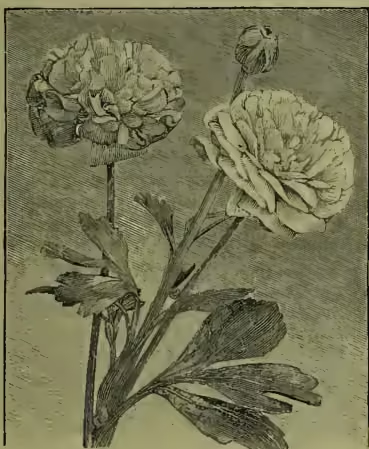
Ranunculus, a genus of plants of the natural order Ranunculaceæ; having five sepals; five petals, with a nectariferous pore at the base of each petal, often covered with a scale; many stamens situated on a receptacle, and ovaries accumulated into a head. The species are numerous, herbaceous plants, mostly perennial. Some of them adorn meadows with their yellow flowers, familiarly known as Buttercups; others, known by the name of Crowfoot, are troublesome weeds in gardens and pastures. Many, as the Spearworts, are found chiefly in moist places, and some are altogether aquatic, covering the surface of ditches, ponds, and rivers, where the water is shallow, with a carpet of verdure exquisitely studded with beautiful white flowers. One species, the Asiatic Ranunculus, or Garden Ranunculus, exclusively the ranunculus of florists, a native of the Levant, has been cultivated in Europe for almost 300 years. The cultivated varieties are extremely numerous, brilliantly coloured, and very symmetrical in form. The ranunculus is propagated by seed, by offset tubers, or by dividing the clusters of tubers. The roots are often taken up in summer, after the leaves die, and kept in a dry place till the beginning of the ensuing winter or spring. The ranunculus loves a free and rich soil. Double-flowered varieties of some other species, with taller stems and smaller white or yellow flowers, are cultivated in flower-gardens, sometimes under the name of Bachelors' Buttons. The acridity of many species of ranunculus is such that the leaves, bruised and applied to the skin, produce blisters; and those of R. sceleratus, a pretty common British species, are said to be used by beggars to cause sores, in order to move compassion. R. Thora, a Swiss species, is of extreme acridity, and hunters were accustomed in former times to poison darts and arrows with its juice. Water distilled from the leaves of R. flammula, a British species, with rather tall stem and ovato-lanceolate leaves, common by the sides of ditches, &c., is an active and powerful emetic, producing almost immediate vomiting, and capable of being used with great advantage in cases of poisoning. Yet the leaves of R. ficaria—sometimes called Pilewort and Lesser Celandine, a very common British species, adorning hedge-banks with bright yellow flowers in spring—are capable of being used as a pot-herb. Pastures in which R. acris, R. repens, &c. are very abundant are injured by them, and they ought to be diligently grubbed out; they are particularly supposed to give an unpleasant taste to milk and butter; but it is thought not improbable that a moderate mixture of these plants with the other herbage is even advantageous, and that they may act as a condiment. Their acridity is lost in drying, and they are not injurious to hay. The small tubers of Pilewort, or Lesser Celandine, are used for the cure of hæmorrhoids; but their acridity also disappears when they are boiled, and they are then a pleasant article of food. R. aquaticus, a British species, very abundant in streams in many parts of Britain, is eaten with avidity by cattle, the acridity so general in the other species being wanting in it.