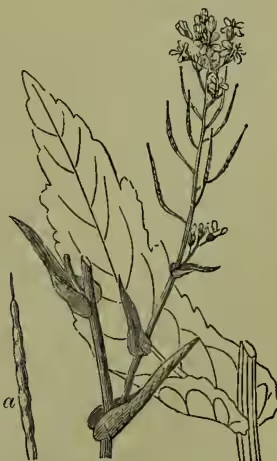
a, silique.
Rape, or COLESEED (Brassica napus; see BRASSICA), an annual plant much cultivated on account both of its herbage and of its oil-producing seeds. It is a native of Europe and perhaps of England; but it is hard to say where it is truly indigenous and where naturalised. It is so nearly allied to Brassica rapa (Turnip), B. campestris (Swedish Turnip, Colza, &c.), B. oleracea (Kale, Cabbage, &c.), and B. pracoax (Summer Rape) that botanical distinction is difficult, particularly as to some of the cultivated varieties. The root of rape is slender, or in cultivation sometimes becomes carrot-shaped (see NAVEW), but it never becomes turnip-shaped. The cultivation of rape is very general in many parts of the continent of Europe, from which it seems to have been introduced into England at least as early as the 16th century; and in the 17th century, if not sooner, large quantities of oil were made from its seeds, chiefly in the fenny and other alluvial districts of the east of England, where also it has long been most extensively employed for feeding sheep. On the Continent it is not unusual to sow rape in order to green-manuring, ploughing its herbage into the soil, a mode of enriching land much more common in some parts of Europe than it is in Britain. Rape delights in a rich alluvial soil, and is particularly suitable for newly-reclaimed bogs and fens, in which the turnip does not succeed well; and it is also extensively cultivated in the chalk and oolite districts of the south of England. When cultivated for green-manuring rape is usually sown broadcast, but when intended to produce seed it is generally sown in drills, and receives manure and culture the same as the turnip. In rich soils rape sometimes attains a height of three or even four feet, so that the sheep turned in are hidden beneath the leaves, and seem to eat their way into the field. They eat the stalks even more greedily than the leaves. A too exclusive feeding on rape is, however, apt to produce diseases, which a sprinkling of salt, a supply of hay, &c. are found useful in preventing. When the seed is ripe rape is cut with the sickle; and, after a short time allowed for drying, the seed is thrashed out, when the haulm is often burned, a wasteful practice, as its decay affords more abundant and useful manure, and indeed cattle are fond of it as food. Rape-cake, the mass of seeds from which oil has been obtained by crushing, is used for feeding oxen and sheep, but is very inferior to linseed-cake and some other kinds of oil-cake. Ground into dust, it is a very valuable manure. Rape-oil is extensively used for machinery and for lamps; but the oil and cake so called are not exclusively obtained from this plant, nor are the names Colza-oil and Rape-oil used to discriminate the produce of different plants, although in some parts of Europe the name Colza is given to varieties of Brassica campestris and B. oleracea, which are cultivated in the same way as rape. B. praecox is also cultivated in some places, being sown in spring and reaped in autumn. The seeds of other cruciferous plants are also crushed indiscriminately with these, and the oil and cake sold by the same names (see OILS, OIL-CAKE).—The name Rape is from Lat. rapa, ‘a turnip;’ Colza is through the French from the Dutch koolzaad, ‘cole-seed.’