Rat, a name applied to the larger species of the rodent genus Mus, but especially to the Brown Rat (M. decumanus) and the Black Rat (M. rattus). Like the mice, which are included in the same genus, rats are agile and graceful animals, skilful in burrowing, predominantly nocturnal. The bright eyes, large ears, naked muzzle, soft fur, and long scaly tail are familiar external characteristics. The brown or Norway rat measures about eight inches in length, not including the tail, which is usually shorter than the body. It is grayish-brown in colour, with flesh-coloured ears, feet, and tail. Black varieties sometimes occur. It is believed to have travelled gradually westwards, perhaps from China, and did not reach France or Britain till towards the middle of the last century. In 1727 swarms swam across the Volga, and rapidly spread over Europe, dispossessing the black rat which had arrived some centuries before. According to some, the black rat was brought to Britain in 1732 in ships from the East Indies. As a common stowaway in ships, it has been distributed over the world, reaching America about 1775. The black rat is smaller and slimmer than the brown rat. The head and body measure six or seven inches in length; the tail is an inch or two longer. The head is more slender than in the brown rat, and the ears are rather larger. In most the colour is glossy black, but white and piebald varieties may occur. It is less fierce than the brown rat, and seems to be less distinctively a burrowing rodent, preferring the upper parts of houses to the cellars. Its original home seems to have been in the East, perhaps in Persia, but it must have reached northern Europe by the 13th century at least, for its troublesome presence is noticed by Albertus Magnus.
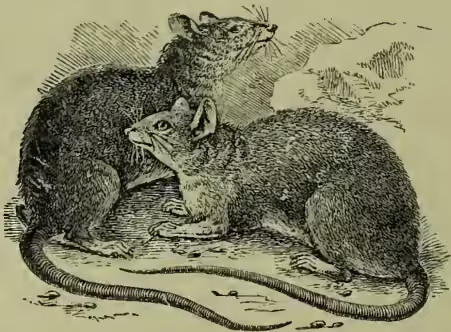
These species of rat have similar habits, and the stronger, larger, and fiercer form sometimes tends to exterminate the other, this being one of the few instances which Darwin gives of his conclusion that the struggle for existence is keenest between closely allied species. As to the habits of rats, it is well known that they find their way everywhere; no door is shut to them; they gnaw and burrow through almost all obstacles. They run and leap, they climb and swim. They are fond of animal food, but will eat almost anything; corn, fodder, all kinds of human food, eggs, young birds, small mammals, all is grist to their mill. In illustration of their voracity it is often related that in a slaughter-house near Paris thirty-five dead horses were picked to the bones in a single night. When pressed by hunger they display much boldness, and their skill in stealing even such unmanageable goods as eggs is well known. Their senses, especially of smell and hearing, are acute, and their intelligence is well developed. The mothers are careful of their tender offspring, but the males display the reverse of parental affection. The albino are delightful pets. Brehm cites several strange observations in regard to the so-called 'rat-kings,' which consist apparently of a number of diseased rats with entangled tails. It is said that over two dozen individuals have been found thus entangled. Rats are very prolific, breeding four or five times a year. Four to ten young are brought forth at a birth, after a very short gestation of about three weeks. Moreover, the young become sexually mature in about six months. All the conditions favour rapid increase, and plagues of rats by no means easy to cope with not unfrequently occur. Rats do much damage in various ways—by their burrows, by their voracious gnawing of all sorts of things, by their omnivorous appetite. They undermine walls, destroy woodwork, devour stores. When pressed with hunger they may attack large mammals, and even man himself sometimes falls a victim. They have been known to eat holes in fat pigs, to gnaw off the legs of birds, and even to destroy the soles of elephants' feet. Their destruction may in many cases be left to their natural enemies—birds of prey and carnivorous mammals—but it is often necessary to resort to the use of traps and poisons. One of the most effective ways of destroying them is to feed them with a mixture of meal and plaster of Paris. Their skin is sometimes used for making glove-leather; and their flesh, according to The Farmer's Friends and Foes, by Theodore Wood (1887), is, if similarly cooked, superior to rabbit.
There are several genera nearly related to Mus— e.g. Nesocia, of which an East Indian species, the Bandicoot-rat (N. bandicota), may measure over a foot in length; Hapalotis, represented by little jerboa-like animals in Australia; Echinothrix, with one species in Celebes, a rat with a very long muzzle, and spines among the fur; Cricetomys, represented by a formidable African species (C. gambianus) of large size and ferocious voracity. To some more remotely related rodents the term rat is often popularly applied—e.g. to the Water-vole (Arvicola amphibius; see VOLE), and to the American Musk-rat (Fiber zibethicus). See MOUSE, RODENTIA.