Reaping, the act of cutting corn, was from time immemorial until far through the 19th century performed with an instrument called a reaping-hook or sickle. The sickles in use among the ancient Jews, Egyptians, and Chinese appear to have differed very little in form from those employed in Great Britain. The reaping-hook is a curved instrument of about a foot and a half in length, tapering from a breadth of about two inches at the butt-end, where it is fixed into a wooden handle. The edge is sometimes serrated; but, as a rule, it has long been made plain and sharp like a knife. In many parts of the British Isles it was supplanted by the scythe in the earlier half of the 19th century. In other parts it lived until the modern reaping-machine was ready to take the place of it as well as of the scythe. The sickle or hook did its work admirably, but it was necessarily slow. On small farms in some districts it is still employed; and occasionally on large farms, when the crop is much laid and twisted, it is resorted to. By the scythe corn can be cut at a rather less cost per acre than with the hook; but the work is not always so neatly done. As nice a stubble will be left by a good hand with the scythe, and often nicer than by the hook, but the sheaves are not, as a rule, so tidy after the scythe, though they will stack rather earlier. Of a fair working crop an adept at the scythe would cut 2 or 2½ acres per diem. The average, however, would not exceed 1½ acres. In fact, if the crop is heavy, that extent is a very hard day's work.
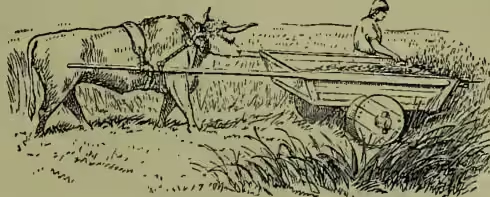
An attempt to trace the history of the reaping-machine would carry us far back into the earlier stages of agriculture. Pliny the Elder, who was born early in the 1st century of the Christian era, found a reaping-machine in Gaul. He says: 'In the extensive fields in the lowlands of Gaul vans of large size, with projecting teeth on the edge, are driven on two wheels through the standing corn by an ox yoked in a reverse position. In this manner the ears are torn off, and fall into the van.' Palladius, about four centuries later, found a similar appliance for reaping corn in Gaul. He gives a more detailed but similar description of the machine. Fig. 1, copied from Mr Woodcroft's Appendix to the Specifications of English Patents for Reaping-machines, represents what is conceived, from the descriptions, to have been the form of this ancient reaper.
In modern times the idea of a mechanical reaper appears to have originated with Capel Lofft (q.v.), who in 1785 suggested a machine something after the pattern of the ancient one described above. Between that time and the Great Exhibition of 1851 in London, from which the general use of mechanical reapers may be said to date, the patents taken out for reaping-machines were very numerous. Among the most promising of these may be mentioned those of Mr Gladstone of Castle-Douglas; Mr Smith of Deanston; Mr Kerr, Edinburgh; Mr Scott of Ormiston; Mr Dobbs, an actor in Birmingham; Mr Mann of Raby, near Wigton; and the Rev. Patrick Bell of Carmylie, Forfarshire. In 1826 Mr Bell constructed an efficient and simple machine, which long continued in use, and several features of which are observable in the reapers of the present day. The inventor of this, the first machine of the kind in Scotland, received a public testimonial from agriculturists, in consideration of the services he thus rendered to agriculture. In America Mr Hussey and Mr M'Cormick took out patents for reaping-machines of superior character in 1833 and 1834 respectively. The movements of the cutters of these machines were various. A few were advancing only, some sidelong and advancing, others reciprocating and advancing, a large number continuous and advancing, and others continuous and alternate. The reciprocating and advancing motion is that now employed on the machines in use.
The principal difference in the machines now so largely used for cutting corn is in the form and character of the cutters, and in the mode of delivering the grain after it is cut.
The cutting-knives are of two kinds—one, obtuse-angled and serrated; the other, acute-angled and for the most part plain. Both are attached to a bar, and are made to work through another bar of iron fitted with hollow fingers, called guard-fingers, which, projecting forwards, catch the standing corn, and retain it firmly until it is cut. The serrated knife saws through it, the plain knife clips it, as it were, the finger-guard forming the fixed blade of the scissors.
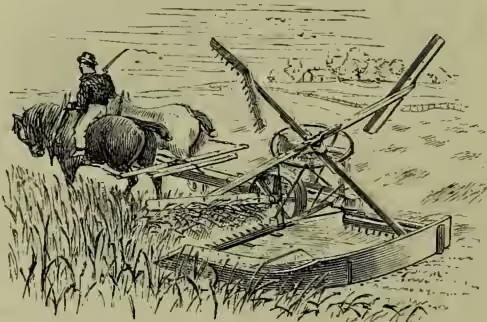
The delivery of the sheaves divides the machines into three kinds—(1) those delivered by manual labour; (2) those delivered by mechanical labour, or self-deliverers; and (3) combined reapers and binders, which deliver the sheaves ready bound. The delivery of the sheaves by manual labour is now chiefly at the back of the machine, the side-delivery being generally abandoned, unless in the self-deliveries. In delivering the grain, a man, with a short-handled rake in his hand, sits upon the machine almost opposite the cutting apparatus. With this he inclines the grain towards the knife; and, when sufficient has been cut to make a sheaf, he rakes it off the platform of the machine, on to which it has fallen, and deposits it on the ground. With the back-delivery the sheaves must be tied up and removed out of the way of the machine before it comes round again. Such a reaper, therefore, always requires a full supply of hands to attend upon it. Carefully handled, this machine will take up laid and twisted crops admirably. Its cost ranges from £18 to £25.
The mechanical or self-delivery machines, as they are generally called, are of two kinds—one lays the cut corn in swathes, the other deposits it the grain towards the cutter. By an ingenious eccentric motion, the rakes are made to sweep the sheaves off the platform at intervals of about 12 feet apart, to the side, and out of the way of the horses. The self-deliverer costs from £25 to £30.
The more recent automatic combined reaper and binder promises to supersede entirely all other reaping-machines. The general appearance and arrangement of Howard's light steel-frame sheaf-binder is shown in fig. 3. The cutting portion of the binder is very similar to that of an ordinary reaping-machine. The cut grain as it falls back on the machine is conveyed by an endless web over the top of the driving-wheel to the knocker. Here it falls into two arms called compressor jaws. These retain it on the knocker table till a sheaf of the prescribed size has accumulated. 'Whenever a sheaf of the desired size has been delivered to the compressors, these relieve the tripper, which sets in motion the needle (carrying the binding twine) and the knotting apparatus. The needle is circular, and in its course it passes the band (twine) round the sheaf, when the band is caught by the knocker, and almost instantaneously a firm and secure knot is tied, while the needle is drawn back ready to operate on a new sheaf. As soon as the knot is tied and the string cut, the sheaf is ejected from the machine in a horizontal position, dropping gently on the ground on its side quite clear of the machine' (Book of the Farm). With a moderate crop of standing grain the binder in its various improved forms does its work in a most admirable manner, though when the crop is badly 'laid' it cannot be used satisfactorily. It is expeditious, and surpasses all other methods in neatness and thoroughness of work. When the binder was first introduced wire was the binding material. There were strong objections to its use, however, and it was not until twine was substituted that the invention made any headway. There are now several British firms engaged in making binders, which are gaining in popularity year by year. A binder costs about £50.
See Woodcroft's Appendix to Patents for Reaping-machines; Mr Jacob Wilson's 'Essay on Reaping-machines,' in Transactions of Highland Society for January 1864; Book of Farm Implements and Book of the Farm, by Henry Stephens; J. C. Morton's Cyclopædia of Agriculture.