Red Deer, or STAG (Cervus elaphus), a large and very handsome animal, inhabiting some of the forests of Europe, West Asia, and North Africa. Those living in the more northern parts are smaller. In Britain red deer are found on Exmoor, in the Highlands of Scotland, and in some parts of Ireland.
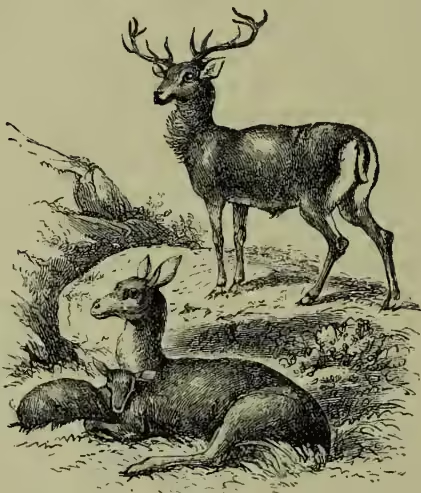
The full-grown animal stands over 4 feet at the withers, and is dark reddish brown in colour, slightly grayish in winter. The Antlers (q.v.), with which the rival males fight, belong to what is called the elaphine type, having protrusive brow-tines, well-marked bez-tines, a rounded beam, and terminal snags 'arranged in a cup or crown.' As usual, they are shed in the spring of each year, and gain 'points' with each year's fresh growth, a 'royal stag' having twelve, though this is not the maximum. Darwin mentions an antler 30 inches in length with fifteen snags, and another with thirty-three, while Flower refers to 'a pair of antlers, weighing 74 lb., and with forty-five points.'
The male stags are distinguished by the possession of antlers, and are rather larger and stronger than the females. Their voice is also stronger, for they bellow very loudly when enraged or when challenging their rivals. The combats are very fierce, and sometimes fatal even to both combatants, for their antlers sometimes interlock inextricably. In fighting, the projecting brow-tines form most effective weapons. The breeding season is in September or October, but the young are not born till the end of May or the beginning of June.
As in most species of Cervus they are first slightly spotted with white. In the first year the young male has only a hint of antlers, in the second year only small unbranched beams; thereafter a tine is gained each year. Nearly allied is the North American Wapiti (C. canadensis), and there are closely related species or varieties in Persia, Cashmere, and Tibet. Baillie Grohmann in Sport in the Alps (1896) has much about red deer. See DEER, DEER FORESTS, STAG-HOUND; Red Deer, by R. Jefferies (1884); and The Red Deer, by Macpherson and others ('Fur and Feather' Series, 1896).