Reed, in Music, the sounding part of several instruments, such as the clarionet, bassoon, oboe, and bagpipe, so called from its being made from the outer layer of a reed (Arundo sativa or donax) found in the south of Europe. The name is also applied to the speaking part of the organ, though made of metal. Reeds are generally divided into two kinds—the beating reed, used in the organ, clarionet, &c., requiring to be placed within a tube to produce a musical sound, and the free reed, used in instruments of the harmonium and concertina kind. The Organ (q.v.) reed (fig. 1) consists of a metal tube, a, with the front part cut away and having a metal (brass, German-silver, or steel) tongue, b, covering the orifice, attached at the upper end, and bent forward at the lower end to permit of vibration. The admission of a current of air to the outer tube causes the tongue to vibrate against the edge of the opening in the tube a, producing a musical note, the pitch of which is determined by the length of the free end of the reed;
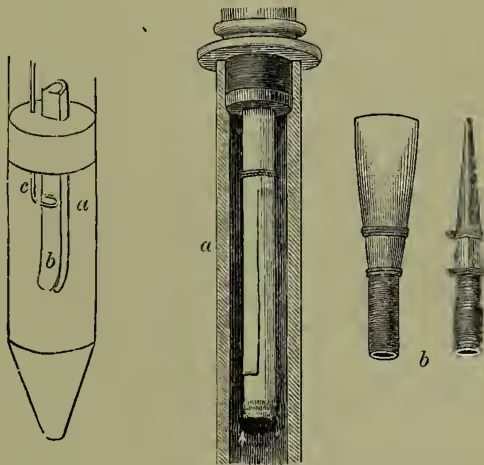
Fig. 2.
this is regulated by a strong movable spring, c, pressing against it, the quality of the sound depending on the length and form of the outer tube. In the Clarionet (q.v.) reed the mouth forms the outer tube. The reed in the drone of the bagpipe is on the same principle as the organ reed, and is made of a piece of reed tube a few inches long, cut across a knot at one end so as to make a stop. A slit is cut in it with a knife to make the tongue. It is shown in fig. 2, a, in situ, the outer tube being shown in section; the air enters from the bag in the direction of the arrow, the free end is the stopped one. The double beating reed (fig. 2, b) is that used in the bassoon, oboe, and the chanter of the bagpipe, and consists of two reeds, shaped so as to be tied together in the form of a tube at one end, either with or without the aid of a metal pipe, to fit the end of the instrument, and thinned away at the other end, where the two meet with a little space between them in the centre. The air being blown into the thin end causes the two reeds to vibrate against one another.
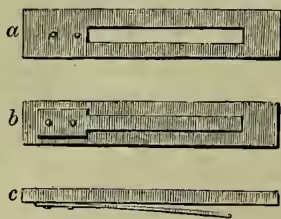
The free reed, shown in fig. 3, consists of a metal tongue, b and c, fixed at one end to a metal plate, a, having an elongated slot large enough to allow the free end of the tongue to vibrate through it on the admission of a current of air; and this vibration forms the note, the pitch of which is regulated by the length of the reed.