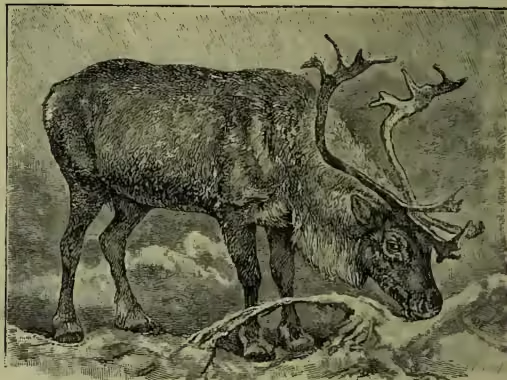
Reindeer, or CARIBOU (Rangifer tarandus), a species of deer, the only representative of the genus. It is a native of the northern parts of Europe, Asia, and America, and was introduced into Iceland in 1770. In Caithness it existed till the middle of the 13th century (Harting's Extinct British Animals, 1880). It is by far the most valuable of the deer, for not only are the flesh and skin of much use, but the animal has long been domesticated in Scandinavia, especially among the Laplanders. The wild reindeer of Lapland is almost equal in size to the stag, but there are great differences of size in different districts, the largest size being generally attained in the polar regions. The domesticated animal is never so large as the wild one; but that of Siberia is, like the wild one, much larger than that of Lapland. The reindeer is strong, somewhat heavily built, but yet very swift. The hair is longer in winter, and is gray or brownish in colour. The legs are short and thick, and the broad main hoofs spread out as the animal speeds over the snow. Besides the main hoofs, there are two accessory lateral hoofs. The head is carried horizontally, not erect as in other deer. The ruffle of the nose is hairy. The antlers are large and are unique in being possessed by both sexes. Moreover, they begin to appear at an early stage in life, within a few weeks after birth, and at the same time in both sexes, whereas in the other deer, in which only the males have antlers, they do not appear before nine months or more after birth. In the female the antlers are somewhat smaller, thinner, and less branched than in the male, and are retained through the winter until the breeding season in spring, after which they are cast. 'The male, on the other hand,' Darwin notes, 'casts his horns much earlier, towards the end of November.' There is great variability in the antlers; 'there is a "bez tine" as well as a "brow tine," which are peculiar in being either branched or palmate.' In summer the Lapland reindeer feeds chiefly on the shoots of willow and birch, while in winter it depends mainly on lichens such as the so-called reindeer moss. It seems that they use both their antlers and their hoofs in removing the snow which hides their food. The animals run swiftly, but not gracefully, taking long sliding strides, and their hoofs snap together as they run. In their natural life the reindeer are gregarious. They migrate from the mountains to the lowlands in winter, and return again in spring, a change in part dependent on the food-supply. Moreover, by leaving the lowlands in spring they free themselves from the gnats and gad-flies, which trouble them very seriously. It is said that the Lapps have to move their herds near the coast in the summer if the health of their stock is to be preserved, and sometimes an immense herd will rush in a headlong race to the sea.
In North America and elsewhere the reindeer is hunted for the sake of its flesh, fat, and hide. They are shot or trapped in snow pits. The flesh and fat are used in a fresh state or made into pemmican. The skin is used in many ways—for clothing, bedding, and the like. To the Laplanders 'the reindeer serves as a substitute for horse, cow, sheep, and goat,' but its domestication is not very complete. It constitutes the chief part of the Lapp's wealth, and some possess tame herds of two thousand or more, which feed chiefly in the mountainous regions in summer and in the lower grounds in winter. The animal can maintain a speed of nine or ten miles an hour for a long time, and can easily draw a weight of two hundred pounds besides the sledge. Almost every part of the dead animal is used in some way. The reindeer also yields excellent milk.