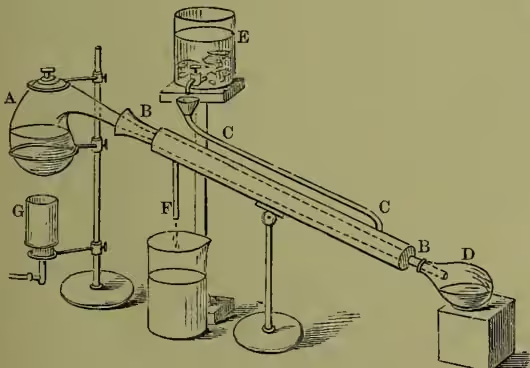
Retort, a vessel employed by chemists for the purpose of distilling or effecting decomposition by the aid of heat. It may be made of glass, earthenware, or metal, according to the purposes for which it is to be employed. Glass retorts are the most common, and their ordinary form is seen in the figure. They may be employed for the production of such products as do not require any extraordinary degree of cold for the condensation of their vapour—as, for instance, for the production of hydrocyanic or nitric acid. The globular vessel in which the neck of the retort is inserted is from its function termed the receiver. Cold may be applied to the neck of the retort—for the purpose of condensing the vapour—in various ways, as by the application of a cold wet cloth, by a current of water, or by a special apparatus known as Liebig's Condenser, shown in the figure at BB.
In ordinary cases requiring a higher temperature than glass could bear earthen retorts are used; for the preparation of hydrofluoric acid retorts of lead are employed; while for the preparation of strong sulphuric acid platinum is the best material for the retort. Iron retorts are employed in the laboratory for the preparation of oxygen from black oxide of manganese and some other processes, and in gas-works for the destructive distillation of coal. See DISTILLATION.