Rhinoceros. This genus, representing a distinct family of ungulate mammals, contains only five distinct species, to which another (R. lasiotis Schlater) may be perhaps (at present, however, doubtfully) added. These five species are distributed in the hotter parts of the Old World as follows: Africa contains two forms, which are often called the 'Black' and the 'White' rhinoceros. These terms are, however, very inapt, since both of them are of a grayish black; in colour there is but little difference between R. simus and R. bicornis. They may, however, be distinguished by other points—the first species is much larger, and has a flat nose and square upper lip, while R. bicornis has the upper lip prolonged so as to enable it to seize and break off branches. Correlated with this structural difference is one of habit; R. simus grazes, while R. bicornis feeds chiefly upon shrubs. A number of other species have been stated to occur in Africa, but it appears that these 'species' have been for the most part founded upon unimportant differences in the length of the two horns with which these animals are furnished. In Asia there are at least three well-marked species of rhinoceros. The large one-horned species, R. unicornis, occurs only in Nepal, Bhotan, and Assam; it is a very big species. A specimen in the Zoological Society's Gardens measured over 10 feet in length and a little more than 5 feet in height at the shoulder. It has enormous folds of skin, which give it the appearance of being 'armour-plated.' The African species have a smooth, though of course very thick, skin. The second Asiatic rhinoceros is R. sondaicus, which is smaller than the last, though also one-horned; it occurs in Java, Burma, and the Sundarbans near Calcutta. The two-horned Asiatic rhinoceros (R. sumatrensis) is found in Malacca, and R. lasiotis, from Chittagong, eastern Bengal, is hardly separable from it.
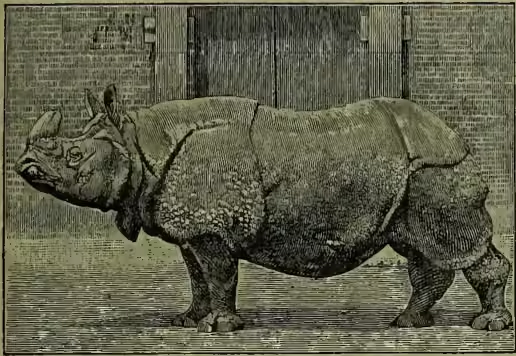
(From a Photograph by Gambier Bolton, F.Z.S.)
Rhinoceroses were more abundant in earlier periods of the earth's history than they are at present; one form (Aceratherium) existed without the characteristic horn or horns, while another (Diceratherium) had the horns placed side by side instead of following each other. The animals are now a waning race, and African hunters report their diminished numbers in that continent. One of the principal authorities upon African rhinoceroses—Mr F. C. Selous—has brought forward facts which tell of the approaching extinction of these great quadrupeds in South Africa. 'Twenty years ago,' he says, 'this animal [R. simus] seems to have been very plentiful in the western half of South Africa; now (1881), unless it is still to be found between the Okavango and Cunene rivers, it must be almost extinct in that portion of the country. And this is not to be wondered at when one reads the accounts in Andersson's and Chapman's books of their shooting as many as eight of these animals in one night as they were drinking at a small water-hole; for it must be remembered that these isolated water-holes at the end of the dry season represented all the water to be found over an enormous extent of country, and that therefore all the rhinoceroses that in happier times were distributed over many hundreds of square miles were in times of drought dependent upon perhaps a single pool for their supply of water. In 1877, during several months' hunting in the country to the south of Linyanti, on the river Chobe, I only saw the spoor of two square-mouthed rhinoceroses, though in 1874 I had found them fairly plentiful in the same district; whilst in 1879, during eight months spent in hunting on and between the Botletle, Mababe, Machabe, Sunta, and Upper Chobe rivers, I never even saw the spoor of one of these animals, and all the Bushmen that I met with said they were finished.' The rhinoceros has got the reputation of being a savage creature, and there are terrible stories of encounters; these, however, appear to have been greatly exaggerated, though individuals may be vicious at times. All the species of rhinoceros have been exhibited in Europe with the exception of R. simus.
The rhinoceros, united with the horse and tapir, forms the Perissodactyle division of the Ungu- lata (q.v.). The Asiatic rhinoceroses are distinguished from the African forms by the presence throughout life of functional incisor teeth. Professor Flower has shown that in other (osteological) characters the African species are to be contrasted with the Asiatic; in spite of its two horns, R. sumatrensis is more closely allied to R. unicornis than to R. bicornis; even the fossil species are referable for the most part to one or the other group. The Siberian R. tichorhinus, of which a specimen, partly preserved through its being frozen, was found by the Russian naturalist, Pallas, belongs to the African group, which is sometimes separated under the generic name of Atelodus.