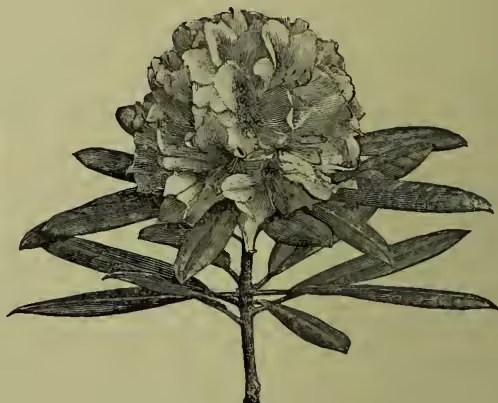
Rhododendron (Gr., 'rose-tree'), a genus of trees and shrubs of the natural order Ericææ, having ten stamens, a very small calyx, a bell-shaped or somewhat funnel-shaped corolla, and a capsule splitting up through the dissepiments. The buds in this and nearly allied genera, as Azalea (q.v.), are scaly and conical. The species are numerous; they have evergreen leaves, and many of them are of great beauty both in foliage and in flowers. A few small species are natives of continental Europe and of Siberia; but the greater number belong to the temperate parts of North America, and to the mountains of India. R. maximum, so designated when the far larger Indian species were unknown, is common in Britain as an ornamental shrub. It is a large shrub or small tree, which forms impenetrable thickets on many parts of the Alleghany Mountains, and has a magnificent appearance when in flower. The leaves are large, oblong, acute, stalked, leathery, dark green and shining above, rusty brown beneath. The flowers are large, in umbellate corymbs, varying in colour from pale carmine to lilac. This species is quite hardy in Britain; as is also R. ponticum, a very similar species, with narrower and more pointed leaves, which are of the same colour on both sides, a native of western Asia, and apparently also of the south of Spain. R. Catawbiense, a native of the southern parts of the Alleghanies, with large purple flowers; R. Caucasicum, the name of which indicates its origin; and R. arboreum, a native of Nepal, with very dense heads of large scarlet flowers, and leaves 4-6 inches long, attaining in its native country a height of 30 or 40 feet, are also fine species, and well known. Most of the extremely numerous varieties now common in our gardens and shrubberies have been produced from them by hybridising or otherwise.—Many splendid species of rhododendron were discovered in the Himalayas, the Khasia Hills, and other mountainous parts of India, by Dr Hooker and others; and many of them have been introduced into cultivation in Europe. R. Falconeri is described as in foliage the most superb of all, the leaves being 18 or 19 inches long. It is a tree 30-50 feet high, with leaves only at the extremities of the branches. It grows in eastern Nepal at an altitude of 10,000 feet. R. argenteum has flowers 4½ inches long, and equally broad, clustered, and very beautiful. R. Maddenii, R.
Aucklandii, R. Edgeworthii, and others have white flowers. R. Dalhousiae is remarkable as an epiphyte, growing on magnolias, laurels, and oaks. It is a slender shrub, bearing from three to six white lemon-scented bells, 4½ inches long, at the end of each branch. R. Nuttallii has fragrant white flowers, said to be larger than those of any other rhododendron. All these belong to the Himalayas. In more southern latitudes, as on the Neigherry Hills and on the mountains of Ceylon, R. nobile prevails, a timber-tree 50 to 70 feet high, every branch covered with a blaze of crimson flowers. R. Keysii and R. Thibaudicense, also natives of the north of India, have flowers with nearly tubular corolla. R. ferrugineum and R. hirsutum are small species, shrubs from 1 to 3 feet in height, natives of the Alps, and among the finest ornaments of alpine scenery. They are called Alpenrose (Alpine Rose) by the Germans. They have small carmine-coloured flowers in umbellate clusters. The mountain-slopes glow with their blossoms in July and August. The flora of the Himalayas contains a number of similar small species. R. anthopogon and R. scotum, dwarf shrubs with strongly-scented leaves, clothe the mountains in eastern Nepal, at an elevation of 12,000 feet and upwards, with a green mantle, brilliant with flowers in summer. R. nivale is the most alpine of woody plants, spreading its small woody branches close to the ground at an elevation of 17,000 feet in Sikkim. R. lapponicum, a procumbent shrub, with small flowers, grows as far north as human settlements have reached in Europe, Asia, and America. Some of the species of this genus possess narcotic properties. An oil obtained from the buds of R. ferrugineum and R. hirsutum is used by the inhabitants of the Alps, under the name Olio di Marmotta, as a remedy for pains in the joints, gout, and stone. R. chrysanthum, a low shrub, with golden yellow flowers, a native of Siberia, is also used in gout and rheumatism. R. cinnabarinum, a Himalayan species, poisons goats which feed upon it, and when used for fuel causes inflammation of the face and eyes. But the flowers of R. arboreum are eaten in India, and Europeans make a palatable jelly of them.