Rhubarb (Low Lat. rheubarbarum, from Gr. rhēon barbaron, literally 'barbarian rheum'; rhēon is an adjective from rha, 'the plant found near the river Rha'—i.e. the Volga; the botanical name being simply rheum), a genus of plants of the natural order Polygonaceæ, closely allied to Rumex (dock and sorrel), from which it differs in having nine stamens, three shield-like stigmas, and a three-winged achenium. The species, about twenty, are large herbaceous plants, natives of the central regions of Asia, with strong, branching, almost fleshy roots; erect, thick, branching stems, sometimes 6 or 8 feet high; the stems and branches whilst in the bud covered with large membranous sheaths. The leaves are large, stalked, entire or lobed; the flowers are small, whitish or red, generally very numerous, in large loose panicles of many-flowered clusters. The roots are medicinal; but it is not definitively known what species of rhubarb yields the valued rhubarb of commerce, which comes from inland parts of China or Chinese Tartary. The bulk of it reaches Europe now direct from China, but the best, in limited quantities, is brought through Russia. It is commonly known in Britain as Turkey Rhubarb, because it was formerly brought by way of Asiatic Turkey.
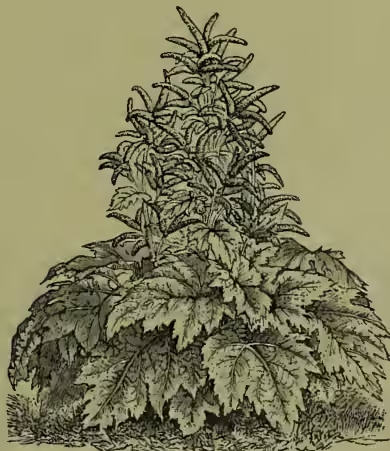
The leaf-stalks of rhubarb contain an agreeable mixture of citric and malic acids, and when young and tender are much used, like apples, for tarts and various kinds of preserves. A kind of wine may also be made of it. For these purposes different kinds of rhubarb are now very extensively cultivated in Britain, and in other temperate and cold countries. A number of species have been introduced into cultivation for their leaf-stalks. The cultivated kinds, R. undulatum, R. rhaponticum, and R. hybridum, with endless varieties produced by the art of the gardener, all have broad, heart-shaped, undivided leaves, and the leaf-stalks flattened and grooved on the upper side. The leaf-stalks are often also of a reddish colour, which in some of the finest varieties pervades their whole flesh. Rhubarb is cultivated on a most extensive scale by market-gardeners. It is forced in winter and early spring by being placed in pots within houses, or by having pots inverted over it, and dung and straw heaped around; and forced rhubarb is more tender and delicate than that which grows in open air. The stalks when blanched are much less harsh in taste and require less sugar to be rendered palatable. It is largely grown also in many parts of the United States.
The well-known medicinal R. officinale differs considerably in appearance from the kinds preferred in kitchen-gardens; the petioles are nearly round, and the under side of the leaf is covered with small, erect hairs. The numerous varieties of commercial rhubarb may be thrown into two groups: (1) Asiatic Rhubarbs—Chinese, passing under the names of Russian, Muscovy or Turkey, Canton or East Indian, Batavian or Dutch trimmed, yielded probably by R. officinale and a variety of R. palmatum; Siberian, by R. rhaponticum; Himalayan large, by R. emodi, and small by R. webbianum; Bokharan or Bucharian, by R. undulatum. (2) European Rhubarbs—English, by R. rhaponticum and R. officinale; French, by R. rhaponticum, compactum, and undulatum; Austrian (Moravian), by R. rhaponticum. R. palmatum is believed to produce some of the best Russian rhubarb. Whether R. officinale occurs in Shan-hsi and Sze-chwan, from which provinces the true rhubarb is chiefly obtained and sent to Hankow, is not definitively known. The export of rhubarb from China (the so-called Turkey Rhubarb) has largely increased of late years. The average shipments of the four years ending with 1889 were 7500 cwt. per annum, against less than 4000 cwt. twenty years before. The Chinese rhubarb is of very variable quality, whole chests of to 3 cwt. sometimes affording but a few pounds of sound roots. The Shan-hsi rhubarb used to be the best in the market, the roots being large, smooth, and extremely fragrant. It is now, however, of inferior quality, and dried with less care, apparently in ovens, in which case it soon rots in the centre, or is attacked by insects. Sze-chwan furnishes a good and cheap rhubarb, esteemed in the London market, where it is known as 'high-dried Shanghai rhubarb.' The roots are small, rough on the exterior, deficient in flavour, and when cut give out little scent. The plant from which the Java rhubarb is derived is not known; it resembles the Chinese in smell and taste, but its activity is one-fourth less.
The rhubarb plant is distributed through an immense tract of country in the central provinces of China; probably several species yield the same drug. According to Professor Maximowecz, R. palmatum is probably the plant producing the drug whose reputation dates from the time of the Arabian and Greek physicians. It was introduced by Dr Mounsey from Russia to Great Britain, and cultivated at Edinburgh by Sir A. Dick prior to 1774. Garden rhubarb (R. rhaponticum) was in use in England in the time of Charles II. The medicinal root is now grown extensively in England, France, Germany, Austria, St Petersburg, and other parts of Europe. It is very difficult to distinguish between the true Chinese rhubarb and the root obtained in Europe by the culture of various species of Rheum. According to Cauvet, the European may be distinguished from the exotic by (1) the rectilinear disposition of its rays, from the centre to the circumference; (2) the presence upon its circumference of a brown zone, relatively large and especially very distinct; and (3) the absence of the radiated systems (stars) so numerous in the Russian rhubarb, less frequent, but always easy to recognise, in the Chinese. In the true rhubarb the rays are dispersed irregularly over the fractured surface. Some English rhubarb, probably obtained from R. rhaponticum, is readily distinguished from Chinese by being less marbled upon the fracture, and by the absence of the diamond-shaped meshes upon its surface. There were formerly three classifications of rhubarb—Russian, Turkish, and Chinese or East Indian, but these are now reduced to European and Chinese. Before the opening of the treaty ports in China most of the rhubarb consumed in Europe was obtained from the Chinese at Kiachta, carefully selected and brought overland through Russia, which has entirely lost this prized monopoly, the quantity now conveyed there overland from China being insignificant. Chinese rhubarb, received direct, is distinguished by the small size, dark colour, and irregular shape of the holes with which it is pierced; by the outer surface being frequently marked with whitish reticulations, which are more evident when the powder has been rubbed off; and by the transverse surface showing a number of star-like marks, but no cortical layer. The plant is hardly cultivated in China, but grows wild. The root-stocks are dug up when from six to seven years old, just before the flowering season. They are then peeled, cut in lengths measuring 4 to 5 inches, bored through the middle, placed on strings and hung up to dry. There is considerable diversity of form in the China rhubarb, arising from the various operations of paring, slicing, and trimming; but these forms are not found in the same package, the drug being usually sorted into what are commonly known as 'rounds' and 'flats.' The Indian rhubarb is frequent in parts of the Punjab Himalayas from 7000 to 14,000 feet. It is less active than the imported rhubarb, and has been often pronounced worthless; but, according to Dr Watt, this is owing to the fact that an inferior variety reaches the plains. The whole sour stems are eaten both stewed and raw, while the leaves of this and other species are dried and smoked in Tibet and in the Eastern Himalayas.
Rhubarb is not individually mentioned now in the official trade returns, but is included with 'unenumerated drugs.' Since 1870, when the imports were 343,000 lb., and the average prices ranged from 3s. 4d. to 5s. 6d. per lb., the supplies have increased and prices have fallen by one-half. The production of English grown rhubarb root now amounts to about 12,000 lb. annually, of which from three to four thousand pounds are exported.
Chemically, rhubarb consists of mucilage, oxalate of lime, an albuminoid containing nitrogen and sulphur, crystalline resins, tannin, gallic acid, sugar, chrysophane (decomposable into chrysophanic acid and glucose), rheotannic acid, and emodin.
Rhubarb may be briefly described as a cathartic, an astringent, and a tonic. As a cathartic it chiefly operates by increasing the muscular action of the intestines; and when the cathartic action is over there is generally more or less constipation. Rhubarb is one of the best aperients for general use in infancy, in consequence of the certainty of its action, and of its tonic and astringent properties, which are of much importance in the treatment of many infantile diseases attended with imperfect digestion and irritation of the intestinal canal. In adults it is serviceable in chronic diarrhoea and dysentery, when it is expedient to clean out the bowels. It is also a useful aperient in convalescence from exhausting disease, as being free from the risk of overacting; and, for the same reason, it is a useful medicine for persons who are constitutionally liable to over-purgation from trivial causes.