Ring Ouzel (Turdus torquatus, or Merula torquata), a species of thrush, rather larger than a blackbird. It is a native chiefly of the western parts of Europe; it spends the winter in the south of Europe, Northern Africa, Syria, and Persia, and visits more northern regions in summer. It occurs frequently in many parts of the British Islands, where it breeds even in the Orkneys, but in very few districts does it remain all the year round. It is seldom seen in the more cultivated and thickly-peopled districts, preferring mountains, heaths, and their vicinity. It begins to breed in the later part of April, and makes its nest generally in heathy banks, often under a bush.
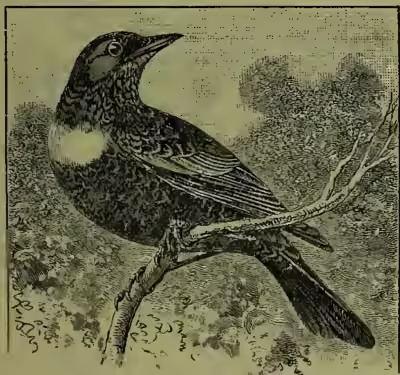
The nest is made of coarse grass, within which is a thin shell of clay, and an inner lining of fine dry grass. The eggs are usually four in number, and are greenish blue in colour, flecked and spotted with reddish brown; and not infrequently there is a second brood in July. The food consists of worms, slugs, insects, and moorland berries, and the bird often makes raids upon fruit-gardens in its neighbourhood; while in vine countries it feeds largely upon grapes. In some parts of Scotland it is known as the Moor Blackbird. It is of a dark-brown, almost black, colour; the feathers are edged with blackish gray, the wing feathers more conspicuously with gray, and there is a broad crescentic white gorget—whence the name. The legs and feet are brownish black. The female is lighter and browner, with a narrower and duller gorget. The song consists of a few loud, clear, and plaintive notes, but is somewhat monotonous. See also OUZEL, and for the Water Ouzel, DIPPER.