Ring (Sax. ring or hring) is any circle or section of a cylinder. Rings of gold, silver, and of other metals and materials have been worn in all times and countries, and while they have been used to decorate the ears, neck, nose, lips, arms, legs, and toes, finger-rings have always occupied the most important and significant place among such ornaments. From the earliest period of civilised relationships the finger-ring was a convenient means for carrying the signet of its wearer. In Genesis, xxxviii. 17, 18, we read that Judah left his signet as a pledge with his daughter-in-law; and in chap. xli. 42 it is narrated that Pharaoh delivered to Joseph his royal signet as a token of deputed power and authority. From the fact that these ancient rings carried engraved signets early ring-lore is intimately mixed up with the origin and development of gem and seal engraving. Herodotus mentions the wearing of finger-rings by the Babylonians; and from Asia the habit probably passed into Greece, although the Homeric poems mention ear-rings alone. In the later Greek legends the ancient heroes are described as wearing rings, and every freeman throughout Greece seems afterwards to have possessed one. The Lacedæmonians wore iron rings. The Romans are said to have derived the use of rings from the Sabines; their rings were at first, as those of the Greeks, signet-rings, but made of iron. Every free Roman had a right to wear one; and down to the close of the republic the iron ring was worn by those who affected the simplicity of old times. Ambassadors, in the early age of the republic, wore gold rings as a part of their official dress—a custom afterwards extended to senators, chief-magistrates, and in later times to the equites, who were said to enjoy the jus annuli aurei, from which other persons were excluded. It became customary for the emperors to confer the jus annuli aurei on whom they pleased, and the privilege grew gradually more and more extensive, till Justinian embraced within it all citizens of the empire whether ingenui or libertini. Rings entered into the groundwork of many oriental superstitions, as in the legend of Solomon's ring, which, among its many magical virtues, enabled the monarch to triumph over all opponents, and daily to transport himself to the celestial spheres, where he learned the secrets of the universe. The Greeks mention various rings endowed with magic power, as that of Gyges, which rendered him invisible when its stone was turned inwards; and in old Saxon romances a similar ring legend is incorporated. The ring of Polycrates (q.v.), which was flung into the sea to propitiate Nemesis, was found by its owner inside a fish; and there were persons who made a lucrative traffic of selling charmed rings, worn for the most part by the lower classes. By many Mussulmans at the present day a ring having enclosed in it a verse from the Koran is worn as an amulet.
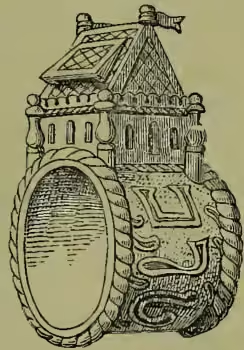
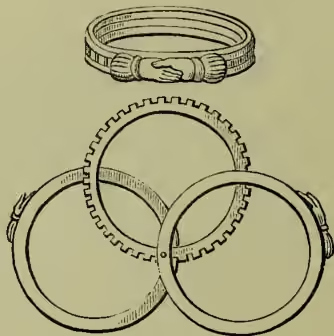
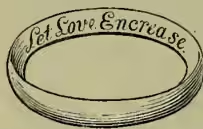
Various explanations have been given of the connection of the ring with marriage. It would appear that wedding-rings were worn by the Jews prior to Christian times. Fig. 1 shows a Jewish marriage-ring beautifully wrought in gold filigree, and richly enamelled, now in the possession of Lord Londesborough. It has been said that as the delivery of the signet-ring to any one was a sign of deputing or sharing of authority, so the delivery of a ring by husband to wife indicated her admittance to share his rights and privileges. In pagan times in Europe the ring seems to have been connected with fidelity or with espousals. Fig. 2 shows a form of betrothal-ring called a gimmel, or linked ring, which was used in later times; the upper fig. shows the three parts brought together, the lower fig. the parts separately. By an ancient Norse custom, described in the Eyrbyggja Saga, when an oath was imposed, he by whom it was pledged passed his hand through a silver ring, sacred to that ceremony; and in Iceland the ceremony of betrothal used to be accompanied by the bridegroom passing his four fingers and thumb through a large ring, and in this manner receiving the hand of the bride, as is represented in a woodcut in an old edition of Olaus Magnus. As lately as 1780 the practice existed in Orkney of a man and woman plighting their faith at the Standing Stones of Stennis by joining their hands through the perforated Stone of Odin. For betrothal, as well as for marriage, a ring is commonly bestowed; and in many countries both spouses wear wedding-rings. Although the third finger of the left hand is the official finger, rings are worn on all fingers, and in mediaeval times even the thumbs were frequently decorated with large and massive rings. During the 16th, 17th, and 18th centuries it was a very common practice to have mottoes inscribed on rings (fig. 3), including wedding-rings, and the motto was called the posy or chanson. The ring was the symbol of the dominion of Venice over the Adriatic; and yearly, on
Ascension Day, a ring was thrown by the Doge from the ship Bucentaur into the sea, to denote that as the wife is subject to her husband, so is the Adriatic Sea to the republic of Venice. The reception of a ring forms an essential feature in the investiture of many Catholic dignitaries; and even in the Anglican communion a sapphire 'pontifical' ring was presented in September 1891 to the new Archbishop of York. The 'fisherman's ring,' containing an engraved representation of St Peter in an ancient fishing-boat, is the official ring of investiture of the pope. It is broken and remade on the death of each pontiff, and when presented to the new head of the church he declares the name under which he desires to rule, which name is thereafter engraved on it. Cardinals on their elevation receive a sapphire ring, and bishops on their consecration are also invested with a special ring. The reception of novices into Catholic sisterhoods is accompanied with the presentation of a ring, which is worn as a badge of espousal to the church. In the investiture of sovereigns the ring also occupies an important place in the coronation ceremonial. In addition to these, special rings were formerly worn by serjeants-at-law, who also on receiving silk made presents to various functionaries of rings (100 sometimes, costing £55 in all, cf. Notes and Queries, 1884). Moreover, the knightly orders, masonic bodies, and merchants employed distinctive rings for enabling them to claim the privileges of their orders or to facilitate their business. The carrying of seals attached to the watch-chain in the first place, and next the introduction of gnmmed envelopes, have had no small influence in decreasing the official importance of rings.
See the article GEM; Finger-ring Lore, by W. Jones (1877), an elaborate compilation of the practices, superstitions, and traditions connected with rings. See also King's Antique Gems and Rings (1872); History and Poetry of Finger-rings, by C. Edwards (New York, 1880); articles by Waterton, Fortnum, and others in Archaeological Journal; and F. Schneider, Die Gestaltung des Ringes vom Mittelalter bis in die Neuzeit (Mainz, 1878).