Roads. Roads form a primary element in the material advancement of a nation, being essential to the development of the natural resources of the country. Canals and railways have no doubt, in modern times, superseded to some extent the common highways; still these retain their importance, were it only as essential auxiliaries.
The Romans were great constructors of roads, and regarded them as of vital importance for conquest and the maintenance of their empire. They are said to have learned the art from the Carthaginians. Except where some natural barrier made it impossible, the Roman roads were almost invariably in a straight line; probably because the chief means of transport then in use were beasts of burden, and not wheeled vehicles, which made the preservation of the level of less consequence. The substantial character of the Roman roads is well demonstrated by the fact that they have in some instances borne the traffic of 2000 years without material injury. The plan of construction was pretty uniform, being that described in the article on the APPIAN WAY, one of the earliest and most famous of them; another was the Flaminian Way (q.v.). They varied in breadth from 15 to 8 feet, and had often raised footpaths at the side, and blocks of stone at intervals, to enable travellers to mount on horseback (see also PAVEMENT). The Roman empire was ultimately intersected by roads—not merely Italy, Spain, Gaul, Illyricum, Macedonia, Thrace, &c., but even in Egypt. In Britain the main lines of Roman roads were four; Elton (in his Origins of English History) gives them as follows: 'The Watling Street represents the old zigzag route from Kent to Chester and York, and northwards in two branches to Carlisle and the neighbourhood of Newcastle. The Fosse Way ran diagonally through Bath to Lincoln. The Ermin Street led direct from London to Lincoln, with a branch to Doncaster and York; and the obscure Ikenild Street curved inland from Norwich to Dunstable, and was carried eventually to the coast at Southampton.' Watling Street and Ikenild or Icknield Street have separate articles in this work.
The roads made by the Romans in Great Britain gradually fell into decay, and the attempts that were now and then made to repair them were insufficient to prevent England falling into a worse state with respect to its highways than most other European countries. In 1285 one of the earliest laws on the subject of roads was passed. It directed that all trees and shrubs be cut down to the distance of 200 feet on either side of roads between market-towns, to prevent the concealment of robbers in them. The first toll for the repair of roads was levied by the authority of Edward III. in 1346, on roads which now form part of the streets of London. In 1555 an act was passed requiring each parish to elect two surveyors of highways to keep them in repair by compulsory labour; at a later period, in place of the compulsory labour, the 'statute labour-tax' was substituted. But long after this the roads even in the neighbourhood of London were wretchedly bad, and in the other parts of the country they were still worse. For the most part, indeed, they were mere horse-tracks; the chief advantage in following them being that they led along the higher grounds, and so avoided bogs. These trackways were usually impassable in winter, being narrow, and in many places so deep and miry as to be liker ditches than roads. So late as 1736 the roads in the neighbourhood of London were so bad that in wet weather a carriage could not be driven from Kensington to St James's Palace in less than two hours, and sometimes stuck in the mud altogether. Much curious information on the state of the roads and means of conveyance in England during the long period which elapsed from the decay of the Roman roads to the middle of the 18th century, will be found in vol. i. of Smiles's Lives of Engineers. The Highlands of Scotland were opened up by the roads made by General Wade about 1725.
In laying out a new line of road the skill and ingenuity of the engineer are taxed to make the gradients easy, with as little expense as possible in excavating and embanking, and to do so without deviating much from the direct course between the fixed points through which the road must pass. To succeed well in this an accurate survey of the tract, including the relative levels of its different parts, and the nature of the strata, is a necessary preliminary. The formation of an extended line of road often involves the construction of extensive bridges, viaducts, and the like, which require the greatest engineering skill.
The importance of easy gradients or inclinations in roads is well understood in a general way; but it gives a more precise idea of it to state that, while, for example, the traction force requisite to draw a wagon weighing 6 tons along a level macadamised road is 264 lb., on a road of the same kind with an ascent of 1 in 50 the traction force is just double, or 533 lb., the speed of the wagon being 3 miles an hour. Compared with this, a stage-coach travelling on the level at the rate of 6 miles an hour, and weighing 3 tons, requires a traction force of 362 lb.; but the resistance on a hilly road is less unfavourable to the coach than to the wagon, because with an incline of 1 in 70 the forces neces- sary to draw the two vehicles are about equal, and the force is proportionally greater for the wagon as the incline increases. Experience seems to show that for a macadamised road the maximum slope should be 1 in 40, although a horse with a moderate load can easily enough trot over a gradient of 1 in 33. On the other hand, as it is not desirable for drainage to have a road perfectly level, the best minimum slope, in a longitudinal direction, has been variously given at from 1 in 80 to 1 in 125. The resistance to moving vehicles is less on paved than on 'metalled' roads; hence the maximum slope of the former should be less than that of the latter, from the greater tendency of a cart or coach to slide down the smoother surface.
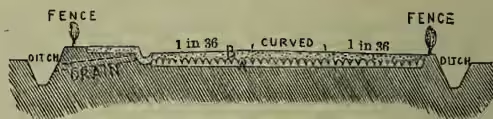
What is the best transverse form for a road has been a much-debated question among engineers. It should be higher in the middle than at the sides; but some have thought it should be much higher than others. As a road can be better kept clear of water by a slight inclination in the direction of its length than by any form which can be given to its cross section, it has been found preferable that it should be as nearly flat as possible, because every part of its breadth will then be equally available for traffic; whereas it is almost necessary to keep on the centre of a highly convex road, and consequently wear deep furrows there, by confining the wheels and horses to pretty much the same track. The figure shows a transverse section of a road in the form of a segment of a circle—the most approved form—with only a slight rise in the centre. The slope from the side to the middle should not exceed 1 in 36.
As respects the construction of the road itself, the first point to consider is the foundation or sub-road. The majority of roads have no artificial foundation. In such cases the surface on which the road-material is to be laid is generally made as solid as possible by means of efficient drainage, and by rolling and beating wherever there are embankments formed. It is the question whether or not a road should have a foundation of rough pavement below the broken stone covering which is the essential point of difference between the two great rival systems of Telford and Macadam. Telford, who began to construct roads in 1803, considered it of great importance that there should be such a foundation. He made it of stones varying in depth from 9 inches at the centre to 3 inches at the sides of the road, these being set with their broadest edge downwards, and no stone being more than 4 inches broad upon the upper edge; upon these were placed a coating of broken stones not exceeding 6 inches in thickness. The Glasgow and Carlisle and the Holyhead roads are excellent examples of the enduring character of those made on Telford's plan.
Macadam (q.v.) preferred a yielding and soft foundation to one which was rigid and unyielding, so that even on boggy ground, if it were but firm enough to allow of a man walking over it, he considered an artificial bottoming quite unnecessary. His roads were formed entirely of angular pieces of stone of such a size as to pass freely through a ring inches in diameter. This plan, first put into practice about 1816, has now fewer advocates than Telford's, or than the one subsequently proposed by Mr Thomas Hughes, where a concrete of gravel and lime is employed for the foundation of the road. But experience has shown that, except in the case of streets with very heavy traffic, Macadam's plan of employing angular pieces of stone is superior to every other as a mere covering for roads, whether they have an artificial foundation or not. So popular at one time was the system of macadamising that expensively paved streets were torn up to be re-formed on the new plan. The advantage of angular pieces of stone is that they dovetail into each other, and do not roll about like gravel.
A few of the best metropolitan roads which are not paved have a Concrete (q.v.) foundation with a layer of broken granite on the top of it. But even for the first-class macadamised roads of London the more general construction is to have a bottom or foundation of 'hard core' laid upon the natural surface levelled to receive it. This is composed of some cheap or waste material which is sufficiently hard and strong, such as fragments and clips of building stone and brick, or pieces of broken-up concrete, the whole layer being a foot thick until it is reduced by heavy rollers to about 9 inches. To fill up the interstices in this bottom, and to form a bed for the 'macadam,' a 5-inch layer of ballast is next put down and also compressed by rolling. The surface layer of the road, consisting of rough broken granite, is then laid down, first one layer 3 inches thick, and then a second layer of the same thickness. Both layers are separately rolled to a combined thickness of 4 inches, sand and water being put on the surface of the upper layer beforehand. The London macadamised roads over which there is a less heavy traffic have a somewhat thinner 'hard core,' covered with 4 inches of broken granite without a ballast layer. Broken flint is sometimes used instead of granite, and these second-class roads are only in some instances rolled. All roads of this nature should, however, be rolled.
In some English counties where flints are abundant the roads are made altogether of this material. Large pieces—say 7 inches or more across—form the bottom or foundation, which is 12 or 13 inches thick, and above this a 6-inch layer of flints, broken to the usual size of to inches across, forms the surface, which is not generally rolled. In some of these country roads broken bricks or other hard waste material are put in as a bottom layer, with broken flints above. Large pieces of flint make an excellent foundation for such roads; but this material is too brittle to form a good surface layer.
The roads in many parts of Scotland and also in some English counties are macadamised with some variety of trap rock, such as basalt or dolerite (see BASALT). These are usually called whinstones, a term also applied to some very hard sedimentary rocks. Most of these form a good road covering. In the granite districts granite is used; Gurney granite is one of the most durable kinds for heavy traffic. Hard limestone forms a very smooth and pleasant road; but many limestones and most sandstones are too soft for road metal, the stone for which should be tough as well as hard. Greywacke rock is also used.
The construction of paved streets is noticed under PAVEMENT; but we may state here that experience has shown that for heavy traffic the best road or street for a town is that formed of asphalt, 2 inches thick, on a foundation of concrete 6 inches thick. Its qualities of durability and cleanliness outweigh the disadvantage of its slipperiness. See ASPHALT.
It will be apparent from what has been said that drainage is in great part secured by the plan on which a road is made. What further drainage a road requires can in many situations be effected by ditches on either side. Where this is not possible, as in the case of portions situated in cuttings more or less deep, proper drains require to be constructed. In such circumstances a drain is either made down the centre, with branch-drains from the sides running into it; or drains are formed along the sides, with gratings at proper intervals to take in the surface-water.
Cyclists have established a Roads Improvement Association, which seeks to stimulate the local authorities to keep the roads in good repair.
See works on road-making by W. M. Gillespie (new ed. 1871), Codrington (1876), Gilmore (1876), Law and Clark (new ed. 1881), F. W. Simms (new ed. 1884), and Threpp (1887); also Jusserand's English Wayfaring Life in the Middle Ages (Eng. trans. 1888), and W. C. Sydney's England in the Eighteenth Century (1891).
Roads in Law.—Roads are included under the general name of highways, a highway being defined as a place over which a right of walking, riding, or driving is enjoyed by the public generally. It is called the King's (or Queen's) highway, because the sovereign is protector of the commerce of his subjects, and as such empowered to make regulations for traffic by sea and land. Highways are of several kinds—footways; foot and horse ways, sometimes called bridle-paths; pack and drift ways, used for driving cattle and pack-horses; foot, horse, and cart ways, over which the public may travel with vehicles of all ordinary descriptions. Navigable rivers are also described as highways. Where a Right of Way (q.v.) belongs not to the public generally, but to the owners or occupiers of land or house property, the way in question is private, not public, and the right to use it is classed among Easements (q.v.). A public way may exist over a place which is not a thoroughfare, as, for example, a street closed at one end. Highways are created by an express or implied grant, whereby the owner of the land dedicates it to the use of the public, by the necessity of things or by act of parliament. If an owner permits the public to pass and repass over his land without interruption, it is presumed that he intends to grant a public right of way; he loses his right to exclude the public, and the way is a highway for ever, unless it should be closed by a public authority under an act of parliament. Public rights may be limited to a particular purpose, as where the inhabitants of a parish have the right to use a way in going to or coming from church. If a highway be out of repair passengers may go over adjacent land; but this is a right to be exercised with caution. Any obstruction placed upon a public way is a Nuisance (q.v.), and may be abated or removed by any person aggrieved. Every part of a highway is equally open to the public; a foot passenger may walk on the carriage-way, and a blind or aged person has as good a legal right to be on the road as any one else. But passengers must use ordinary care to guard themselves against accident, and they must comply with the well-known 'Rules of the Road' (q.v.)—a person driving must keep to the left on meeting another vehicle, and to the right on passing another vehicle; and if he transgresses these rules without justification he will be liable for the consequences. No person is justified in using a highway for any purpose, however useful, which interferes with the general right of the public to pass and repass. Thus it has been held that a local authority cannot lay down tramway lines so constructed as to damage the wheels of carriages using the street, although the tramway might be for the convenience of the public generally. On the same principle it was held an indictable nuisance for a telegraph company to place its posts on a strip of land adjoining the road. Nothing but an act of parliament can legalise such uses of a public way.
Subject to the rights which he has conferred on the public, the owner retains his right of property in the land. If the land on both sides of a highway belongs to the same owner, it is to be presumed that his rights extend over and under the road; if the land on one side belongs to A and on the other side to B, each is presumed to be owner up to the middle line of the way. If, for example, a mine should be opened in the neighbourhood of the road, the adjoining owner or owners would have the right to mine under it, so long as sufficient support is left for the surface of the road. If a gas or water company without authority of parliament takes up a road to lay its pipes, this is not only a nuisance but a trespass, for which damages may be recovered by the owner of the land. It has been held that a person loitering on a highway for the purpose of poaching may be indicted for trespassing on the land of the adjoining owner.
The repair of a carriage-way involves a regular outlay, and there are some cases in which this burden is imposed upon the owner of the land, ratione tenuræ, as a part of the service by which he holds his estate. But the general rule of common law is that the inhabitants of a parish must repair the highways within the same; they are liable to indictment if they fail to perform this duty, and no agreement they can enter into will relieve them of their liability. Many townships, &c., which are not separate poor-law parishes are separate highway parishes by ancient custom. The management of highways separately maintained by the parish was regulated by an act passed in 1835, and amending acts; a parish surveyor was elected by the ratepayers; in parishes over 5000 population a board might be elected. Under an act of 1862 many parishes were grouped in districts. The highway board of a district consisted of wardens elected for the parishes therein, and of the acting justices who reside in the district. Under the Public Health Act an urban sanitary authority was made the highway authority within its district. Many of the main roads throughout England were constructed or improved under Turnpike trusts, constituted by acts of parliament. Turnpike trusts and highway boards have alike been superseded by the provisions of the Local Government Act of 1878 and subsequent acts. The control of the main roads of a county now rests with the county council, and the burden of their maintenance is a county charge. The rural district councils are the highway authorities for highways other than main roads, and have the powers of the surveyor of highways. In boroughs the powers of the county council are exercised by the corporation. The parish councils take charge of the repair of footpaths. Tolls had been generally abolished before these sweeping changes in road management; see TOLL. Legislation as to road-engines and motor-cars is treated at TRACTION-ENGINES.
In the law of Scotland a highway is said to be inter regalia; but it seems that the presumption is that the land over which a road passes belongs to the adjoining owner or owners. Public rights of way are acquired by actual use for the prescriptive period of forty years. There were formerly two classes of roads—statute-labour and turnpike; by the Roads and Bridges Act, 1878, the management of all roads was vested in county road trustees; by the Local Government Act of 1889 the powers of the road trustees were transferred to the county council; in the burghs they are managed by the town council or the commissioners of police.
For an outline of the English law, see Wright and Hobhouse, Local Government in England; for the Scotch law, Goudy and Smith, Local Government.