Rocking-stones, or LOGANS, are large masses of rock so finely poised as to move backwards and forwards with the slightest impulse. They occur in nearly every country. Some of them appear to be natural, others artificial; the latter seem to have been formed by cutting away a mass of rock round the centre-point of its base. The former are chiefly granitic rocks, in which felspar is abundantly present; for, this mineral being readily decomposed, the rock becomes disintegrated to grit, sand, and dust, which are carried away by rains and wind, so that what was formerly a solid rock soon assumes the appearance of a group of irregularly-shaped pillars, separated into portions by horizontal and vertical fissures. As decay proceeds, the edges of the blocks forming the pillar are first attacked and disappear, and the pillar now becomes a pile of two or more spheroidal rocks, resting one upon the other. Should a mass of rock be so situated as to preserve its equilibrium in spite of the gradual diminution of its base or point of support, a rocking-stone or logan is the result. Although rocking-stones are most frequently of a granitic nature, they occur also among basalts and other crystalline igneous masses. For the principle regulating the stability of equilibrium of rocking-stones, see STABILITY. Various explanations have been given of the uses of these singular objects. They are supposed to have been used in very early times for purposes of divination, the number of vibrations determining the oracle; hence it came to be believed that sanctity was acquired by walking round them.
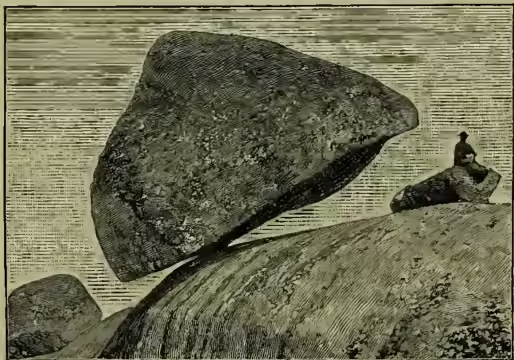
Some rocking-stones occur near to remains of ancient fortifications, which seems to bear out a statement in one of the poems of Ossian, that the bards walked round the stone singing, and made it move as an oracle of the fate of battle. In Greece rocking-stones occur as funeral monuments, and are generally found on conspicuous places near the sea. Rocking-stones are numerous in Yorkshire, Derbyshire, Cornwall, and Wales. The famous Logan Rock, near Land's End, in Cornwall, is computed to weigh over 70 tons. It was wantonly displaced in 1824 by Lieutenant Goldsmith, R.N., and his boat's crew of nine men. He had to replace it at a cost to himself of £2000; but whether it has since rocked as well as ever is a moot point. Near Warton Crag, Lancashire, are no less than seven of these stones; and in Scotland they occur in the parishes of Kirkmichael, Dron, and Abernethy, Perthshire, and Kells, Kirkeudbrightshire. In Ireland they are found in many places; one situated at a place called Islandmagee, on Brown's Bay, County Antrim, is popularly believed to acquire a rocking tremulous motion at the approach of sinners and malefactors. At Andaford (Faroe Islands) a large block of basalt, measuring some 16 feet in length by 10 feet in breadth, and rising for about 10 feet out of the water, swings to and fro with the motion of the sea, which is about seven fathoms deep. All these, however, are as marbles compared with the rocking-stone of Tandil in the Argentine Republic, 250 miles S. of Buenos Ayres, for this weighs over 700 tons, yet is so nicely poised that it rocks in the wind, and may be made to crack a walnut. See Frank Vincent's Around and About South America (1890), from which our illustration is copied.