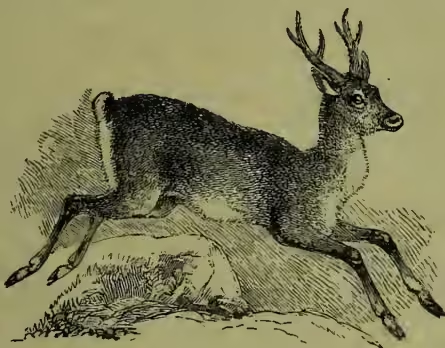
Roe (Capreolus caprea), a small species of deer inhabiting Europe and some parts of western Asia, chiefly in hilly or mountainous regions which are covered with forests or with scattered bushes and heath. It is seldom found in the higher and more naked mountain tracts, the haunt of the stag or red deer. It was once plentiful in Wales and in the hilly parts of England, as well as in the south of Scotland, but is now very rare south of Perthshire. The roe is about 2 feet 3 inches in height at the shoulder. Its weight is about 50 or 60 lb. Its colour is a shining tawny-brown in summer, more dull and grizzled in winter; on the under surface and around the tail the colour is whitish, but there is considerable variety. The hair is longer than in many deer. The tail is very short, concealed among the hair. The antlers, which are peculiar to the male or Roebuck, are 8 or 9 inches long, erect, round, very rough, longitudinally furrowed; having, in mature animals, two or three tines or branches, which, as well as the tip of the horn, are sharp-pointed, so that the antlers form very dangerous weapons. The habits of the roe are somewhat like those of the goat, or even of the chamois. It keeps its footing on rocks with great security, bounds very actively, and takes great leaps. Its usual pace, when not very hard pressed, is, however, a kind of canter. It is not gregarious, not more than a buck and doe with one or two fawns being usually seen together. Contrary to what is usual among deer, the male and female remain attached during life. The voice of the roe-deer, resembling that of a sheep, but shorter and more barking, is often heard through the night. The males are very combative at the breeding season. The roe browses on the tender shoots of trees and bushes as well as on herbage, and is thus very injurious to young woods. It is never very thoroughly tamed, and when partially so is apt to become mischievous, and the male dangerous. The venison is superior to that of the stag, but not equal to that of the fallow-deer. The horns are used for handles of carving-knives and similar articles.