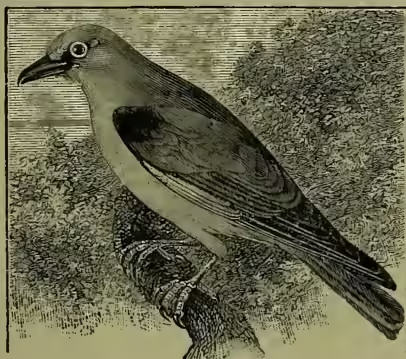
Roller (Coraciidae), a family of Picarian birds characteristic of the Ethiopian and Oriental regions, although the common Roller is extensively distributed in the Palæarctic region and a few species enter the Australian region. None are found in the New World. Madagascar possesses three species peculiar to itself, and so different from one another that they are regarded as types of different genera, and so different from other rollers that they are grouped into a separate sub-family, Brachypteracianæ: they are named ground-rollers, and are nocturnal in habit. An Indian species, Eurystomus orientalis, is also nocturnal. The Common Roller (Coracias garrula) is an autumn or more rarely a spring visitor to the British Isles; and about one hundred have been recorded since the first one was noticed by Sir Thomas Browne in 1644. Some have visited the Orkneys and Shetlands, one has been found as far west as St Kilda, and about half a dozen have been recorded from Ireland. It is a straggler to northern Europe; in central Europe it is common; in countries bordering on the Mediterranean it is very abundant. It ranges through Asia to Omsk in Siberia and to North-west India. In winter it extends its migrations to Natal and Cape Colony. In size it is about a foot long. The general colour is light bluish green; the mantle is chestnut-brown; the wings and rump are adorned with beautiful azure blue. The female resembles the male in plumage. Nesting takes place in the woody haunts in May. The nest, which is made in a hollow tree or wall, is built of a few chips, or of roots, grass, feathers, and hair, according to circumstances. The eggs are five or six in number and are of a glossy white colour. The food consists of beetles and other insects captured on the ground. The name 'Roller' is given to the bird on account of its varied and unsteady flight and the habit the male has, during the breeding season, of indulging in extraordinary tumbling antics, and turning somersaults in the air.