Rose. The rose, the most lovely and fragrant of flowers, the favourite of poets and the national emblem of England, is a shrub or sometimes a tree, very widely distributed, and giving name to the large and comprehensive order Rosaceæ, to which some of our choicest fruits belong. Restricting ourselves to the genus Rosa, which alone we acknowledge as the rose, we find the characteristics thus: shrubby growth, stems generally prickly, leaves alternate, stipulate, flowers terminal, often corymbose, spreading with five petals, in colour white, yellow, pink, or red, stamens numerous, styles exserted, seeds (achenes) numerous, enclosed in a fleshy berry, globular or ovate, which is known as the hip or hœp, and is in some sort edible. The calyx is generally five-lobed, and the lobes are more or less pinnatised, and sometimes (as in the moss rose) furnished with a beautiful process of filament.
(1) The wild rose is a native of the northern hemisphere, found in all temperate climes, and even as far south as Abyssinia, the Indian Peninsula, and Mexico, extending also to the arctic zone, and of such diversity that more than 200 species were admitted by former botanists, which have now been reduced, however, to less than a fifth of that number. In Britain we find it indigenous as Rosa spinosissima (the Burnet-rose, from which descend the many varieties of Scotch rose); Rosa canina (the Dog-rose of our hedges, with several sub-varieties); rubiginosa and micrantha, well known as the Sweet Briers; arvensis, a prostrate and unfragrant kind; tomentosa and villosa, having downy foliage and deep-red blossoms. The recent tendency of botanists, gladly accepted by the gardener, has been to restrict the number of species and allow more scope to variety, so that the above list may soon be compressed.
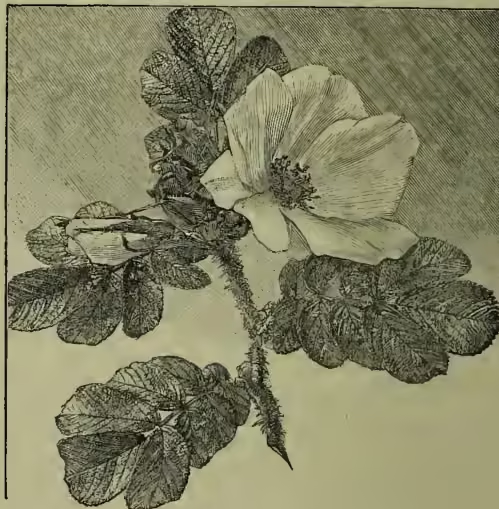
(2) The cultivated rose is a fuller and generally larger form, obtained by the nurture and skill of the gardener, and still receiving improvement by skilful crossing and loving observance. In the Gardener's Chronicle of 1885 may be found Mr Baker's scientific classification of garden roses, which are marshalled into ten companies or groups, chiefly according to leaf and prickle. Mr William Paul, however, in the last edition of his great work, permits us to reduce these ten groups to six, which will be as follows: Simplicifoliae, Systylæ, Banksiane, Bracteate, Centifoliae, and Caninae. But the general grower may be well content with the arrangement in the catalogues of our leading nurserymen, as recognised by the National Rose Society, and observed in our chief exhibitions; though the principle of division is not botanical, neither is the broad line drawn between summer and 'perpetual' roses always justified by fact; so that many good rosarians now protest against the too popular neglect of a fragrant, lovely, and freer flowering class. (a) Summer roses, thus ostracised by a hasty vote, are of many families, and bloom for the most part in June and July—the Boursault, the Scotch Rose, the Damask, the Provence, the Moss, the French and Hybrid French, the Bourbon and Chinese Hybrids, the Austrian and Sweet Brier, the Ayrshire, Evergreen, and Multiflora, the Polyantha, Prairie, and Banksian roses, as well as some few others. Many of these are of the greatest beauty—for instance, the Moss rose, perhaps the loveliest of all flowers; and some are the best of all for trellis or for pillar, and the hardest in bad weather. (b) The Perpetual, or Remontant rose, as the French more correctly term it, instead of making growth alone after the gorgeous summer show, affords a succession, more or less continuous according to variety and weather, of bud and bloom until the frosts forbid. Yet even with these it is rare to find the aftermath of beauty as free or as fine as the summer crop had been; and many of the so-called perpetuals retire as meekly as the summer rose, especially in dull seasons. Perpetual roses are chiefly as follows: the Chinese or Monthly, the Hybrid Perpetual, the Tea-scented, Bourbon, Noisette, Macartney, Rugosa, Microphylla, Lawrenceana, and Perpetual Scotch. The old Chinese, Rosa Indica, commonly called the Monthly Rose, is still popular as an early and abundant bloomer; so are the Bourbons and Noisettes. But the Hybrid Perpetual and Tea-scented are now the chief favourites of the rose-grower, and have almost engrossed his attention. Of these two classes the former has for many years been undoubtedly the leading rose, but the Tea begins more and more to vie with it in favour, and many rosarians now place it first, for its exquisite refinement, grace, and delicacy, bewitching modesty, and pensive charm. But the hybrid perpetual claims bolder brilliance, more velvety damask, and profundity of glow. And indeed it seems difficult to achieve or conceive more perfect beauty than has already been attained by loving ingenuity and persevering skill in many of the roses we now possess; though manifold gardeners are hankering still for a blue rose, which would not accord with the form and tint of the foliage if they got it.
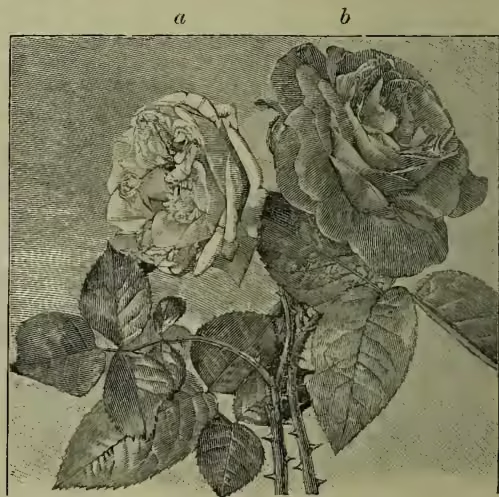
a, Tea-rose; b, Hybrid perpetual.
Roses are also divided, according to the form of flower, into globular, cupped, compact, and expanded, the last named often becoming reflexed in the later stage of bloom; and again, according to modes of culture, into standards, half-standards, pyramids, bushes, pendulous, pillar, and trellis form. The standards and half-standards, once so popular, are now in less demand, though still approved by those who plant for exhibition, or special effect at a distance; and the bush (the more natural and easy growth) becomes every year more general. For pillar and trellis work there are but few of the hybrid perpetuals and tea-scented sufficing in vigour and hardiness; though certain strains have been obtained of some of the leading favourites, such as Jules Margottin and Devoniensis, through 'sports' (as it is expressed) of the old kind, which serve the purpose fairly; and under glass or in a very snug spot that Corypheus of yellow roses, Maréchal Niel, affords a grove of gold.
The question of stock must also be discussed, without acrimony if possible, though upon no other has there been so hot a war of roses. For any kind that is strong enough in constitution to support itself its own roots are the best feet and feeders, ousting all trouble of suckers, and often affording renewal by means of young shoots. But many of the fairest and sweetest, especially of the tea-scented class, require stouter sustenance, and must be budded or grafted on a more robust variety. The stocks chiefly used by our nurserymen are the Dog-rose, Manetti, and De la Grifferae; and the first is procured in three different ways—from its home in the hedges, or from cuttings, or from seed; and each way has its advocate. Others prefer the Manetti, a seedling Italian rose, as stock; and some, especially of the tea varieties, do best upon La Grifferae. But as a rule the Manetti is a treacherous foster-mother, affording brief vigour, and encroaching with deceptive suckers. Whatever stock may be chosen, the nobler rose is worked upon it, either by budding or grafting, and must engross the entire resources.
Again there are roses not a few, of delicate constitution or feeble habit, which should be grown in pots and sheltered through the winter. Many also of the stronger kinds are cultivated thus to bloom in the winter and spring, and some are of little value otherwise. But they must have plenty of air and light, and will not endure strong forcing. The Tea-rose, Indica odorata, descended from the Chinese blush and yellow, is grown most largely under glass, whether in pots or border, and being most lovely in the bud is especially fitted for bouquets. Maréchal Niel (perhaps more correctly classed as a Noisette of late), Niphotos, Catherine Mernet, and Souvenir d'un Ami are at present most popular for this sweet use.
New varieties of the rose are loudly heralded every year, and every season adds one or two lasting names to the lengthy catalogue. But old friends also pass out of date, and are no longer heard of; sometimes from a real advance upon them, sometimes from their own relapse. About 1860 nearly all new roses were the product of French nurserymen; but now we get many quite as good from the skill of our own rosarians. The crossing of the flowers is a process needing both judgment and dexterity. But the general grower will be content to cultivate the established kinds, which require no great trouble. Their abode must not be overhung, nor beset with stagnant water, the soil should be rich and deeply delved, and well-compressed round the neck of the plant. Plenty of water must be given in time of drought, and a mulching of good manure is welcome, and the growth of leaf and bud must be secured from countless enemies by daily and even nightly care. Three-quarters of the buds should be nipped off when true discretion orders it. As soon as the first flush of bloom is past, a little judicious pruning helps the prospect of a later crop; for the winter there should not be much shortening of the branches, unless they are threatened by the wind; but the general pruning remains for March.
See books by W. Paul (9th ed. 1888, with 1898 supplement), Dean Hole (15th ed. 1896), Ellwanger (New York), Baker, Cranston, Rivers, Shirley Hibberd, Sauer; and French books by Jamain and Forney, Singer, and Lachaume. See also PERFUMERY, OTTO OF ROSES; and for the Roman de la Rose, see FRANCE, p. 786. Rose is a name for Erysipelas (q.v.)