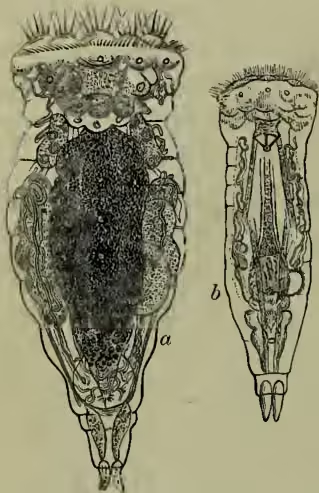
a, female dorsal view; b, male ditto.
(The Rotifera, Hudson and Gosse.)
Rotatoria, or ROTIFERA, a class of minute aquatic animals, popularly called wheel-animalcules. Most of them are microscopic, very trans- parent, and exceedingly active. The body is unsegmented, and almost always bears a posterior ventral 'foot,' and an anterior equipment of cilia, whose movements suggest a rapidly rotating wheel. Another characteristic structure is the masticating mill in the pharynx, a complex apparatus consisting in part of two hammers, which work against an anvil. The food seems to consist of yet smaller organisms and of organic debris. The nervous system consists of a single dorsal ganglion. There is a body-cavity containing fluid, and there are muscles retracting and extending the ciliated disc and the foot. There are no circulatory organs, but two excretory tubes are present. Rotifers live both in fresh waters and in the sea, and sometimes in damp moss. A few are parasitic. Some are able to survive desiccation, and may be wafted about by the wind, but it is likely that in some cases the regeneration after prolonged drought is due not to a revivification of the adults, but to the development of the eggs, which can remain for a long time quiescent. There are three kinds of eggs: small ova, which develop into males; thin-shelled summer ova; and thick-shelled resting or winter ova. And it is said that a given female produces only one kind. Sometimes they are laid in the water, or attached to water-plants; sometimes they are hatched within the mother. In most, if not all cases, the eggs are parthenogenetic, developing without fertilisation. For in one series of rotifers (Philodinae) the males have never been found; while in other cases the males, which are usually smaller and simpler than the females, do not succeed in fertilising the eggs. As representative rotifers the following may be mentioned: Rotifer vulgaris, very common in stagnant fresh-water pools; Hydatina seuta, with exceedingly rapid development; Melicerta, which forms an ensheathing case of disorged pellets; the parasitic Seison, Albertia, Balatro, which have lost, or almost lost, the characteristic ciliated wheel; Floscularia, living in a gelatinous case; the exceedingly beautiful Stephanoceros; Pedalion mira, a unique jumping rotifer, with six hollow leg-like appendages. The zoological position of rotifers is uncertain, but some regard them as remotely allied to Chætopod worms.
See Hudson and Gosse, The Rotifera (1889); Plate, in Jenaische Zeitschr. f. Naturwiss. (xix. 1886).