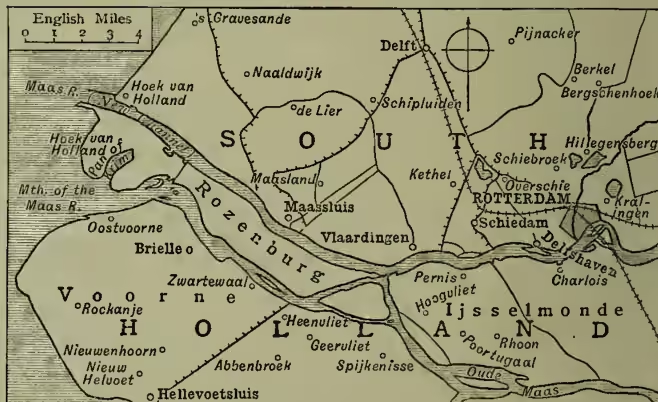
Rotterdam, the busiest port of Holland, stands on both sides of the Maas, 19 miles from its mouth, and 16 miles by rail SE. of the Hague and 45 SW. of Amsterdam. Since Holland was separated from Belgium, the trade of Rotterdam has grown at an extraordinarily rapid rate, especially since the middle of the century. New wharves and quays and new docks have been built almost every year since 1847. In 1888 the quays measured 15 miles in length and the docks covered an area of 190 acres; and since then two new docks have been made and the (separate) petroleum wharves have been extended. Since 1872 sea-going vessels have ceased to approach Rotterdam by the old channel of Brill (Brielle); they have used instead the New Waterway—i.e. the Maas and the Scheur, the latter of which has been connected with the sea by a canal cut through the Point (Hoek) of Holland. Every effort has been made to render this new waterway available for large ocean-going steamers, and the work of improvement has been constantly going on ever since it was opened, until in 1890 it had a depth never less than 22 feet at low tide, and big ships were able to reach the sea in two hours from Rotterdam. Taking all the vessels that enter all the ports of Holland from abroad, more than 53 per cent. (estimating by tonnage) enter at Rotterdam. The net tonnage of the vessels (which numbered 4535 in 1890) so entering doubled between 1875 and 1890, and was in the latter quoted year eight times what it was in 1850—viz. 2,918,425 tons in 1890 as against 1,411,828 in 1875, and 346,186 in 1850. To this foreign trade must be added 84 per cent. of the total trade between Germany and Holland by way of the river Rhine, or (in 1890) some 2,582,800 tons, and a traffic of 6,850,000 tons carried on on the inland canals and streams. If all these items be put together the total tonnage of vessels entering Rotterdam amounts to nearly 12½ million tons, a figure that is only exceeded by London amongst European ports. But, on the other hand, it must be remembered that the bulk of the inland traffic would in other countries be counted amongst the statistics of goods brought by railway. The figures quoted do not include the returns of the fishing fleet, which sells in Rotterdam fish (chiefly herring, cod, &c.) to the value of £20,000 per annum. The merchant fleet of Rotterdam itself numbered, in 1899, 150 vessels of about 360,000 tons. The imports consist principally of mineral ores and metals, grain (wheat, rye, oats, maize), coal, oil (petroleum chiefly), seeds, tallow and similar greasy substances, sugar, rice, tobacco, hides, indigo, &c.; whilst the more important exports are linen, flax, butter, cheese, cattle, and spirits (gin, &c.). From this port there sail every year between 5200 (1885) and 15,200 (1889) emigrants from various parts of Europe, most of whom go to the United States. There are flourishing industries, as iron and other metal works, shipbuilding, distilling, sugar-refining, and the manufacture of tobacco, chemicals, &c.
The town is intersected by canals, which communicate with the Maas, whilst their banks serve as wharves. On the south side of the river, opposite the city proper, are the busy ironworks and shipbuilding-yards of the island of Fijenoord, besides some of the largest docks. This island is connected with the other bank by two lofty bridges (one a railway bridge). In the city the more important buildings are the Gothic church of St Lawrence (15th century), with a very large organ, the monumental tombs of the Dutch admirals Witt, Cortenaer, Van Brakel, Van Liefde, and others, and a lofty tower (295 feet high); the Boymans Museum (1847), with a fine collection of paintings by Dutch masters; the yacht club-house, containing an ethnological collection; the town-house, exchange, and similar public buildings. The public institutions include an academy of art and science (nearly 1100 pupils), schools of music, navigation, and the technical arts, and an excellent zoological garden. Pop. (1890) 203,472, with which compare the figures for earlier years—72,300 in 1830, and 104,724 in 1858. Rotterdam counts as her most illustrious sons Erasmus and the poet Tollens; James, Duke of Monmouth, and Grinling Gibbons, the English wood-carver, were also born here. The history of the place is marked by very few notable events, except its capture by Francis of Brederode in 1488, who lost it to the Austrians in the following year, and the occupation by the Spaniards in 1572.