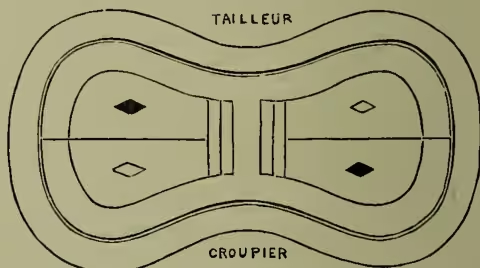
Rouge et Noir (Fr., 'red and black'), TRENTÉ-UN ('thirty-one'), or TRENTÉ ET QUARANTE ('thirty and forty'), is a modern game of chance, which is played by the aid of packs of cards on a table covered with green cloth. The table is of a form similar to that shown in the figure. It is divided into four portions, each marked in the centre with a diamond, the diamonds being alternately red and black; and these quarters are further separated, two and two, by bands which cross the table at its narrowest part. At the end of the table are a series of concentric bands painted of a yellow colour (not represented in the figure). The game is played as follows: one of the tailleurs (or dealers, who manage the table, take charge of the bank, and keep an eye on the players) takes up his position at one side of the table, opposite to the croupier (another tailleur), and unseals, in the presence of the players, six packs of cards, which are first counted, then shuffled by several tailleurs, and returned to the first tailleur, who presents them to one of the players to be cut. This is performed by the insertion of a blank card in any part of the pack, which is then adjusted, and the game proceeds. Each player must stake his money on some one of the four chances, denominated noir, rouge, couleur, and l'inverse, which will be afterwards explained. After the stakes have been laid on the table (those for the noir being laid on either of the quarters marked with a black, and those for the rouge on either of the quarters marked with a red diamond, those for the 'couleur' on one of the transverse bands, and those for the 'inverse' on one of the yellow circles at the end of the table), the tailleur takes a handful of cards from the top of the pack, and deals first for the noir, taking one card after another from the top of the handful and placing them on the table side by side, till the number of pips on them amounts to more than thirty, when he stops. He then deals out another row in a similar manner for the rouge, till, as before, the number of pips amounts to more than thirty. In reckoning the number of pips, the ace is counted as one, the other plain cards according to the number of pips, and the court-cards ten each. It will thus be seen that the number to which each of the two rows of cards amounts, must be more than thirty and not more than forty. If the value of the first row is nearer thirty-one than that of the second, then the first row, or noir, wins; if the contrary is the case, then the second row, or rouge, wins. Couleur wins if the first card tabled by the tailleur is of the winning colour—for instance, if the first card laid down is a 'spade' or 'club,' and if noir wins; but if the first card dealt be not of the winning colour, then inverse wins, and couleur loses. Two (and no more) of the four chances can be winning chances at one time; and the winning players have their stakes increased by an equal sum from the bank, and then withdraw their stake and winnings, while the stakes of the losers are raked by the tailleurs to the bank in the centre of the table. When the value of the first, or noir-row, is equal to that of the second, or rouge-row, it is a refait, and the dealer must commence to deal anew from the cards remaining in his hand; when the refait occurs the player may either withdraw his stake, or stake on a different chance, with the same or more or less money as he thinks proper. The game of Rouge et Noir would be an even one between the players and the bank were it not for the following regulation: When the points dealt for the noir and the rouge each amount to thirty-one ('un refait de trente-et-un') the half of all the stakes on each of the chances belongs to the bank, and this the players may either pay or have their stakes 'put in prison,' the next deal determining whether they shall belong to the bank or be restored to the player. If a second doublet of thirty-one occurs in the deal immediately succeeding, the stakes which were in prison are diminished by one-half, which goes to the bank, and the other half is 'put into the second prison,' from which it requires two successive winnings of the player to regain them. The chance of 'un refait de trente-et-un' is about once in sixty-four deals. This game superseded Faro (q.v.) and Biribi in France about 1789, but along with Roulette was forbidden by law in 1838. See work cited at ROULETTE.