Safety-lamp. It has been long known that when methane, marsh-gas, or light carburetted hydrogen, which is frequently disengaged in large quantities from coal-seams, is mixed with ten times its volume of atmospheric air, it becomes highly explosive. Moreover, this gas—the fire-damp of miners—in exploding renders ten times its bulk of atmospheric air unfit for respiration, and the choke-damp thus produced is often as fatal to miners as the primary explosion. With the view of discovering some means of preventing these dangerous results, Davy instituted those important observations on flame which led him to the invention of the safety-lamp. He found that when two vessels filled with a gaseous explosive mixture are connected by a narrow tube, and the contents of one fired, the flame is not communicated to the other, provided the diameter of the tube, its length, and the conducting power for heat of its material bear certain proportions to each other; the flame being extinguished by cooling, and its transmission rendered impossible. In this experiment high conducting power and diminished diameter compensate for diminution in length; and to such an extent may this shortening of length be carried that metallic gauze, which may be looked upon as a series of very short square tubes arranged side by side, completely arrests the passage of flame in explosive mixtures. The following are Davy's directions regarding the structure of his lamp: 'The apertures in the gauze should not be more than d of an inch square. As the fire-damp is not influenced by ignited wire, the thickness of the wire is not of importance; but wire from th to th of an inch in diameter is the most convenient. Iron-wire and brass-wire gauze of the required degree of fineness are made for sieves by all wire-workers, but iron- wire gauze is to be preferred: when of the proper degree of thickness, it can neither melt nor burn; and the coat of black rust which soon forms upon it superficially defends the interior from the action of the air. The cage or cylinder should be made of double joinings, the gauze being folded over so as to leave no apertures. When it is cylindrical, it should not be more than two inches in diameter; for in larger cylinders the combustion of the fire-damp renders the top inconveniently hot, and a double top is always a proper precaution, fixed at the distance of half or three-quarters of an inch above the first top. The gauze cylinder should be fastened to the lamp by a screw of four or five turns, and fitted to the screw by a tight ring. All joinings should be made with hard solder; and the security depends upon the circumstance that no aperture exists in the apparatus larger than in the wire gauze.' The oil is supplied to the interior by the pipe projecting from the right side of the figure, and the wick is trimmed by a wire bent at the upper end, and passed through the bottom of the lamp, so that the gauze need not be removed for this process. (The wire is here shown in the figure.) When a lighted lamp of this kind is introduced into an explosive mixture of air and fire-damp the flame is seen gradually to enlarge as the proportion of fire-damp increases, until at length it fills the entire gauze cylinder. Whenever this pale enlarged flame is seen the miners should depart to a place of safety, for although no explosion can occur while the gauze is sound, yet at that high temperature the metal becomes rapidly oxidised, and might easily break; and a single aperture of sufficient size would then occasion a destructive explosion. In a strong current of air the heated gas may be blown through the apertures of the gauze before its temperature is sufficiently reduced to prevent an explosion; but such a contingency may be guarded against by placing a screen between the draught and the lamp.
The first lamp which would safely burn in an explosive mixture of gas and air was contrived in 1813 by Dr W. Reid Clanny of Sunderland. Into this lamp fresh air was blown through water, and heated air escaped through water by means of a recurved tube. Such a lamp was unfit for ordinary use. George Stephenson invented a safety-lamp which was tried at the Killingworth pits in 1815, and the reader will find its merits discussed in Smiles's Life of George Stephenson. Both Clanny and Stephenson applied wire gauze cylinders to their lamps after Davy's came into use, or at least after a communication about it had been made to the Royal Society in 1815. Stephenson's lamp, or as it is called the 'Geordie,' has a glass cylinder inside the wire gauze, the former having a cap of perforated copper. Small orifices below the glass admit the necessary air, and when the air becomes highly explosive the light goes out, so that the lamp does not get overheated. To enable it to burn well this lamp requires to be either held or suspended. What has long been known as Clanny's lamp (not his original lamp) consists of a cylinder of thick glass round the light, and on the top of it resting on a metal ring is a narrower cylinder of wire gauze through which the feed air enters. In the first or earlier form of this lamp there is imperfect combustion and it is not very safe, but when the gauze is protected by a metal jacket or bonnet it appears to be secure in currents having a velocity of 25 feet per second. The Mueseler lamp resembles the Clanny in having a glass cylinder below and wire gauze above, but within the gauze top there is a central chimney opening just above the flame. The peculiar construction of this presents an obstruction of two gauzes to the inlet air, while the heated outgoing air only passes through one. Consequently the strong upward draught tends to draw the fresh air briskly through the gauze to the wick, thus keeping the two currents separate and ensuring a good combustion.
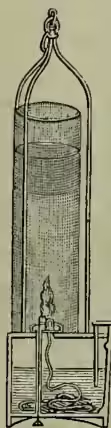
Davy Lamp.
For many years after the Davy, the Stephenson, and the Clanny lamp were introduced, the air-currents in coal-mines seldom reached a speed of 5 feet per second. Nowadays, owing to improved ventilation, this speed sometimes exceeds 20 feet per second in the main airways, while in some mines it is not greatly less at the faces where the men are hewing the coal. The old forms of these lamps, though safe under former conditions, are consequently no longer secure. But the Davy lamp can be rendered safe by enclosing it in a lantern, and when so protected against strong currents it is called the 'tin-can Davy.' Nevertheless, this lamp is falling out of use on account of the miserable light which it gives. In the Final Report of the Commissioners on Accidents in Mines, published in 1886, the subject of safety-lamps is very carefully gone into. After describing a considerable number of these which had been experimented with, they say: 'Many of the more secure lamps are, however, rendered unsuitable for regular use by one or more of the following circumstances; either they yield a very poor light, or they require most careful handling to prevent the light from being extinguished, or they are exceedingly sensitive to oblique currents, or they are so complicated as to present great difficulties in putting them together and lighting them.' The Commissioners add: 'But there are four lamps in which the quality of safety, in a pre-eminent degree, is combined with simplicity of construction and with illuminating power at least fully equal to that of any of the lamps hitherto in general use. These are Gray's lamp, Marsaut's lamp, the lamp of the latest pattern proposed by Evan Thomas (No. 7), and the bonneted Mueseler lamp. With the last care must be taken to avoid a considerable inclination to the vertical direction.'
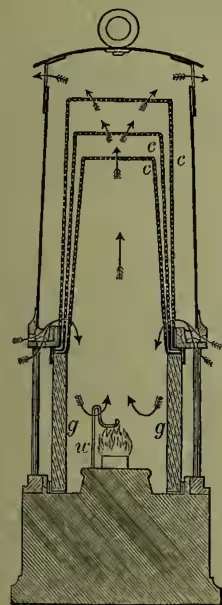
Of these four lamps the one by M. Marsaut, of the Bessèges Collieries, Gard, France, seems to have become the favourite; at least it is now very largely used. Like some other forms it is in principle a bonneted Clanny, but it is made with either two or three wire-gauze covers, c, c, c, fig. 2. In common with the other three lamps mentioned above as exceptionally safe, the lower portion g consists of a glass cylinder surrounding the light on the top of which the gauzes are fixed. The curved arrows show how the air enters to support combustion, and the straight arrows show the products of combustion escape at the top; w is the wire for trimming the wick. This lamp made with three gauzes will not cause an explosion in so strong a current as 50 feet per second, or even when the inner gauze is at a bright red heat, unless it is kept in the fire-damp till the glass cracks; it may be said to be safe for three or four minutes. With two gauzes the light is two-thirds and with three gauzes it is one-half that of a standard candle, the light of the two- gauze kind being three and a half times greater than that of a Davy lamp.
To prevent safety-lamps being surreptitiously opened in a mine it is necessary that they should be locked. One of the best ways of doing this is to fasten the oil-vessel to the other part of the lamp by a riveted lead-plug, and impress it at each end with a mark which should be varied from day to day. Lamps have also been constructed which go out when opened, and one kind can be opened only by help of a powerful magnet.
As respects the illuminants for a safety-lamp seal-oil and refined rape-oil are the two staples, but the former is superior to the latter in burning qualities. Both are improved in this respect by the admixture of two parts of either with one part of petroleum or paraffin-oil of a flashing-point not lower than 80° F. This is considered a safe mixture. A patent was granted on February 16, 1889 (No. 2779) to J. Thorne for what is called the Thornebury miners' safety-lamp. The peculiarity of this lamp is that it is adapted to burn a heavy petroleum-oil with a high flashing-point, and gives a light from one to one and a half candle-power, which is much greater than that of other modern safety-lamps. It has been tested by Sir F. Abel and Professor Dewar, who report that the lamp fulfils the conditions essential to safety as laid down by the recent Commission on Accidents in Mines.
Electric glow-lamps are used for lighting up pit-bottoms and roadways, though hardly as yet for illuminating the working faces of mines. But portable, self-contained electric lamps that are perfectly safe have been devised which will furnish for several hours a considerably better light than that of the best safety-lamp in use. As air is completely excluded from these lamps they give no indication of the condition of the atmosphere of a mine, so that their employment would require the use of fire-damp detectors, and also of some ordinary safety-lamps.