Saghalien, or SAKHALIN (though the proper name is Karaftu), is a long (670 miles) and narrow (20 to 150 miles) island, running north and south, and lying close off the east coast of the Maritime Province of Siberia. The Strait (or Gulf) of Mammia Rinso (or Tartary) separates it from the mainland; the Strait of La Pérouse parts its southern extremity from the Japanese island of Yezo; and the misty, chilly sea of Okhotsk washes its eastern and northern shores. Owing to the vicinity of this sea, to the presence of ice-floes off the east coast, and to the dense forests, chiefly of coniferous trees, which clothe the mountains (5000 feet) that run from end to end of the island, the rainfall is heavy and mists very prevalent, so that the climate is on the whole extremely raw and cold. The rivers are navigable only for very short distances; but they, as well as the adjoining seas, teem with fish, the rivers especially with salmon. Petroleum and naphtha exist in the island, and coal is mined by Russian convicts. Soon after the Russians became masters of the whole island (1875) they made an attempt to colonise it by means of convicts; but the scheme proved a failure, as neither the climate nor the soil are adapted for agriculture. Some 4000 to 5000 convicts are, however, employed to work the coal-mines. Area of island, 24,550 sq. m.; pop. 19,000, of whom one-half are Russians; the remainder belong to the Ainios (q.v.) and a couple of Mongolic races, with some Japanese.
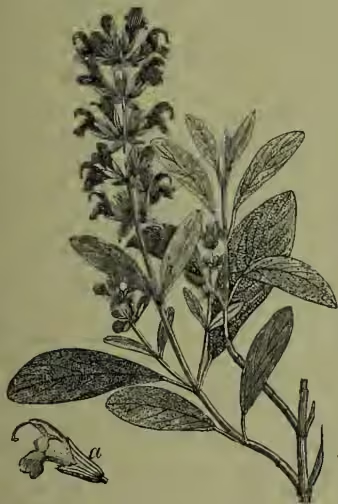
a, a flower.
Bears, sables, wild reindeer, tigers, and other wild animals occur. The vegetation is chiefly Siberian in character. Saghalien has been inhabited since the stone age, of which, as well as of the bronze age, many relics, such as dwellings, bones, implements, &c., have been discovered. It belonged to China until the beginning of the 19th century. The Japanese then considered themselves masters of the southern part down to 1875, when they ceded it to Russia, certain of the Kurile islands being granted in return. The Russians had begun to settle in the northern part about 1857, and now are masters of the whole island.